

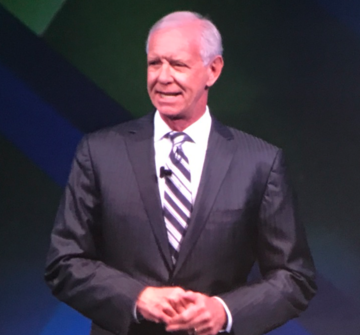
Chesley Sullenberger
PALM DESERT, Calif.–No remarks by Capt. (Ret.) Chesley Sullenberger are complete without him sharing the harrowing details of piloting his damaged US Airways jet to a safe landing on the Hudson River, as he did in January of 2009.
As CUToday.info reported here, Sullenberger shared with the PSCU Member Forum here is thoughts on leadership, including some blunt remarks about today’s political landscape. But Sullenberger, now known around the world simply as “Sully,” also shared the incredible story of those “102 seconds” from a bird strike until hitting the water.
After departure from New York’s LaGuardia Airport, the aircraft was traveling 316 feet per second when it struck the birds, which weigh from eight to 10 pounds or more, severely damaging the engines.
“The flight was completely unremarkable for first 100 seconds,” he recalled. “I saw the birds a few seconds ahead of time. I could feel and hear the thuds as we struck them. I could feel terrible vibrations that I never felt before in an airplane, and I could smell in the air coming into the cabin the burning birds in the engines. And then I felt the thrust loss. It was sudden, complete, symmetrical. It felt as if the bottom had fallen out of our world. My first three thoughts were: This can’t be happening, this doesn’t happen to me, and unlike all the other flights, this one probably would not end on a runway. I was OK with that as long as I could solve the problem.”
Pulse Raced
Sullenberger said he could feel his pulse shoot up and his perceptual vision field narrow as happens in stressful situations.
“Three things made a difference,” he shared. “I forced a practiced calm on myself. Second, although we never trained for this, because I knew my plane so well I was able to set clear priorities. I adapted what I did know in a new way. Third, I knew because of the extreme time pressure, I didn’t have time to do everything I needed to do. So, I did the highest priority things and did them very well, and then I had the discipline to ignore the things I couldn’t do. Multi-tasking is a myth. (Co-pilot) Jeff (Skiles) did the same thing. Fortunately, Jeff also had 28,000 hours of flying time. He had just gone through a month of classroom training on the Airbus. But this was his first trip flying it.”
US Airways Flight 1549 crashed on the river at 3:31 on a Thursday afternoon; Sullenberger had never met Skiles until the previous Monday. “You would have thought we had been working together for years because we knew our roles and responsibilities.”
Immediately after the bird strike, “Within two seconds, I took two actions: I turned on the engine ignition, so if they could restart they would, and I turned on the airplane’s auxiliary power unit.” In fly-by-wire aircraft such as the Airbus, power is always needed in order to maintain control. “Airbus gave us a three-page checklist for this circumstance. It assumes you are at 35,000 feet and have 35 minutes to trouble shoot. We got through the first page,” recalled Sullenberger.
“I took control of the airplane from Jeff, because I knew it was my responsibility as captain. I had been on the Airbus for 5,000 hours,” he said. “The flight attendants very suddenly found themselves in one of the most challenging situations anyone can. I didn’t have time to tell the passengers and crew the whole story. Before I made my one announcement to alert passengers and crew, I took what was probably an extravagant amount of time to choose my words very, very carefully. I wanted to sound confident. ‘Brace’ is such a word. In the spur of the moment, I used another word that we were then not trained to use, to give passengers and crew a vivid image, a word picture. Without engine thrust we were using gravity to provide the forward motion of the plane; we were dropping what would be two floors per second if on an elevator. I choose ‘impact.’ I said, ‘This is the captain, brace for impact.’ I knew we had everyone on the same page.
Critical Maneuver
“Just before the landing, Jeff knew the final critical maneuver was for me to judge visually where depth perception is difficult, the height to begin the landing to begin raising the nose and reduce rate of descent,” Sullenberger continued. “So, he began to call out the air speed and attitude. He knew to do that intuitively. Right before we landed, I asked Jeff a question: ‘Got any ideas?’ It wasn’t a flippant remark. He knew the meaning in the context; I’ve done everything I can do that I can think of. Do you have anything? He responded, ‘Actually, not.’ He knew we had done all we could do. I had to judge within a fraction of a second when to pull on stick; a quarter-second difference makes a difference of 10 or 20 feet. I got just to the point where I thought we can’t wait any longer. The landing began at 100 feet, about three times higher than normal, but that only lasted four seconds. I was shooting for the nose up at 10 degrees, we got to 9.8. We landed at 125.2 knots. When we finally stopped on the river it was obvious the aircraft was intact. We looked at each other and both thought, ‘Well, that wasn’t as bad as I thought.’ We weren’t high-fiving. We were acknowledging we had solved biggest problem of the day.”
The evacuation of the passengers to the New York ferries that responded quickly went smoothly, he said. As has been documented, Sullenberger made two passes through the plane to ensure no passengers were still onboard, before he evacuated.
“I was last one off. That’s not training, I just thought that was my job.”