

PALM DESERT, Calif.–Capt. (Ret.) Chesley “Sully” Sullenberger’s famous exploits in safely landing a passenger jet on the Hudson River are well known—but in remarks unlike those he has given to credit unions previously, he also made several veiled references to today’s political landscape and asked CU execs how they will be remembered.
While he knows what he will always be remembered for, Sullenberger challenged CU execs at PSCU’s Member Forum here to ask themselves whether or not they are making a difference during their lives, and whether they are courageous enough to “speak up when it matters.”
He described the current challenge as the need to make “important decisions based on facts, not fears and falsehoods, and especially not big lies told loudly.”
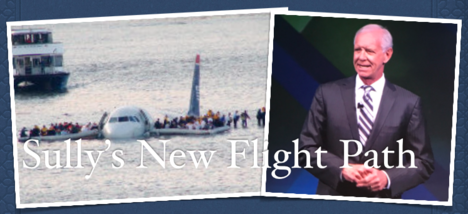
In addition, Sullenberger used the events of Jan. 15, 2009—an account of which CUToday.info will feature more fully in the Friday Fresh Today–– to frame much broader lessons on leadership, civic virtues, and performing under stress, noting that no one ever really knows when there “208 seconds” will occur. That was the amount of time from when birds struck Sullenberger’s US Airways jet until the time it crash-landed on the water, with all 155 passengers surviving.
It’s what takes place before those “208 seconds,” he emphasized that are most important.
He recalled that when six National Transportation Safety Board investigators first sat down to listen to the cockpit recordings of himself and co-pilot Jeff Skiles they sat in silence until one of them observed, “That guy has been training for this his entire life.”
“He was almost right. But I believe it started before that,” said Sullenberger, noting his grandparents had all been born in the 19th century, and all went to college.
No Single Skill-Set for the Future
“I was fortunate to grow up in a safe environment, where education was valued and striving for excellence was expected,” he said. “I think that has become an economic necessity for us now as the pace of change globally only accelerates. I think it’s unlikely anyone will be able to get through life anymore with a single skill set. We must know how to innovate. My definition of innovation is to change before you are forced to.”
Sullenberger recalled his basic training at U.S. Air Force Academy in 1969 (the initial 1,400 students would shrink to 800 by graduation) and the lesson “we had encountered a system designed to change us and tear us away from the comfortable, the easy and the familiar. It was designed to convince us if we worked hard and together, we could accomplish things we didn’t know we could. It was no longer about me, instead, it was about us.”
What concerns him, said Sullenberger, is that “civic virtues have gotten lost in all the noise.” While some may wonder whether such virtues as duty, compassion and courage still exist, Sullenberger said he is convinced they do.
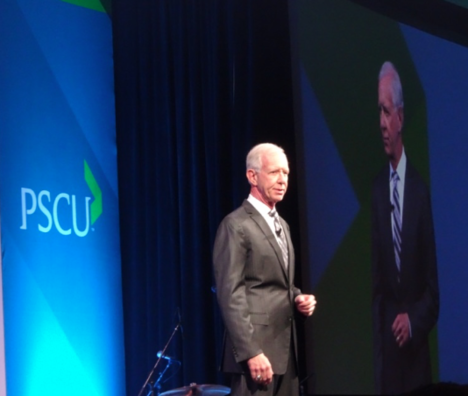
Chesley Sullenberger speaking to PSCU meeting.
“We desperately need this. I think we have a civic duty to do so,” There are certain things we owe to each other, these little gifts of civic virtue, despite what some people say. This is what makes civilization possible,” said Sullenberger. “I think we owe it to be informed, educated voters. We must be scientifically literate. You can’t legislate it if you don’t understand it, and that’s especially important as we face challenges nationally, and globally. We must make important decisions based on facts, not fears and falsehoods, and especially not big lies told loudly.”
Understanding the 'Why'
Sullenberger said what has been critical during his life is understanding the “why” behind what he does. It means understanding the “connectedness” of things, he said, and learning that “bad outcomes are seldom the result of a single error or decision. I began to sensitive myself to risk and to see the links in the chain and to break them before they could lead to a bad outcome. It’s after the flight, in a debriefing, where the really learning occurs.
“Almost every rule and procedure we have in commercial aviation, we have because people somewhere died to give us that knowledge, and we dare not forget it and have to relearn.”
Noting that at one point in aviation history the “cockpit culture” was one in which the captain was never questioned, he said the world of flight (28,000 flights in the U.S. every day) is much safer now that is no longer the case.
“We’ve created a shared sense of responsibility among team members,” said Sullenberger.
Where Responsibility Begins
It’s a responsibility, he said, that begins with each individual.
“My reputation had been built one interaction one person, one day at a time, and I think that is true in each of our lives,” he said. “In every encounter, there is an opportunity for good, for ill, for indifference: we just have to choose which one it is to be. At end of our lives, I think we have to ask ourselves, “Did I make a difference?’ Years from now, our grandchildren may ask us if we got involved; if we spoke up when it mattered. What will you tell them? I hope you tell them that you did.”