

Editor’s Note: This column was first published on ChipFilson.com and is reprinted here with permission.
By Chip Filson
Chip Filson
On Jan. 26, 2022 I wrote a detailed analysis of the transfer of $10 million of members’ capital to a nonprofit organized by the former CEO and chair of the now-merged Finance Center Credit Union in Stockton, Calif. My position was that this was an improper taking of funds owned by the members, but asked, “You be the judge.”
This is a follow-up analysis since the Oct. 1, 2021 merger and funds transfer that includes principals’ various explanations in a CU Today story.
Looking Back at the Merger Issue
In the words of the CEO of a local community food kitchen for the needy, “Stockton is not a destination city.” Its population of 322,000 residents is 42% Hispanic, 24% Asian, 19% non-Hispanic white and 13% black. It is one the most racially diverse large cities in America, according to a U.S. News analysis based on 2020 census data.
It is not a wealthy city. Median household income is $71,612 and per capita, $29,095. (2022) The poverty level is 15.6%. And only 18% of the population over 25 years in age has a college degree.
The Stockton record summarized the city’s variable reputation in a November 2023 under the headline, “Stockton has topped another list and this time it’s not a bad thing.
The city is the ideal opportunity for a locally focused credit union. The member needs are many. And until Oct. 1, 2021, this was Financial Center Credit Union’s (FCCU) long-time home market. On that date the CEO and board transferred via merger all the credit union’s savings, loans, members and operational direction to Valley Strong CU, whose main office is in Bakersfield, a city approximately 250 miles and a four-hour drive away.
Setting Up the Transfer
On June 25, 2021, then Chair Manuel Lopez and then CEO Michael Patrick Duffy of FCCU registered a nonprofit in California named FCCU2. Forty two days later, Chair Lopez signed the official Members’ Meeting Notice to merge FCCU into Valley Strong. The notice includes the transfer of $10 million to this newly established corporation, one of several merger disbursements members were asked to approve in the merger vote.
To my knowledge, this transfer of member capital to the sole control of a former CEO and board chair had never occurred. It appeared to be a “taking spoils” from the event. The amount, the singular nature of the transfer. and the credit union’s prior five-year downtrends raised the question of whether this money grab was proper.
The Trend Line
Duffy and his sister, Nora Stroh, had been the senior executives at the credit union since 1993. At the merger date, the credit union had served the Stockton community for 66 years, with Duffy as CEO for the final 22. In the years prior to the merger, the then $635-million credit union recorded these trends:
- A decline in loans outstanding from $176 million in December 2016, to just $102 million at the merger date. This is an annual negative growth of 10.3%.
- Total membership declined by 2,900 from December 2016 to the merger, a fall of over 2% per year. These declines in loans and membership were the exact opposite of the growth gains reported by all other segments of the credit union system.
- Even with this decline in risk assets, the credit union continued adding to reserves from earnings. The result was a net worth (capital) ratio of 20% at December 2018 and 17% in December 2020, nine months before the merger. During this five-year period, the credit union at times reported a net worth/asset ratio of more than 100% of the loan/asset ratio.
High Pay, High Profile
In the IRS 990 filing for 2018, the three highest reported salaries of Duffy, Stroh (who was COO) and Steve Liega, who headed up accounting and finance, were a combined $3.1 million, or 46.5% of all compensation for a staff of more than 90 employees.
During this period of decline in members and loans, CEO Duffy maintained a high-profile public image. The credit union reported numerous local and statewide political donations and grants to area nonprofits in its annual 990 filings.
The Critique
My January 2022 post was called A Theft of $ 10 Million or Just Spreading Goodwill? . provided multiple data points about the credit union’s loan and member decline, million-dollar executive salaries, and net worth sometimes greater than 100% of the loan-to-asset ratio.
In a video from the Stockton Mayor’s office of a $1-million donation to Stockton Strong in 2020, the speakers state the money is from the “employees of the credit union and the Michael P. Duffy Family Fund.”
The only credit union employee in the 11-minute video is Duffy. The video shows two mock checks of $100,000 each to charities feeding food-insecure residents. In the same year as this employees’ gift, the credit union’s outstanding loans declined by $40 million.
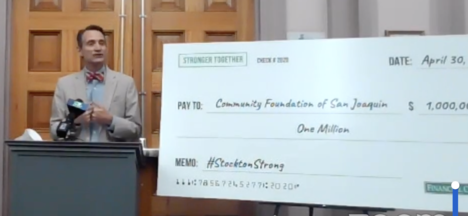
Presentation of $1 million check.
I can find no public reference to the Michael P. Duffy Family Fund in either California’s registrations or IRS 990 tax exempt filings.
CEO Duffy’s May 1, 2021 press release announcement of the merger included the following rationale: “As the CEO of Financial Center Credit Union for the past 21 years, my perspective on mergers has evolved…I have marveled at what credit unions of today’s scale can accomplish when they join forces…This merger is a true embodiment of the credit union industry’s cooperative mind-set…This merger represents a strategic partnership between two financially healthy, future focused credit unions committed to providing unparalleled branch access, digital access, and amazing service for the members and the communities they serve.”
There was no data or hard facts to support this sudden strategic insight. The only concrete future service promise in the Member Notice was access to Valley Strong’s 19 branch offices, which were an average of 250 miles from the former Stockton headquarters.
Press Follow-up of the $10 Million Question
CU Today published an extended story following up the $10 million transfer to Duffy’s control. The story, “Leaders from Merged-Out Credit Union Head New Foundation,”provides the participants’ explanations as follows:
- The individuals involved in setting up the arrangement say it was approved by the regulators and is designed to fulfill the new merged-out credit union’s mission, while state and federal regulators issued vague statements saying no laws were violated and that the creation of the $10 million foundation was “a business decision” on the part of the credit union.
- Duffy’s specific statement of the $10 million was, ”It’s not a diversion, but rather an investment in the communities it serves. This ensures that the funds will be used in the manner in which it was intended: to advance and support the needs of the members.”
- When asked why it was not paid to members, Duffy told CUToday.info, “The board viewed its strategic decision through three lenses: members, team and community…It’s a symbiosis between the three and we wanted to continue the continuation while improving opportunities through cooperation vs competition.”
Keeping Control
In all, the merger involved the transfer of $634 million total assets, $102 million in loans, 29,500 members and their $540 million of savings to another credit union’s control and leadership, along with the “free” transfer of the members’ $107 million of capital.
Duffy said in the report he kept control of $10 million to, in his words, “advance and support the needs of members.” But that was after transferring managing $634 million of member assets out of Stockton and away from local control (but keeping his CEO-level compensation).
In the next part in this series we will look at data and events since the merger.
Chip Filson is a co-founder of Callahan & Associates and well known within credit unions as an author, frequent speaker, and consultant. Filson also previously served as president of the Central Liquidity Facility (CLF) and Director of the Office of Programs at NCUA. For more info: www.chipfilson.com.