

By Frank J. Diekmann

In case you weren’t listening, you may have missed some provocative and thoughtful insights shared lately…
Zoom and other virtual meetings are here to stay, even if often you don’t really feel like staying yourself. But don’t let the stigma discourage you from some of the value and insights the new platforms/reality can bring, as some recent meetings have proven.
In case you didn’t hear them, I wanted to share some of the keen observations that have been made during some recent webcasts that may have been virtual in nature, but the nature of the observations was real.
I’ll begin with some of the points made during the recent week-long “Commitment to Change” series hosted by the African-American Credit Union Coalition.
‘I, Too, Could be George Floyd’
From NCUA Chairman Rodney Hood, in response to a question on how the death of George Floyd affected him: “I, too, could be George Floyd.

Rodney Hood
My father in North Carolina taught me how to respond if I am pulled over. This was 40 years ago, and I am still having similar talks with younger men, and it’s troubling that we haven’t gotten past that. In my 30 years in business I have never been able to have a platform to discuss these sorts of issues, but I am now finding CEOs and other people of color like me are recognizing it is our duty to address these issues. I, as first person of color to oversee a federal regulatory agency, would be derelict in duty if I were not to address these issues. I am using this opportunity to be a champion for those who need a champion more than ever.”
Throw a Flag on the ‘Frozen Middle’
From Maurice Smith, president/CEO of CEO of Local Government FCU in North Carolina, on why attention to DEI given at the top of organizations doesn’t filter into what is sometimes called the “frozen middle.”
“It’s important if you are a senior manager to understand the obstacles that get in the way of DEI. Part of that is scalability. There are only so many seats in the board room and the C-suite. When we start talking about bringing in other points of view, if I am already in the C suite and you are bringing in someone new, somebody has to go. So, it creates friction and some insecurity in having this conversation.
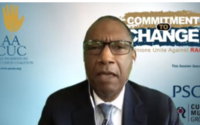
Maurice Smith
“Those who work in the C suite are usually blind to what the barriers are. I have spent my career advocating that I don’t need handout or a lucky break, I just need you to move the barriers to allow me to succeed. So, someone may need to be shown where the barriers are. If you already know where they are, don’t assume the senior leadership of the organization knows, too. Getting those out of the way is in the credit union’s interest to see middle management do well. Give your organization the opportunity to remedy those. I judge an organization by how inclusive it is, how open it is. If someone is underperforming because there are systemic barriers to improvement, you are hurting your own credit union. If you see it, point it out and throw a flag on the play.”
The full story is here.
Why SWOT Analyses Need a Good Swat
From CUNA Mutual’s Discovery Conference
Cheryl Connelly, manager of global trends and futuring with Ford, offered reasons for CU leaders to rethink why forecasts so often miss the mark.
Among the points made by Connelly:
- ““Those people who never learn to think differently will always be surprised by the future.”

Cheryl Connelly
- “The problem with the popular Strengths, Weaknesses, Opportunity and Threats (SWOT) analysis, according to Connelly, is it’s “basically exaggerated naval gazing” that starts with an internal analysis. “But you don’t own your space.” As an example, Connelly cited her own industry, auto manufacturing, which was churning out as many SUVs as possible in the run-up to the Sept. 11 terrorist attacks. That suddenly led to concerns over the price of gas, while at the same time evangelical ministers started to take on environmentalism, and all those long-haired tree huggers of the ’60s grew up to become respected business leaders who said “We can no longer deny the way they people are living their lives is having an impact on the world around them. So, here was a situation where an industry relied on its strengths and was blindsided,” said Connelly. “None of those things would come up in a SWOT analysis.”
- One point Connelly said she wanted to emphasize is there is danger when someone says the trend or forecast doesn’t apply to them or their industry. “The problem is, sometimes when we focus only on our region or our industry, we miss the big picture. Industries excel at putting the spotlight on the one area in which they are interested, and then they get blindsided,” said Connelly. “You need to have a floodlight on the global market.”
- According to Connelly, the easiest way to start thinking like a futurist is to do so the next time a person finds themselves in a meeting and someone says, “That’s not going to happen, not under this leadership. Just say, ‘Hold on, let’s just talk about what would have to be true for that to happen, and how does that undermine our plans?” said Connelly. “Something really wonderful happens when an organization lets go of the idea they can control the future. It forces them to be resilient and flexible. The only way to predict the future is to create it.”
The full story is here.
The Wrong Comparisons
As shared during Filene’s “New & Novel Ideas” meeting by Joe Heck, of Happy Money:

Joe Heck
- Should you blow up your business model and change the next day? No. It really starts with building out the right strategy and building out against that strategy. Who do you want to benchmark yourself against? I so often hear of credit unions comparing themselves to another credit unions or banks, but frankly, that’s more of the same. Find someone to benchmark yourself against that’s not another bank or credit union and that your members measure you against.”
- “You should be thinking five to 10 years out and asking how can you run experiments with small teams that have the risk appetite to try and fail, try and fail. I often hear fail fast, I really like the mindset of learn fast. Failure is when you don’t learn anything. Really pushing the envelope to learn fast that the track you’re on isn’t the right one. It all starts with a strong focus on strategy.”
The full story is here.
Big Aspirations, Big Lessons, Big Box
From CO-OP Financial Services’ recent THINK20 Virtual Conference, Mark King, the CEO of Taco Bell.
- “It’s not if you grow, it’s how you grow…We really don’t have a choice as CEOs if we want our brands to be relevant and to move forward. We don’t have to follow macro-trends, and most people will tell you that you do. That’s not true. You have the ability to control your own growth, and it starts with how you think. So, you have to have a growth mindset and you have to believe growth is possible regardless of the situation.”

Mark King
- Organizations must have big aspirations. “Yes, we all want to do good in the world, but this is financial, something really big. It’s not a target or a timetable. It’s a North Star. And we look at this this way: Is this decision going to help me on the path to get to that aspiration? If we keep doing the same things we are doing, we are going to fall behind. COVID has accelerated so many things and put pressure on us. So we have to be thinking what are new creative ways to do our busines and take care of our customers…The most interesting thing I found out is if we have a big aspiration but limited resources, there is this gap. We fill that in with new ideas and creativity. Companies stall when their aspirations and resources get equal to one another, because people aren’t developing new ideas.”
- “For centuries, all of us have used the command-and-control leadership model. It’s been around forever. There’s nothing wrong with it, but it’s really for a world that’s about control and predictability and incrementalism, and we live in disruption, speed and big changes,” said King.
- “Every year the same executives go to the same offsite every year and say, ‘Let’s think outside the box.’ But there’s no creative thinking for people who have exhausted their creative thinking, and you have same stale ideas. Leaders don’t have to have the ideas; they have to ask for the ideas. For me personally it’s the single biggest influence on my career.
The full story is here.
Frank J. Diekmann is Cooperator in Chief of CUToday.info and can be reached at Frank@CUToday.info. Mr. Diekmann is also author of the new book, ‘501 Name Tags: Everything You Need to Know About Business Can be Learned at a Conference & Forgotten in the Trade Show.” For info: www.501nametags.com.