

By Mike Brown

I recently conducted a survey of 1,500 adult Americans to gauge how much money they have in savings.
Unfortunately, it’s not much.
Let’s quickly review some key findings from the report, which you can find on Breeze, my employer and an online insurance broker for disability insurance and critical illness insurance.
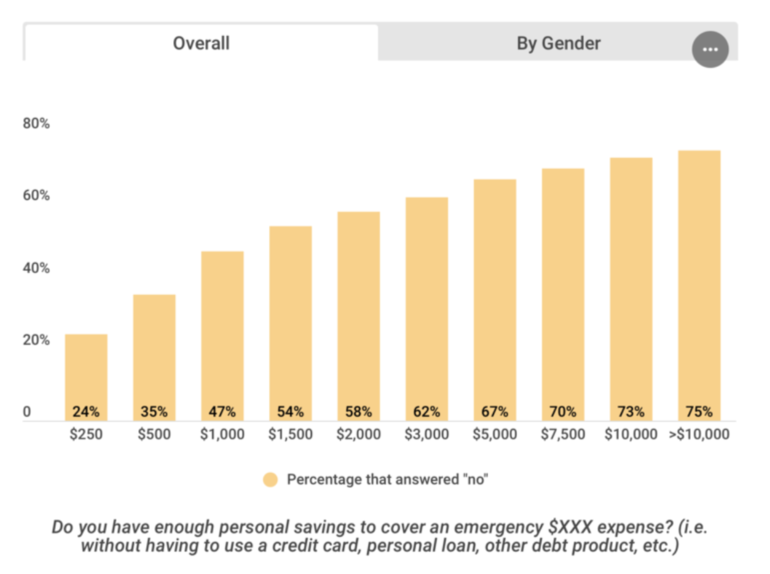
- 24% of Americans are unable to cover a $250 emergency expense with just their personal savings, including 34% of female respondents and 15% of male respondents.
- 35% couldn’t cover a $500 expense with just savings. 47% for a $1,000 expense. 54% for a $1,500 expense.
- 58% couldn’t cover a $2,000 expense, including 63% of female respondents and 45% of male respondents.
As a result of such limited personal savings, 61% of poll participants indicated they were reducing their 2021 holiday budget, with another 14% opting not to reveal their holiday budgeting plans.
Moreover, the average consumer planned to finance 38% of their holiday budget with debt from a credit card, personal loan, or something else.
And, finally, a plurality of respondents, 29%, indicated they could not cover expenses with savings and debt past one to four weeks if they suddenly stopped earning an income for an unknown amount of time. Another 16% said they could make it between five and eight weeks.
In summation, Americans have very little money stowed away in savings and are living everyday life on razor thin margins, where one poorly timed event could spell financial disaster.
As a result, debt is being relied upon, especially during the expensive holiday season.
What does this all mean for credit unions?
How to Win Over Consumers
So many Americans have so little saved in the credit union/bank. This means they likely don’t have many other financial accounts, whether that be another checking account, investment account, or a high-yield savings account.
They may have their one central savings/checking account that takes all the deposits and distributes all the withdrawals.
This is their primary account and it means everything.
Credit unions should focus on trying to convince these consumers to bring their financial needs to them.
Pitch on a personal experience where their money, no matter how much or little, is going to be prioritized and taken care of.
“You really want to have your money in a big national bank where your account is just one of millions?”
Help with budgeting and managing expenses. Provide a free checkbook or safe deposit box. Give them updates on interest rates or a new savings option. Just call and check in once and a while.
Do the little things to help these consumers and their funds feel significant and secure because they should.
Consider Offering Disability Insurance
As evident from the data, many consumers live paycheck-to-paycheck and are unfortunately in no position to absorb any type of major emergency expense.
What happens if they are struck by a car and are unable to work for three months due to the injury, surgery, and then rehabilitation? It’d be debt on top of debt on top of debt after savings were wiped out in just a couple of weeks for most.
Credit unions should explore the possibility of offering disability insurance as a product to their members. Disability insurance typically replaces between 40 and 80% of a person’s income if they become too sick or injured to work and earn a living.
It can be an excellent safety net and should be considered by credit unions looking to help their members achieve financial security.
Think Balance Transfers
As a result of having such little in personal savings, a lot of members/consumers have no other choice but to resort to debt to cover everyday expenses and those heightened expenses that come with the recent holiday season.
They are likely going to be heading into the new year with an inflated debt balance that probably does not have the best interest rate either.
If not doing so already, credit unions should evaluate the feasibility of launching a low-interest balance transfer credit card to members.
Every new year, curiosity in these cards peak after a couple of months of holiday shopping.
If credit unions can launch such a product with an introductory period of no interest followed by a still low interest rate, they could see a lot of interest and even some new members.
Mike Brown is the Director of Communications at Breeze. His work has been featured in most major publications from The Wall Street Journal to The Washington Post.