

By Michael Brown

Darn near everything about the coronavirus pandemic has been unprecedented; the virus has challenged and upended everything society once knew and the world will never be the same because of it.
The financial services industry has surely not escaped the wrath of the coronavirus pandemic.
On a macro-level, market meltdowns, mass unemployment, business shutdowns and a crashing GDP have all been squeezed into a six-month window and have fractured our financial system at a deep level.
And on a micro-level, financial services company LendEDUrecently published a report that found consumers have been struggling mightily with financial issues and headaches due to COVID-19.
LendEDU’s report analyzed consumer finance complaints from the CFPB’s consumer complaint database and found there’s been a 44% year-over-year (YOY) increase in complaints during the coronavirus pandemic.
The Numbers
The report from LendEDU analyzed consumer finance complaints from three different periods:
- March 13, 2019, to July 17, 2019, to find YOY increases/decreases
- November 7, 2019, to March 12, 2020, to find increases/decreases from the previous 127-day period
- March 13, 2020, to July 17, 2020, to find complaint numbers during the pandemic
Here’s a look at the total number of complaints during each of the three periods, in addition to the number of complaints pertaining to each specific category:
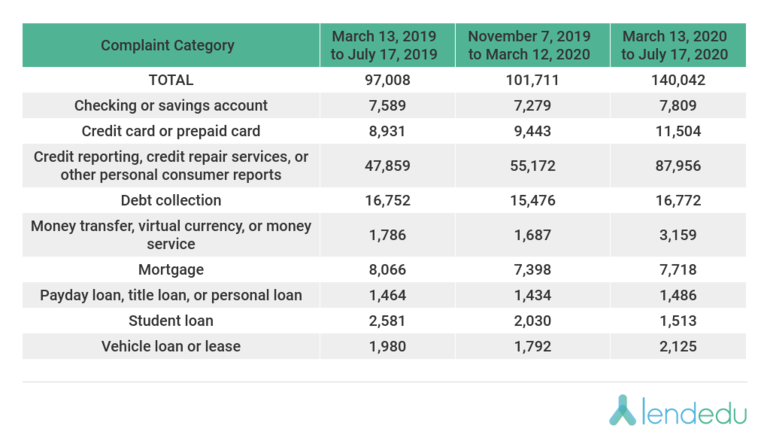
And while it’s easy to spot the massive jumps in consumer finance complaints during the coronavirus pandemic, this is what the specific YOY percent increases looked like:
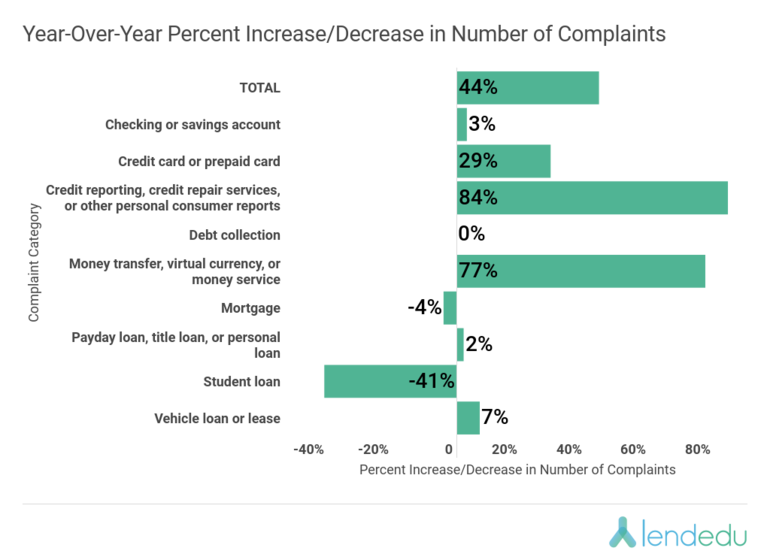
The LendEDU analysis found a 44% YOY increase in the number of consumer finance complaints, and specifically, an 84% YOY increase in credit reporting complaints, a 77% YOY increase in money transfer/service complaints, and a 29% increase in complaints pertaining to credit cards or prepaid cards.
Interestingly, there was a notable 41% YOY decrease in the number of complaints pertaining to student loans, but this is likely due to the Department of Education placing all federal student loan accounts in pandemic forbearance until October 1, 2020, which means no payments will be required until then nor will student loan interest accrue.
The Question
But why the massive YOY increases in virtually all other finance categories?
The sharp increase in credit reporting complaints is the easiest to explain. When the pandemic began and budgets tightened, many financial institutions were flexible with borrowers in allowing reduced or deferred monthly payments for things like a mortgageor credit card.
However, it seems these pandemic-induced agreements between lenders and borrowers were never truly set in stone and relayed to the credit reporting agencies, because countless consumers saw erroneous marks on their credit reports for missed or late payments that also sunk their credit scores even though they had reached temporary agreements with their respective lenders.
In addition to these incorrect delinquencies, a number of consumers saw their credit limits unexpectedly slashed which brought their credit utilization to nearly 100% and subsequently damaged their credit scores.
Phishing Scams
When it comes to the large jump in complaints pertaining to money transfer services found in the LendEDU report, that can be attributed to an increasing number of phishing scams where consumers are getting fake messages from banks attempting to collect on a debt and are told to send the money through a service like Venmo or Zelle.
And it appears that much of the rise in credit card or prepaid card complaints are due to the faulty rollout of the government debit cards being sent to people as part of the CARES Act stimulus package.
Finding the Good
Sometimes, it takes the absolute worst of things to happen to find out what’s wrong and fix it.
This is how one can put a positive spin on the LendEDU analysis that found a massive rise in consumer finance complaints during the coronavirus pandemic. It appears that something is structurally faulty when it comes to how financial institutions communicate with credit reporting agencies in regard to amended payment plans that consumers have.
Before the coronavirus pandemic, consumers, financial institutions, and credit reporting agencies have never had to deal with such a sudden change to the financial climate that led to a mass alteration in the way consumers were paying down debts.
This pandemic-induced change flooded the system and lenders were not able to confirm or finalize the new payment schedules with credit bureaus, which led to the rise in incorrect negative credit marks, which led to the rise in complaints.
Hopefully, the good that comes out of this is a more modern and prepared system of communication between consumers, lenders, and credit bureaus so that new payment plans are known and this doesn’t happen again.
Michael Brown is director of communications with LendEDU.