HAS TWO CHARTS
By Mike Moebs
“Between a rock and a hard place” accurately captures the position of today’s Fed. Increase interest rates and you have higher prices chasing fewer dollars, or inflation. Increase the Money Supply, which increases employment and output, but at a price regulators, investors, politicians and consumers won’t pay today. Do nothing is an option: don’t raise interest rates and leave Money Supply the way it is.

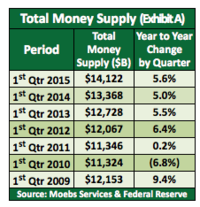
In the past seven years Money Supply has increased an average of 3.6%, or half of the 50-year average of 7.5%. This “new normal” growth makes it more difficult to get the economy moving. If Money Supply had grown at the normal rate of 7.5%, total Money Supply would be $18,422 Billion (B) instead of today’s $14,122B (Exhibit A). The difference between where Money Supply is and where it should be is $4,301 billion.
They Will Lend Money, Won’t They?
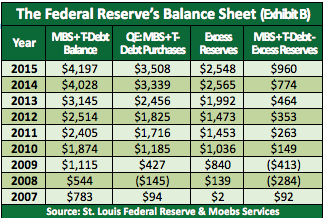
In the book “Too Big To Fail,” then Fed Chair Ben Bernanke is quoted as asking Secretary of the Treasury Henry Paulson about the money made available to the banks at the start of the Great Recession in 2008: “They will lend the money won’t they?” Well they didn’t. The money the Fed purchased through its Quantitative Easing (QE) programs was $3,508 billion and only $960 billion, or 27%, made its way into the economy. (Exhibit B)
QE was intended to stimulate the economy and increase the Money Supply by getting loans out in the marketplace from cash from the sales of securities – just a swapping of assets with no money supply change. Clever move, but unfortunately it did not work. Upon receiving the money for the Treasury Bonds (T-Debit) and Mortgage Backed Securities (MBS), the banks quickly sold 73% of the funds back to the Fed becoming Excess Reserves.
The Fed’s Balance Sheet now has $4,197 billion in MBS and T-Debt. This is well beyond a base of about $700-billion before the Great Recession started. The Fed has not attempted to get rid of this debt by taking $3,508 billion back from the economy with Fed sales due to the inherent risk of inflation. Similarly, if Financial Institutions would start using their excess reserves, the economy would definitely take off, but so would inflation.
So, the Fed’s bloated Balance Sheet comes from its own making by using QE instead of Money Supply to stimulate the economy.
Mike Moebs is president and chief economist with Moebs $ervices in Lake Forest, Ill. For info: www.moebs.com.