

By Frank J. Diekmann

The discussion was titled “Hell No, We Won’t Go…Away,” and it was targeted toward and attended by the leaders of smaller credit unions who believe they face a list of challenges longer than a CVS receipt, but most of all they believe in themselves.
As I wrote here last week, the confidence shared by the group of CU leaders during the “Underground Boutique Xchange” hosted by Mitchell Stankovic Associates was inspiring, even if it’s unfortunately not representative of the kind of spirit to be found in every corner office.
But for those attending from wherever their corner office might be, there were numerous unique perspectives shared that if you missed them, you’re in luck, as we are going to fix that right here.
Sue Mitchell, CEO of Mitchell Stankovic and the creator of the Underground Xchange meetings, called credit unions of less than $300 million in assets the “power behind the industry.” It’s a power that can often dim and fade away quietly in mergers, with the (not so) unspoken reality that large CUs are often on the prowl for smaller shops.
But participants in the Underground Boutique Xchange indicated they weren’t eager to exchange their name for another, as the chart below shows when attendees were polled on their challenges.
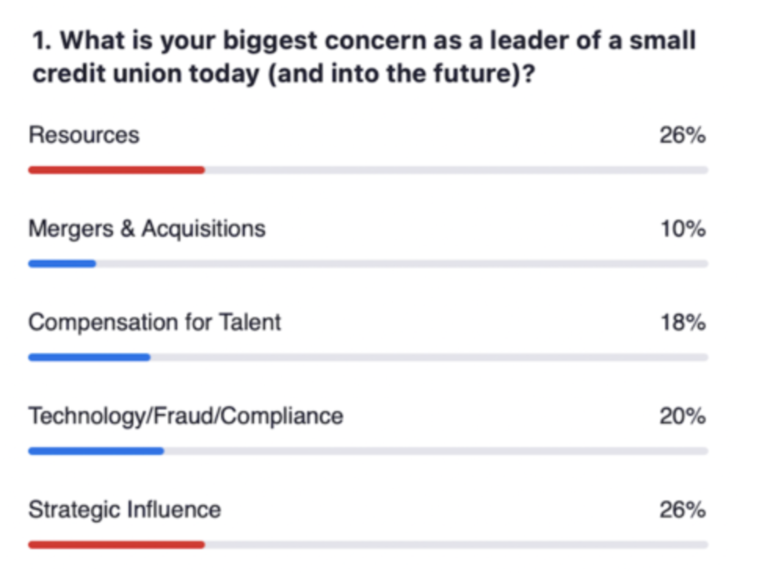
Here’s what some of the CEOs on the call had to say about mergers:
- “We know someone is waiting to see if we can make it. If you don’t have the resources to do what you need to do and don’t have the stomach, a merger should be your plan B. I know there are some people who are waiting, who are near retirement.”
- “I don’t worry about M&A for us, but I do for the credit union movement, even though I think we are the credit unions that do the most for our members.”
And here is some of what was shared on other issues in front of CEOs:
On Limited Resources
- “There are a plethora of resources available; the question is how to get through to what you need. In our credit union, I’m not paying for another contracted service unless it’s clear what that resource can do for us.”
- “From a resource perspective. It has to do with capital. But more and more, it’s difficult to add money to the bottom line. Technology continues to offer efficiencies, but it’s really expensive and it also takes resources to manage. We just rolled out a new digital banking solution. It was more expensive than what we had and has more functionality, but it also requires more back office support, too.”
- “We are a $150-million credit union. It is hard if you don’t have the economies of scale, and that’s the pitch for the M&A, the economies of scale. If you are a $10-million credit union you cannot compete with Bank of America and, unfortunately, consumers don’t see us as being much different.”
- “If you look at the key ratios across the over-$300-million credit unions and the under $300-million credit unions, it really tells the story. It’s harder to grow when you’re smaller.”
- “I had to hire a vendor to do our marketing. They do our social media, our marketing and our website and it has made a huge difference. But the cost is pretty expensive as a small credit union.”
On CUSOS, Collaboration
- “At our league meetings, it’s amazing. The league puts on these different sessions for small credit unions, and only three or four show up.”
- “I’m a big CUSO advocate. I think there are definitely ways to achieve economies through CUSOs. A lot of smaller credit unions don’t think they can start or be part of an investment in a CUSO.”
The Employment Future
- “I don’t think we are going to have tellers moving forward. If we are going to pay $25 an hour there is going to have to be a higher skillset. We are all moving that way, the consultative approach, the employee who cannot only answer members’ questions, but help with the budget; those kinds of things. Walmart pays $15 an hour and that is competing for our front-line talent, as well.”
- “We are also going to universal associates. It is hard for a smaller credit union. What is your largest expense? Salary and benefits. Being competitive with the BofAs and Walmarts is hard in today’s environment, but they also may not offer benefits, such as health insurance.”
- “I’ve heard (work) flexibility is the new currency in terms of attraction and retention. We have a front-line, member-facing function: how do we provide flexibility there? Where I am, the (Northwest Credit Union Association) website has hundreds of front-line openings. I think we’ve gotten used to offering benefits because we always have, but are there ways to look at those dollars differently.”
The Strategy Moving Forward
- “Members trust their local credit union. You can see that with the deposit growth. The whole idea is this is not the time to shut down that growth. I’m hopeful our regulator continues to be supportive both on the national and local levels with idea that we need to have some flexibility.”
- “We have made a concerted effort to be a CDFI and to serve low-income communities. We are in one of the richest areas in the country, but we also have a very large Hispanic community, many of whom work jobs such as landscaping, that sort of thing. They have to go to ‘buy here pay here’ places and pay 30% or more on their car. They have many doors closed to them. One of the products that helps them hugely is a mortgage program. They have been paying double the interest other people do. We found we can bring them into our Independence Mortgage, a second mortgage with first position, and save them (considerable money).”
- “All of our staff are financial counselors and 60% have a Latino background and some have been through the process themselves. They understand members don’t really understand what they don’t understand. I don’t see that happening at BofA, where they are paying $10, $15 a month for a checking account.”
- “I wish other small CUs would find their niche.”
Technology
- “The pandemic forced us to upgrade phone system. We are now able to pick up our phones and take them home with us. We were tapped into a government building and it didn’t give us much flexibility. It’s good that the new system is also less expensive.”
- “We had been moving to the cloud, and the pandemic (sped that along). It’s been really simple for us. We didn’t have to do too much to be ready to go virtual."
- “There has been a lack of time to do contract review. We are now trying to unwind some of those. What can we do to share resources around making the right technology decisions and vendors?
- “There is a fear of failure and an unwillingness to ask for help.”
The Pandemic & Permanent Changes
- “This is a permanent change. We are drive-through only and the only people I expect to see more of is our older generation of members who would prefer to deal with cash and with people in person. But it’s been so long in doing it this way it’s the normal now.”
- “I think this has been a good opportunity to reframe our business. We have removed the expensive transactional accounts to move to solution-education type of services. I could see younger generations looking to find a future and want a one-on-one session. This tech question, I think, ties in nicely to the whole CUSO idea and the sharing of costs. You can share expertise.”
- “I often wonder if we could redraw the lines around what community is. I was at a quite-large credit union, and I feel we were good for our community, but what if our community were our larger credit unions providing additional resources to the 75% of our industry that could use them. Help support those who are supporting communities.”
- “I think we can still create a bond with the member. There are opportunities to connect with members virtually. We may not be seeing them face to face, but we can do more than Chime. Chime isn’t going to be doing a giveaway or local scholarships.”
- “We needed the pandemic to happen. We needed to know how to open accounts virtually or use technology such as Zoom, etc. I think we did a good job and that we can still be relevant.”
- “We’ve never had an issue before, but now we are losing members to low-rate offers. We don’t do indirect. We have to educate and get them confident and even if they get a better rate they will tell other people we really helped them out.”
- “You have to have clarity around who you are and who you want to serve.”

Applicable to All, But...
That last piece of advice is applicable to every CU in the country regardless of asset size. But it’s especially important to remember if your determined to declare, “Hell no, we won’t go…away.”
Frank J. Diekmann is Cooperator in Chief of CUToday.info and can be reached at Frank@CUToday.info. Mr. Diekmann is also author of a brand new book, “The Last Lyric,” a humorous satire about a murder investigation at the Rock & Roll Hall of Fame in which every line of dialogue is either a classic pop/rock song title or lyric. Available on Amazon, Apple iBook, Barnes & Noble and Smashwords.