By Larry Fazio
NCUA’s efforts to modernize its regulations and identify credit unions that take outsized risks have been the subject of a great deal of attention, and some in the industry still wonder if we really need this rule.

Larry Fazio, NCUA
The answer is yes, and let me explain why.
NCUA’s Board voted at its January 2015 meeting to propose a revised risk-based capital rule and open the proposal to a 90-day comment period. This revised proposed rule is the product of a careful and comprehensive review of the more than 2,000 comment letters the agency received after it first proposed a new RBC rule in January 2014, as well as comments Chairman Matz, board members and staff heard at last year’s listening sessions. We listened carefully to what stakeholders had to say about the original proposal, and our revised proposed rule reflects the time and consideration we put toward addressing areas of concern.
During our review it became clear many in the industry don’t recognize why a risk-based capital requirement is necessary and appropriate for credit unions, or understand why it was important for NCUA to move on this issue at this time. It’s inevitable with any new rule that attention will be focused on the potential regulatory burden. But, it’s important that we not lose sight of the risk this rule is intended to mitigate or the importance of ensuring our regulations are effective.
Why Is It Necessary to Look at Risk-Based Capital?
NCUA is not out to punish credit unions for taking risk or to discourage them from doing so. Our intent isn’t to require the credit union system as a whole to hold more capital. The purpose of assigning an RBC classification to credit unions is to identify outliers, credit unions taking elevated credit risk with capital levels insufficient to cover those risks.
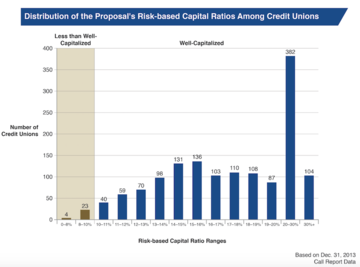
Granted, these credit unions are few. Most credit unions already maintain capital levels well above the regulatory minimum. In fact, 98% of credit unions would be considered well-capitalized were the revised proposed rule to be adopted as-is today. The proposed RBC rule will help NCUA identify outliers before they experience losses that cost the National Credit Union Share Insurance Fund and, by extension, the rest of the credit union system.
Why Not Just Use the Net Worth Ratio?
Among other things, the financial crisis demonstrated two important concepts. The first is that even credit unions with high net worth ratios can lack sufficient capital to protect against risk. NCUA data show that, over the past 10 years, 84% of failed credit unions were considered well-capitalized based on their existing net worth ratios two years prior to their failure. Many had net worth ratios above 12% two years beforehand. The second concept is that, in order to be effective, capital adequacy measures must have a forward-looking component.
A net worth ratio is calculated as a credit union’s net worth divided by its total assets, and therefore is a lagging indicator. NCUA is required by statute to retain the net worth ratio minimum of seven percent for all credit unions, and most credit unions already exceed this minimum threshold. As an insurer, however, NCUA is more concerned with how a credit union’s assets will perform in the future. The risk-based capital ratio, which assigns inherent risk weights to various classes of assets, provides a more forward-looking measure of credit risk. Again, this measure will be used to identify credit unions whose capital is insufficient to cover their credit risk exposure.
Why Now?
A risk-based net worth requirement was implemented in 2000 as part of the prompt corrective action regulation required by the Credit Union Membership Access Act of 1998. So, the existing rule is 15 years old and it currently requires only two credit unions out of the 6,400 in operation today to hold additional capital.
Importantly, the rule does not account for the remarkable change the credit union system has experienced over the last 15 years. The system now tops $1 trillion in assets, has expanded its portfolio and services into new and more complex areas, and weathered the worst financial crisis since the Great Depression. The current rule also doesn’t reflect more recent evolutions in accounting theory and international capital standards, like Basel II and III. For these and other reasons, NCUA’s Inspector General and the U.S. Government Accountability Office had advised the agency in recent years to improve its capital standards.
It was also necessary to update the rule because NCUA is required by the Federal Credit Union Act to maintain parity with federal banking regulators, which have made recent changes to their risk-based capital standards. Accordingly, NCUA’s revised proposal is very comparable to the risk-based capital requirements for banks, but still takes into account the uniqueness of credit unions.
NCUA’s revised proposed RBC rule is intended to better correlate capital to risk. Had this proposed rule been in place in 2007, losses to the Share Insurance Fund would have been substantially lower, and many credit unions failures might have been prevented.
The revised proposed rule is the product of a lengthy dialogue between NCUA and credit union system stakeholders. I hope the information here will provide some context for stakeholders as they assess our proposal. Visit the Proposed Risk-Based Capital Resources page on NCUA’s website for more information.
Larry Fazio is Director of NCUA’s Office of Examination and Insurance. Mr. Fazio can be reached at lfazio@ncua.gov, or 703.518.6360.