

By Frank J. Diekmann

How often have you heard credit unions described as a “best-kept secret?” Too often, I’m guessing. And yet it appears the most amazing part is who is actually keeping the secrets.
As I wrote here about 18 months ago, after I had been covering credit unions for approximately 20 years as a reporter and editor, my father casually mentioned one day that he had served on a credit union’s board at one point during his career. Why he felt I needed two decades to prepare myself to absorb and handle this news, he never mentioned.
In the case of my father, he served on the board of what was once the Cincinnati Central Credit Union. Fun fact: among those who were on the board with him was Louise Herring, the Ohio CU pioneer nicknamed the “mother of credit unions” and for whom a certain Award for Philosophy in Action is named.
Now, it turns out I’m not alone or unique when it comes to family members who don’t want to divulge their credit union past, for some reason.
A few weeks back, NCUA Chairman Todd Harper was speaking to the African American Credit Union Coalition meeting in St. Pete Beach, Fla., when he mentioned that his father, too, had served on the board of a credit union. But again, it wasn’t something his father saw any reason to bring up until after his son was on the board of the federal credit union regulator.

And it turns out Mr. Harper and myself aren’t the only members of the club.
Recently, Robert Kelly, CEO of the Association of British Credit Unions, Ltd. (ABCUL), was speaking to the World Credit Union Conference in Glasgow. He said that when he joined the credit union community 20 years ago, “I have to confess I didn’t know what a credit union was. I actually went home and chastised my parents about that. My dad said, ‘I’ve been a member of one for years, I just never told you’.”
And by the way, I think with more than 130 million Americans as members, credit unions can bury that “best kept secret” claim at this point.
The Report on Reports
Like many of you, when I was in grade school we were prepared for our future lives in the work force by having to do “reports,” which were only acceptable, of course, if done while adhering to APA formatting, which we were told was absolutely critical if we ever wanted anything out of our futures other than to be a fax machine salesman who lived in that “one part of town” before dying a penniless pauper who didn’t even qualify as underserved.
Why, adults didn’t so much as write out a grocery list without using APA formatting, we were reminded again and again.
I don’t know what your experience was, but our teachers would demand we have at least two sources for whatever the subject matter of the report was, and they couldn’t be encyclopedias (note to younger readers, Google encyclopedias and enjoy the irony).
Let’s say in sixth-grade you were doing a report on cheetahs. To abide by the no encyclopedia rule, your options were 1) wait for the Internet to be invented or 2) go on a safari. It was at this point your 12-year-old brain began to suspect the adults were crazy—something your own adult brain would confirm later.
So, you would copy your report out of the encyclopedia while changing the occasional word here and there in what you thought was a pretty ingenious strategy to throw the teacher off the scent of the scofflaw.
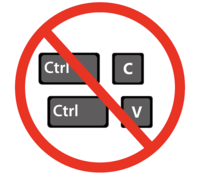
But not every sixth-grader was so fiendishly clever, and I distinctly recall a classmate reading his report aloud to the class and stating, “See picture, page 164.” This was in the days before Control C, Control V, and he had so faithfully copied every word from the encyclopedia with such focus that he diligently captured what the words were, but not what they meant (maybe it helped his word count?)
Digital Sloppiness
I bring all that up because today we may not be turning too often to encyclopedias or APA formatting, but the sloppiness and carelessness remains, just in a digital format (this is one area digital has not disrupted). Case in point is a recent disclosure form related to a merger that was filed with NCUA by one credit union in which, under the header “reasons for merger,” it cited the always noted “improved products and services” it would gain, in this case by combining with “Continuing Credit Union.”
I may not be as sharp as the average sixth grade teacher, but a show of hands from everyone who believes that was copied-and-pasted straight out of an email from the merger consultant.
Er, What?
Finally, from the See Picture, Page 164 Department, a disclosure form filed by a different credit union recently told members it needed to merge in order to “differentiate itself.”
I don’t even know how to respond to that, regardless of the formatting used.
Frank J. Diekmann is Cooperator in Chief of CUToday.info and can be reached at Frank@CUToday.info. Mr. Diekmann is also author of several new book, including the brand new “The Last Lyric,” a humorous satire about a murder investigation at the Rock & Roll Hall of Fame in which every line of dialogue is either a classic pop/rock song title or lyric. Available on Amazon, Apple iBook, Barnes & Noble and Smashwords. Mr. Diekmann is also author of a non-fiction compilation of the very best & worst he has seen and heard in covering more than 500 CU meetings and conferences, “501 Name Tags: How Everything You Need to Know About Business Can Be Learned at a Conference & Forgotten in the Trade Show.” It is available on Amazon, Barnes & Noble, Apple, Lulu, and Smashwords