By Frank J. Diekmann

Perhaps you’ve heard the theory the world is getting smaller. Now meet the proof: the World Credit Union Conference. It, too, has shrunk even as it’s simultaneously gotten larger.
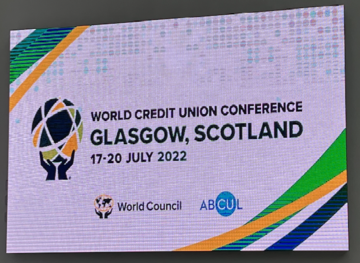
Hosted by the World Council of Credit Unions (WOCCU), the event wrapped up a week ago in Glasgow, Scotland. It drew approximately 1,600 attendees from 50+ countries, according to WOCCU, with the largest contingent from the U.S. (the title for being most vocal, however, goes to the Brazilians, who have knocked off the Australians for the honor in CUToday.info’s Official Boisterous Attendees Rankings—and this being credit unions, obviously abbreviated OBAR).
How has it gotten smaller? In the same ways the planet Earth itself has.
In a Credit Union Land not all that long ago, one could look at the agenda and know immediately you were picking up a name badge at a World CU Conference, wherever on the globe you might be. And even if you had not yet reviewed your menu of educational options, you just knew you were at the WCUC—you could feel the buzz of very disparate and culturally unique folks coming together in their shared enthusiasm for cooperativism. They may speak different languages, but they could count to seven, as in the Seven Cooperative Principles, which now that I think about it, I don’t believe I heard nary of mention of in Glasgow.
Already Been There
And then there was the agenda. There were sessions on what U.S. credit unions at the time considered fundamental and basic, like some sort of syllabus from Credit Unions 101. I once caught up with a couple of Australians over a beer or two while they regaled with stories of trying to get CUs up and running on some Pacific islands where the locals misunderstood “not-for-profit” to mean the operation intentionally seeks to lose money.
Back in the day—and it really feels like it was just days back--attendees would find breakouts on how to push through CU-enabling legislation in various governments, how to deal with regs and market conditions unique to a country or region, and even how to go about hiring professional staff at CUs run purely by volunteers.
The Americans would sniff that they were far too sophisticated for anything like that. They can quit sniffing now.
Looks Familiar
Fast forward to 2022 and the agenda at the WCUC could easily be mistaken for the line-up at just about any CUNA or NAFCU meeting. I’ll admit I miss hearing and experiencing some of those perspectives from folks in places where the word “movement” wasn’t some old-fashioned reference to the days of George Bailey; it was about really moving members to better financial lives.
I’ll admit, too, to missing the kind of passion and fervor you would encounter from people in developing movements, and meeting with the respective Friedrich Raiffeisens and Dora Maxwells from other parts of the globe who were doing pioneer work in chartering credit unions and keeping the flame burning.
The point here isn’t to be nostalgic. Rather, it was good for the American delegation to be exposed to these cooperative enthusiasts, to get a reminder on why they were there on their members’ dimes, even if the Yanks—and this is true of just about every country’s delegation—tended to stick together with the other Yanks.
The folks from the States still tend to interact with each other, that’s natural—what’s worse are the CU boards that are in attendance and which move about in unison like nine-headed Slinkies. There should be a rule for boards at such events that the last time they do anything as a group should be at the airport when they arrive, when after gathering their luggage they come together and agree to meet again in three or four days to report back on what they’ve learned independent of each other.
The Irony
But back to what’s really changed, and it’s an irony. As credit unions have gotten larger, their world has gotten smaller. Of course, that’s not just true of credit unions, but check the name of this publication.
During her presentation sharing how her CU has turned itself around by closing its three branches, Carma Parish, CEO of the $48-million NorthPark Community Credit Union in Lebanon, Ind., was presenting a session that had “Small Credit Union” in the session name. So, she asked for a show of hands for CUs of less than $100 million in assets, fully expecting “small” credit unions to be filling the seats. No hands raised. What about $500 million? Still the same number of hands you get if you ask a classroom of kids, hey, who’s up for a pop quiz? Finally, she asked who was over a billion dollars? Just about everyone.
I can hear many readers of CUToday.info already asking, if a billion dollars is small, what are we? And Parish’s informal poll was interesting, too, because the average size of a credit union in Ireland, for example, is 100 million U.S. dollars, and the Emerald Isle was well represented in Glasgow, but apparently not at the session.
Emergence of Global Regulators
Another development that has made for a smaller planet at the World Credit Union Conference is regulation. Increasingly, four international regulatory standards-setting bodies—the Basel Committee, the European Commission, the International Accounting Standards Board, and the Financial Stability Board—are driving regulations that eventually come out of the national regulators, such as NCUA, and state regulators in the U.S.
The World Council has recently scored some victories around “proportionality”--which means rule makers will take the size and complexity of credit unions into account—including the Basel Committee. WOCCU has been emphasizing just what a coup this is and why it’s so important, but my guess is most American CU leaders gave it little attention, since Basel is in Switzerland and what does that have to do with us? Or, worse, they think this is some reference to the culinary herb and hey, our credit union has a drive-through but we don’t serve food.
Communities Without Borders
The other piece that has shrunk the world at the World CU Conference is technology. It’s true that a decade ago credit unions in the U.S., Canada and Australia had a big lead technologically over their counterparts in other parts of the globe. So much so that I recall after the devastating tsunami hit Sri Lanka, representatives from that country’s credit unions shared stories of attempting to restore member records by drying out paper in the sun. That was in 2004.
Now, there’s been a new tsunami and it’s swept up credit unions everywhere. It turns out COVID didn’t just have worldwide effects on human health. Technology hasn’t just closed the gap, it’s pushed some countries’ cooperatives ahead of those in the U.S. in many ways. Thanks to cheaper, more readily available technology, they’ve leapfrogged legacy systems and the need for branch networks and have developed their own platforms or partnered with fintechs to do so.
That “digital disruption” you hear so much about? It’s also disrupted the CU development curve.

The Kwaara app in Kenya.
No longer can the folks carrying the U.S. passports strut about the meeting knowing they are a generation ahead of everyone else. In fact, the best thing they could do to deliver ROI on the cost of attendance at these international events is to shut up and listen to what others are doing, including in Brazil, as reported here, and in Kenya, as reported here.
And, of course, technology has created a world in which people form common bonds on Tik Tok and Facebook and other social media that have nothing to do with national borders. When CUs come together at international meetings now, perhaps the flag ceremony should feature flags of common interests rather than common citizenship.
The Last Piece
Finally, there’s one other final piece that has also made the meeting’s a bit more homogenous. The world may have gotten smaller, but at least in the Summer of 2022 (winter for those in attendance from the Southern Hemisphere), it’s also gotten much more expensive to travel. That means more people from big credit unions in the U.S. and Canada and Australia (some of which brought their entire boards), and fewer from places where in order to attend everyone has to double or triple up in hotel rooms.
This year, even extending the concept of cooperation to the room situation couldn’t sufficiently extend the budget for some.
What Does it All Mean?
So, what does all that mean for the World (CU Conferences) ahead? Change never stops, and the point here isn’t to lament a lost past, just to note that things are different.
Ahead for the World CU Conference is likely a trendline where there may be 50+ countries in attendance that will continue to be represented during that opening flag ceremony, but in some ways it almost feels like everyone hails from the same place.
Co-opistan, anyone?
Frank J. Diekmann is Cooperator in Chief of CUToday.info and can be reached at Frank@CUToday.info. Mr. Diekmann is also author of several new book, including the brand new “The Last Lyric,” a humorous satire about a murder investigation at the Rock & Roll Hall of Fame in which every line of dialogue is either a classic pop/rock song title or lyric. Available on Amazon, Apple iBook, Barnes & Noble and Smashwords. Mr. Diekmann is also author of a non-fiction compilation of the very best & worst he has seen and heard in covering more than 500 CU meetings and conferences, “501 Name Tags: How Everything You Need to Know About Business Can Be Learned at a Conference & Forgotten in the Trade Show.” It is available on Amazon, Barnes & Noble, Apple, Lulu, and Smashwords