

By Greg Hoeg

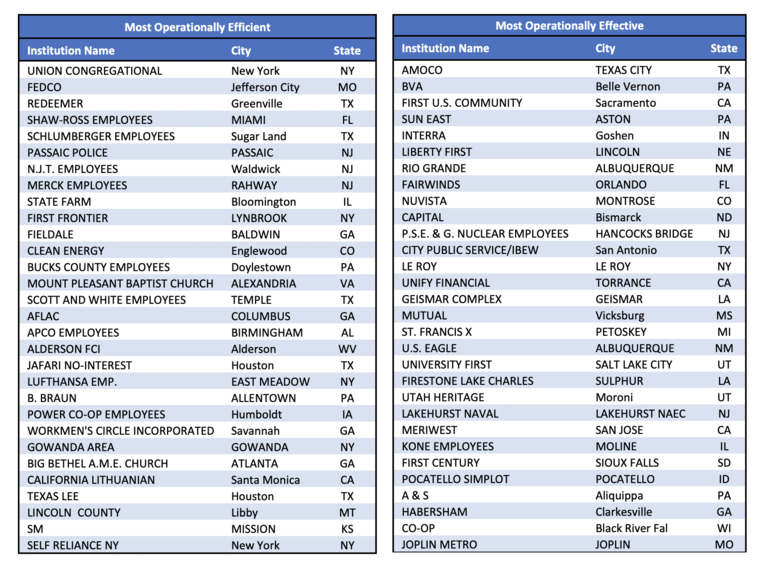
Our company has completed its review of the U.S. credit union industry for 2019 and identified the most and least Operationally Efficient and Effective institutions.
The review included 5,338 credit unions operating in the U.S. and measured their performance in terms of how efficiently they managed their operations and how effectively they built and maintained quality business portfolios. In other words, the review measured how much “bang for the buck” each institution got from what it spent on its business operations and the quality of the book of business it manages.
- Operational Efficiency: A measure comparing each credit union to industry best performers in terms of the total cost of their business operations relative to the value of the revenue those operations generate
- Business Effectiveness: A measure of the quality of the business portfolio each credit union has built in terms of its profit potential, independent of operating costs, compared to industry best performers
These measures are developed using Efficient Frontier Analysis (EFA), a concept from portfolio theory to identify best performance, which we applied to operational measures. The evaluation is objective, using publicly available data reported in credit union financial statements (call reports) and with no input from the credit unions themselves.
The result is an accurate set of measures of how effectively and efficiently each credit union manages its business resources and operations compared to industry best performers.
Industry Setting - 2019
The U.S. credit union industry in 2019 experienced an improving economy and increasing interest rates. From a supply and demand perspective, the industry experienced both increasing demand and more costly supply, but with demand increasing to a greater extent than the increase in the cost of funds.
In such an environment competitive success for a credit union is largely dependent on either having a portfolio of business that maximizes profitability through low interest costs or managing business operations very efficiently, or both.
Best Performers
Unsurprisingly, those credit unions that achieved the highest levels of operational efficiency tended to be much larger than the typical U.S. credit union in terms of assets and net income in 2019. This is likely the result of achieving economies of scale in their operations due to their size and/or a specialized member and function approach. Unfortunately, these credit unions were well below the industry average for effectiveness in building and maintaining a quality business portfolio for profitability, thus countering much of the benefit gained by being operationally efficient.
Those credit unions that achieved superior levels of effectiveness in building and maintaining a quality book of business also tended to experience better than average levels of operational efficiency. These credit unions were also generally much larger than the typical credit union in the Industry, as measured by assets and net income.
Their ability to excel at building a quality business portfolio while operating at a competitive level of efficiency means they are contributing to their bottom lines both operationally and strategically.
Worst Performers
Credit unions in 2019 that most underperformed the industry in portfolio effectiveness, with few exceptions, also underperformed in operational efficiency. As a group, these credit unions tended to be much smaller than the typical institution in the Industry in terms of size for both assets and net income. This group’s make up was not skewed toward new or start up entities, as one might expect, and had a mix of federally and state-chartered entities.
Those credit unions that most underperformed the industry in 2019 in terms of operational efficiency also generally underperformed in business portfolio effectiveness, suggesting that focusing on operating efficiently may help drive a credit union to building a better portfolio of business.
This group was also significantly smaller than the typical credit union in terms of both assets and net income. Because both underperforming groups are generally composed of smaller institutions, their inefficiency is likely due to a lack of economy of scale.
In conclusion, size does matter for credit unions, at least if they want to be operationally efficient, but, once big enough, pursuing a quality book of business appears to be the better path to overall success in both operational efficiency and effectiveness.
Gregory J. Hoeg leads Hoeg & Co. in Lahaska, Penn. For info: gjhesq@hoegco.org.