

By Frank J. Diekmann

The most important question any credit union can ask itself has nothing to do with the products or services it offers or its ALM/pricing or even its increasingly important menu or technology options.
Instead, the most critical question you and your board can ask yourselves is, “Are we relevant?” And then the follow up, "No, seriously, are we really?"
Relevance is at the heart of every decision every consumer makes. In the case of financial services, it’s relevance-related questions such as, “Does this place make my everyday life better and can it help me get to the financial goals I have?”
Relevance extends to the emotional bond the consumer/member has with the credit union. We all shop or eat at or buy from places where we feel some sort of connection, and will exchange one value (higher prices) for another (we feel connected, they know us, I like the business model, etc.). That means your pricing is important, but it’s not most important. Instead, your relevance in this case means something deeper.
More Than Foundational
One particular relevance question has always been the foundation for credit unions—or is supposed to be—but every decade or so it becomes much more than foundational and opens a window to and a door for the opportunity to live up to the mantra. Now is one of those times of opportunity.
Many Americans are feeling financially squeezed by inflation. Remember that old saying that it “costs a lot to be poor.” Now it costs a lot more. And it’s not just the poor. It’s a big chunk of the middle class suddenly staring in the face a phrase they may have heard but never experienced: “Living paycheck to paycheck.”
The National Credit Union Foundation and CUNA have announced a major push in 2022 and beyond for the role of credit unions in financial wellness. The timing couldn’t be better, because many are feeling unwell. Similarly, CUToday.info has launched an ongoing series on how economic changes need to also lead to changes in how credit unions provide financial counseling to members.
A Case in Point
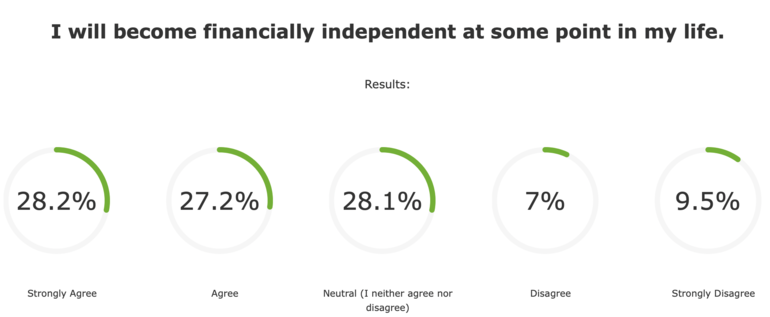
Case in point for all this: As CUToday.info has reported, just over half of Americans still believe they will become financially independent and achieve the American Dream at some point in their lives, according to a new survey conducted by the National Financial Educators Council (NFEC).
This is pretty much a piggy bank half full, half empty scenario, as what the survey found also means that approximately half of Americans believe the American Dream is just that, a dream. The only way they believe they will ever see it is in their sleep.
The survey, which was conducted June 18-23, 2022, measured people's feelings and attitudes toward money and level of confidence when making financial decisions. Adults around the U.S. were asked to rate how much they agree with the statement, "I will become financially independent at some point in my life." Response choices were "Strongly agree," "Agree," "Neutral (I neither agree nor disagree)," "Disagree," or "Strongly disagree."
Of the 1,506 respondents, 55.4% responded either "Strongly agree" or "Agree" to this question. Only 16.5% said they felt they would not reach financial independence in their lifetimes. The remaining 28.1% responded "Neutral," indicating that they “may be on the fence about this important issue,” according to the NFEC.
Another Metaphor For You, Because You Need One
You know that SUV you can no longer afford to fill at the pump? It has over the years also been filled full of various metaphors about what you stand for as a credit union, and here’s another: it’s credit unions’ role to get their members on the right side of that fence, or at the very least to show them how to get there.
Credit unions, you need to be honest with yourselves. As you get larger, members can become smaller. CEOs and senior management with bonuses tied to performance can begin to forget, conveniently, about the folks who don’t stop in very often—because, hey, who wants to be reminded personally when the news is bad?—and instead become enamored with higher-margin wealth management services or loans on EVs (where the E stands for expensive).
Not a Good (Dollar) Sign
All of us have been reminded of the state of the economy in many ways this year. One example that has stuck with me is this: Dollar General (which will no doubt be Two-Dollar General stores soon, thanks to inflation), have begun providing financial services to its customers, including a buy now, pay later (BNPL) solution.
While it is easy to laugh at the idea that anyone is financing their purchases at Dollar General, it’s really an alarm-ringer about the state of many consumers’ finances, including your members’.
The Dollar General announcement also dovetails with recent J.D. Power research, which found 81% of retail bank customers say they feel strongly that financial institutions are in a position to help them.
Well, Are You?
People need their credit unions to help them, and that’s especially true for those people who are the reason Filene and Bergengren and Herring and all those other pioneers helped to create them in the first place, many during the Depression era.
Credit unions and their trade groups like to measure things and show their findings to Congress. Why not measure all the members whose lives have been made better as a result of a concerted CU effort?
We are not in a depression as a country, but for many Americans and members, their personal finances are. Are you relevant? There’s seldom been a better time to ask yourself that question, and then to answer it for your members.
Frank J. Diekmann is Cooperator in Chief of CUToday.info and can be reached at Frank@CUToday.info. Mr. Diekmann is also author of several new book, including the brand new “The Last Lyric,” a humorous satire about a murder investigation at the Rock & Roll Hall of Fame in which every line of dialogue is either a classic pop/rock song title or lyric. Available on Amazon, Apple iBook, Barnes & Noble and Smashwords. Mr. Diekmann is also author of a non-fiction compilation of the very best & worst he has seen and heard in covering more than 500 CU meetings and conferences, “501 Name Tags: How Everything You Need to Know About Business Can Be Learned at a Conference & Forgotten in the Trade Show.” It is available on Amazon, Barnes & Noble, Apple, Lulu, and Smashwords