By Frank J. Diekmann

Much has been observed, stated, predicted and written during 2021, but the Most Insightful Observation of the Year Award goes to these 57 words:
"The value of the old, face-to-face, personal service credit unions excel at is fading away. Our surveys show this kind of service just does not mean as much to consumers anymore as does a nice, easy-to-use digital transaction. This is a sea change. The old way of doing customer service is going away."
Go ahead and read those five-dozen words again. They deserve it. Make them your screen-saver. Print them out the old-fashioned way and tape them to your door. Get t-shirts made, or, better yet, get a tattoo. Turn those words into a neon mural and illuminate a wall of your boardroom with them.
The quote is from David VanAmburg, managing director of the American Consumer Satisfaction Index at the University of Michigan in Ann Arbor, and were shared during an interview with CUToday.info’s Ray Birch that offered insights into why credit unions have again finished behind the banking industry when it comes to consumer satisfaction as measured by the Index.
Drowning in Kool-Aid
I addressed this troubling issue here in 2019 in a piece headlined, “Here’s the Disruption. Now, Where’s the Leadership?” and here in a 2020 piece headlined, “Is Anyone Else Worried About this Trendline?”, and now it appears the country’s credit union community is no longer just drinking its own Kool-Aid, it’s drowning in it. But there is still hope, I believe.
In the former piece, written in the wake of CUs being ranked behind banks for the first time in the survey, I challenged credit union leaders to ask the hard questions over what needed to be done to ensure it was a one-off finding and wouldn’t happen again. When that’s exactly what happened again, I wrote, “If one was considered an aberration, and two suggests a trend, what in the world will the reality be for Credit Union Land when three rolls around? Or four and five or…”
Three has now rolled right up to the front door and, as Mr. VanAmburg states unambiguously, there is indeed a new reality.
As CUToday.info was first to report, for the third year in a row the nation’s credit unions have not only—wait for it--again fallen behind banks--but also hit another “historic low” when it comes to consumer “satisfaction” with their CU.
This is not the kind of history credit unions want to be making.
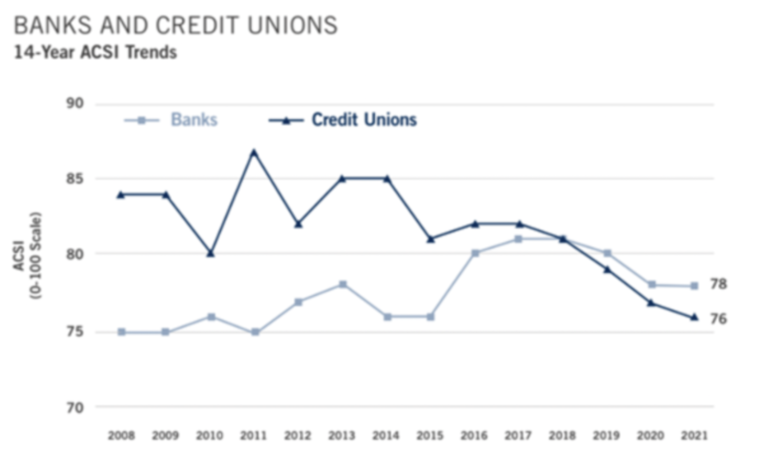
What on Earth? Exactly.
That quote that deserves all your attention above was included with other observations and insights about what in the world is going on. It’s an apt metaphor, as the world has changed in Earth-sized ways since March of 2020. Perhaps you’ve read about it—an international pandemic has been taking place and a decade’s worth of change has been compressed into fewer than 24 months. As I said in remarks to one group recently, if your strategic plan for next year is designed to prepare you for 2022, you’re half a Rip Van Winkle behind—it’s 2032.
And because it’s now the 2030s, as Mr. VanAmburg explained, the definition of service has changed in the minds of consumers—moving away from the personal face-to-face interactions to streamlined e-services—and banks are just better at digital delivery.
“The world has been shifting, long before the pandemic, towards more digital banking experiences, more efficient experiences,” VanAmburg continued. “Technology is winning the day versus that good old-fashioned customer service. This means that credit unions are not failing at delivering a high level of satisfaction relative to banks in the past few years, but it’s more that this friendly approach to service just does not mean as much to many consumers these days.”
In other words, NPS is nice, but MPH is better. Everyone needs to heed the need for speed.
The New Points of Reference
As I also told the group I mentioned above, when it came to perceptions of service most consumers until recently rated their financial institution according to the in-branch experience, and for the majority it was “good” or “great” and there was much back-patting to be had inside CU C-suites. But consumers/members really had no point of comparison for how good or great the experience was, as most weren’t swiping their ways through other bank/CU lobbies—they did business in one place without any frame of reference.
No more. Now, and ironically, given what has happened with the Yellow Pages, they are letting their “fingers do the walking” and rating their satisfaction with your CU by comparing you to the experiences they are having with every other phone icon they tap on, including other FIs, fintechs, retailers, dating apps, and the mother of smooth operators, Amazon.com. Forget those secret shoppers—it’s no secret where your members are doing their shopping—how do you compare?

David VanAmburg
Friendly Service, But…
Credit unions still “beat banks handily” on that in-branch experience, VanAmburg related, but that’s a little like saying the friendly staff at your electronics store can help you with the widest selection of VHS tapes in town.
“When consumers go into a branch credit unions are still excelling,” VanAmburg said of the research behind the American Customer Satisfaction Index. “But banks are beating credit unions on quality of the mobile app, the viability of the mobile app and website satisfaction. So, logging on to your Chase.com account is winning over that smiling teller and increasingly during the pandemic people are going to their electronic devices more.”
So, what should credit unions be doing? It should be obvious. I’m out of columns in which I shout from the top of Mt. Co-op about the need for CUs to wake up to how serious the trendline has become. If you haven’t gotten the message, I don’t think even coming down from that mountain with stone tablets in hand is going to make much difference at this point.
A Challenge For You
Instead, I have a challenge, and it’s a challenge I believe at least some in credit unions can meet. I challenge you, someone--anyone, really--to act. The leadership is not going to come from the trade associations, so for all of you in credit unions who like to talk about the power of the grassroots, it’s time to do your grassroots thing. I’m happy to put folks in touch with each other.
Credit unions—especially smaller CUs—have an e-services/mobile access problem, and the gobs of money being spent on building consumer awareness are going to drive zero ROI as long as members/consumers are
“aware” the digital offerings of many in the movement are lacking due to a lack of digits in the investment department.
Can groups of smaller and midsize CUs (or CUSOs or fintechs) come together and create digital experiences every bit as friction-free as those of the biggest banks or—and you should really be paying attention here--some of the fintechs such as Acorns that have seen explosive growth in recent years? That has been, after all, the promise of e-services, that even the small, community financials can appear “big” when accessed via a device in the consumer’s pocket or purse. But it hasn’t been playing out that way, and won’t, until you change it.
I challenge one or more people who are part of Filene’s i3 initiative or some from among the thousand-plus Development Educators in the country to take on this challenge. Looking for something to be innovative or passionate about? How about survival?!
In the quote of 2021 shared above, Mr. VanAmburg, observes, “This is a sea change.” So, how will credit unions respond? Is the plan to sail on to new seas, or are you content to eventually find a resting place on the bottom?
Might I suggest everyone cooperatively come together to hoist the digital sails?
Frank J. Diekmann is Cooperator in Chief of CUToday.info and can be reached at Frank@CUToday.info. Mr. Diekmann is also author of several new book, including the brand new “The Last Lyric,” a humorous satire about a murder investigation at the Rock & Roll Hall of Fame in which every line of dialogue is either a classic pop/rock song title or lyric. Available on Amazon, Apple iBook, Barnes & Noble and Smashwords. Mr. Diekmann is also author of a non-fiction compilation of the very best & worst he has seen and heard in covering more than 500 CU meetings and conferences, “501 Name Tags: How Everything You Need to Know About Business Can Be Learned at a Conference & Forgotten in the Trade Show.” It is available on Amazon, Barnes & Noble, Apple, Lulu, and Smashwords.