

By Frank J. Diekmann

If you’re new to credit unions, and by new I mean you started drinking the Kool-Aid in the last 20 years or so, then here’s some news that may surprise you: there used to be a time when if another credit union could suddenly serve your field of membership, that really pissed some people off. A lot.
It was called “FOM overlap,” and it was a thing.
The prevailing view for many at the time was that they were called fields of membership for a reason, because fields had fences around them. You stayed in your field, other credit unions stayed in theirs, and the world was a happy, cooperative, non-overlapping place.
For the most part, up through the mid-1990s, many of those in credit union management had come up in credit unions during the earlier single-field era when financial institutions were regulated to the point the government set the hours, the deposit rates and the loan rates. Basically, running a CU was a bookkeeping job, which is why so many credit union “managers” had started as part-timers crunching credit union numbers as a side gig at the sponsor company before the CU grew to the point it could hire a full-timer.
The Day Everything Changed
Both the part- and full-timers knew something else—you didn’t “compete” with other credit unions. Period. And then that all changed, the repercussions of which we are still seeing and feeling today.
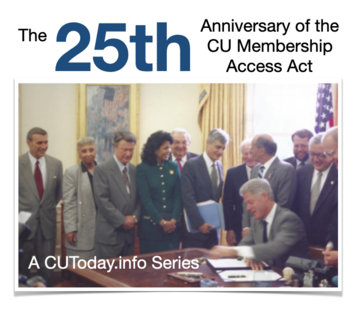
On Aug. 7, 1998, President Bill Clinton signed into law the Credit Union Membership Access Act, still better known in the code-speak credit union vernacular as HR 1151.
The signing announcement had come as a big surprise. Yes, everyone knew Clinton was going to sign the bill, but no one knew when, only that it would be several weeks after the passage of the bill. And that was true until it wasn’t. Suddenly, the White House—perhaps distracted by the Monica Lewinsky affair that was at its peak at the time--was saying Clinton planned to put his signature on the Credit Union Membership Access Act in an Oval Office ceremony in just a few days, and swiftly everyone in the credit union community was scrambling, especially those wanting to make the A-list for one of the coveted slots for the Oval Office ceremony.
It Came So Fast
It all had come so fast after what had been an unprecedented two years of victories and fears and arguments and nervousness and excitement and wins and losses for America’s credit unions, which had in the process learned a painful lesson, which is that while wearing a white hat might send a signal in movie westerns, in Washington hats are mostly for being passed around and besides, no matter what color it is, it certainly doesn’t mean a bad guy won’t try to shoot you.
This was especially true at a time when credit unions weren’t just outgunned—they didn’t have any guns (or really understand why they needed them). In the late 1990s, the nation’s banking industry had about $4.5 trillion in total assets, compared to credit unions’ $348 billion. The elephant didn’t really care what color hat the mouse was wearing.
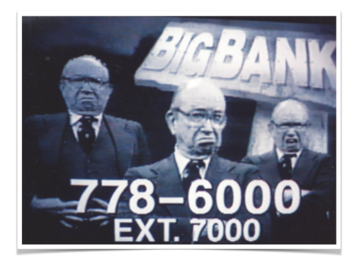
A credit union ad during fight for HR 1151.
It was among many lessons that have changed credit unions, for better and sometimes worse.
Just the Fax
With the White House announcement in early August of 1998 I raced to send a fax—a fax!–to the White House press office requesting credentials to cover the signing ceremony. And several days later, there we all were in the Oval Office, members of the press facing the president and, lined up behind him, the small group of supporters of the Little Credit Unions That Could.
On hand were congressmen, especially Paul Kanjorski and Steven LaTourette, who had helped wrestle and prod HR 1151 through Congress toward what had been a landslide vote (after getting out of a committee by just a single vote and with CUs having had to swallow some sour to go with the sweet, like the MBL cap in the Senate); the Treasury secretary; leaders of the credit union trade groups and the shotgun marriage known as the Credit Union Campaign for Consumer Choice, other CU dignitaries, and members of the NCUA board. Big smiles on every face. Photos taken. Commemorative pens handed around. Congratulations and handshakes and more.
And then Clinton, as was his gift, a bit later during a ceremony in the Rose Garden that was being held for something wholly unrelated to credit unions departed from his remarks to talk about the Credit Union Membership Access Act and what it meant for the country, before going back to his script.
I Guess We’ll Leave Now
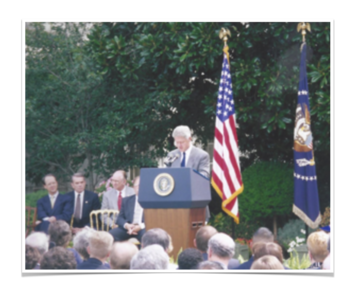
President Clinton in the Rose Garden after signing ceremony.
I listened for a while in the Rose Garden, and then returned to the White House Press Room where I hammed it up in a photo on the podium where the president’s press secretary typically takes questions before walking around the place a bit more. Finally, in another sign of how things have changed and after no one ever asked me why I was there, I and another reporter let ourselves out of the White House.
On Aug. 7 and over the days that followed champagne bottles were uncorked from one Washington to the other, but what few remember is that the joy was matched just as much by relief. There had been very real worries that without an update to the then 64-year-old FCU Act, credit unions would stagnate and die.
American commerce had been constantly evolving, but credit union regs had not. Many of the companies—indeed entire industries—that had once chartered CUs to serve their workers were shrinking and even disappearing and taking their fields with them. Even CUs that had stable memberships, such as government employees or teachers, could only grow so far, and as those workforces aged their credit unions were slowing down with them. It had become more like common bondage for many.
All About One Letter
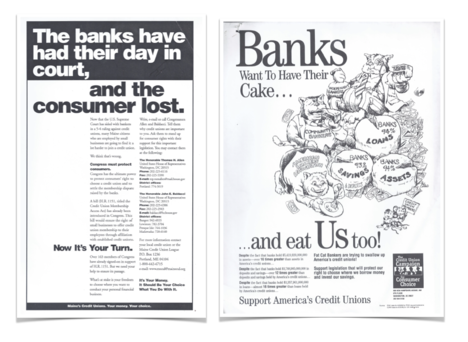
Two ads run by the Consumer Choice campaign.
And that brings us back to that thing about fields that I mentioned above. For all the Herculean effort that had gone into supporting its passage—and fighting it—HR 1151 really came down to the letter “s.”
And that’s 100% due to a lawsuit filed by a little bank in North Carolina–that you can read more about here–that had filed suit arguing what was then AT&T Family FCU had violated the FCU Act by serving, basically, folks outside its telephone industry field. That is fields, not a field. Years later the Supreme Court would agree, and a supreme effort by credit unions was launched.
In Hindsight
We all know the old observation about hindsight, and as people prepared to party like it was 1999 few had any inkling of how the Credit Union World was going to change or how in some ways everyone had enrolled in Be Careful What You Ask For 101. You cannot overstate that the credit union community no doubt owes its survival to HR 1151, but the same can’t be said for many individual credit unions.
More than half of all credit union charters have gone on to that Great Cooperative in the Sky since that day. The usual PowerPoint bullets are thrown up on the screen for the reasons so many have met their demise–regulations, cost of technology, disappearing sponsor companies–but what I don’t think many realize is the missing bullet points around boards of directors and managers who were completely unprepared for the new world to come, when CUs needed to be run like real businesses and that monthly newsletter typed out each month by the CU president just wasn’t going to cut it anymore as "marketing."
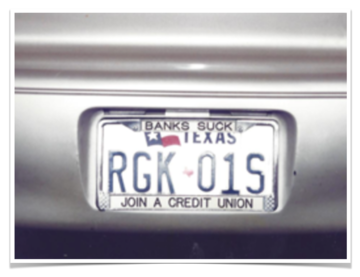
One person uses license plate holder to share view.
While ole’ Charlie and Alice may have been good folks who had retired after long careers at the plant and were now generously volunteering their time at the credit union, they just weren’t ready for the new marketplace of a brand new digital century—including how aggressive some other CUs were about to become.
And that hasn’t changed over the past 25 years, as CUToday.info regularly demonstrates by leading the industry in documenting why credit unions continue to say they need to merge, as we most recently reported here and here.
A Different World
If you’re new to credit unions, welcome. And if you’re semi-new but still weren’t around in 1997 and 1998, you likely have little idea how different the CU world is today. In those days credit unions were smaller and more “clubby,” if you will. You could look at someone’s name tag and immediately see where they were from and who they served, as Location/FOM was the primary “branding” for the first three-quarters of a century for CUs.
Up until the early 1990s, “overlap” was mostly a byproduct of too many trips to the league annual meeting buffet. By the late 1990s, it was something wholly different.
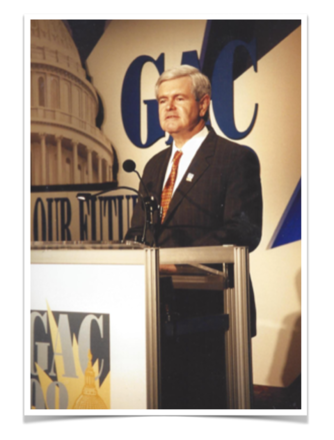
Speaker Newt Gingrich getting ready to bring a CU crowd to its feet.
Speaking of name tags, before you’re even handed one at a CU meeting today someone will start prattling on about advocacy. But today’s advocacy, while heartfelt, doesn’t match the passion seen in 1997 and 1998. As I wrote in this space earlier, “What had happened…was the Supreme Court of the United States knocked some of the arrogance out of credit unions. Credit unions just knew they were the righteous apostles of cooperative finance. Credit unions just knew bankers were the wrongteus ones. And credit unions just knew the Supreme Court would give its blessing to all that when it ruled from on high. And then, credit unions suddenly discovered what they didn’t know.”
But what they didn’t know they made up for with fervor and intensity. If you’ve ever been to a major sporting event where the electricity of the crowd can be felt in the hair on your arms and the home team’s last minute win creates a roar like you’ve never heard, well, then you know what it was like at CUNA’s GAC after the crowd—which had earlier been struck mute as that Supreme Court decision against CUs was announced—shook the DC Richter Scale when Speaker of the House Newt Gingrich announced he was departing from traditional practice and signing on to HR 1151.
Then and Now
It isn’t just credit unions that have changed. In the early 1990s, CUNA was a Madison, Wis. trade group that also had a Washington office. NAFCU was a FCU-only Washington operation focused inside the beltway Up until the mid-1990s, CUNA CEOs were guys who had come up through the “system.” Today, two of the three CUNA CEOs to hold that job since the mid-1990s have been/are former congressmen.
In the series of articles on the 25th anniversary of HR 1151 that will be published in CUToday.info this week, Larry Blanchard, who was the neutral party leader of the Credit Union Campaign for Consumer Choice, observed that CUNA and NAFCU were forced to come together at least temporarily under “one tent” to get the legislation passed. Now, 25 years later, the two trade groups are merging under the same tent, just for different reasons.
A High Point

Credit unions set up tables at a zoo to collect signatures on petition.
Some have occasionally referred to 1997 and 1998 as a low point for credit unions. They’re wrong. I think they were two of the best years in American CU history. There was a great awakening to what a world without CUs would mean, and that included lost livelihoods. CU folks flew and car-pooled and chartered buses and train cars to rally in Washington, with thousands in attendance in homemade T-shirts and hand-drawn poster board signs. They wrote tens of thousands of letters, not by cutting and pasting a form on which they clicked "send," but actual hand-written letters that filled the offices of their Washington reps and got noticed. This was especially true for Arkansas' delegation, as members from across that state pasted two pennies to their letters as they gave their reps their "two cents." How fitting, as credit unions may not have had the dollars in Washington, but they had fervor and fury and zeal. And a lot of pennies.
Tables were set up with petitions to sign in lobbies asking local representatives to get onboard with HR 1151 (credit unions themselves added, “or else!”). One CU collected signatures at a zoo, and more than one “suggested” to members that if the bankers had their way their credit union would likely have no choice but to close up shop and all loans would be due immediately. Yes, that was hyperbole, but, hey…
What Mustn’t Change
In many ways, those really were the two years that changed everything for CUs. But what mustn’t change, what can’t be forgotten, is an understanding of why there was a first credit union chartered in 1909, why the Federal Credit Union Act was enacted in 1934, or why the Credit Union Membership Access Act overcame such huge obstacles to become law in 1998–there has always been and remains a great, fundamental need for the work credit unions do for their members and really, for all Americans.
And if you don’t agree, you’re welcome to stand in your field and send me a fax.
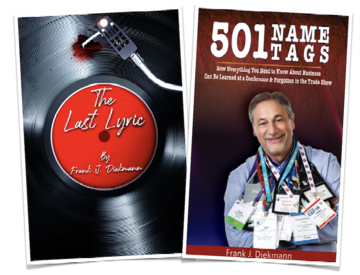
Frank J. Diekmann is Cooperator in Chief of CUToday.info and can be reached at Frank@CUToday.info. Mr. Diekmann is also author of several new book, including the brand new “The Last Lyric,” a humorous satire about a murder investigation at the Rock & Roll Hall of Fame in which every line of dialogue is either a classic pop/rock song title or lyric. Available on Amazon, Apple iBook, Barnes & Noble and Smashwords. Mr. Diekmann is also author of a non-fiction compilation of the very best & worst he has seen and heard in covering more than 500 CU meetings and conferences, “501 Name Tags: How Everything You Need to Know About Business Can Be Learned at a Conference & Forgotten in the Trade Show.” It is available on Amazon, Barnes & Noble, Apple, Lulu, and Smashwords
.