By Frank J. Diekmann

Advocacy. Advocacy. Advocacy. You’ve heard it constantly. I’ve reported it. What’s that old saying, “If I had a dollar…?” In this case, if I had a buck for every time the credit union trade associations use the word “advocacy,” I’d be able to, well, charter a credit union.
And yet, there’s a gaping lack of “advocacy” where credit unions could really use it, especially now.
I’m not talking about the kind of “advocacy” that CUNA and NAFCU have put right up front in the store window of reasons why they need to combine--to be even stronger at advocacy inside Washington.
No, at a time when the collective credit union chin has taken a lead uppercut/cross combo, I’m referring to the real need right now for advocacy on behalf of the 99.9% of the country and credit unions that lie outside the D.C. beltway?
As CUToday.info has (regrettably) been reporting, the white hat has recently has been spending a lot of time getting splashed in mud puddles. Over the last few weeks credit unions have been called everything from predators to addicts to profit-seekers “masquerading” as something entirely different.
A Gut Punch
The latest gut punch came in a piece published on the broadly read Politico.com by Aaron Klein, the Miriam K. Carliner chair and senior fellow in economic studies at the Brookings Institution and a former deputy assistant secretary of the Treasury, who wrote, “There’s a new predator making money off overdraft fees: credit unions.”
As CUToday.info reported here, Klein’s critique was based on the first-ever “Annual Report of Income from Fees on Nonsufficient Funds and Overdraft Charges,” published by California’s Department of Financial Protection and Innovation, thanks to a new state law that requires state-chartered FIs to disclose how much they earn from overdraft and nonsufficient funds fees.
‘Escaping’ Responsibility
After saying many banks have made changes to their OD/NSF policies in recent years (while not stating some of the reasons they’ve done so), Klein said credit unions have “escaped” that debate in large part because of their “reputation for being small, nonprofit, member-owned entities. One would hardly think they would become addicted to charging their most vulnerable members high fees.”
He didn’t mention many credit unions have lowered or eliminated NSF fees, and he further omitted mention that overdrafts come with costs that are borne by everyone in the cooperative.
Klein went on to suggest “many California credit unions are taking millions from their most vulnerable customers and spending it on perks and bonuses for executives that resemble those of big banks more than nonprofits.”
‘Predatory’ Credit Unions
After calling credit unions “predatory,” Klein alleged the money CUs are collecting is going toward things like The Golden 1’s $6 million a year sponsorship of naming rights for the arena that’s home to the NBA’s Sacramento Kings (Golden 1 had $24 million in NSF/OD revenue), and North Island CU’s naming rights deal for a music venue (the credit union had $10 million in NSF/OD income in 2022).
Klein went on to single out a number of other credit unions, as well.
“Do these business practices sound like those of nonprofits designed to provide basic banking services to people who share what the law calls a ‘common bond,’ such as a workplace or other connection required for membership?” asked Klein. “Or are they what would expect from for-profit banks?”
‘Discarded Mission’
Klein’s piece followed by just a few weeks another attack on CUs by the president emeritus of the Tax Foundation, who blasted the credit union tax exemption in an opinion piece in the Wall Street Journal.
In that piece, Scott Hodge posited credit unions have “discarded their mission of serving people of modest means and have become profit-seeking enterprises masquerading as tax-exempt nonprofits.”
Hodge called CU membership rules “almost meaningless,” said CUs deserve the “same scrutiny lawmakers have recently targeted at nonprofit hospitals and professional sports leagues,” and added, “Credit unions have also undermined their nonprofit image by buying commercial banks. Such deals are legal but seem at odds with the mission to seek not profits but the underserved.”
In case the reader was unsure where he stood, Hodge concluded by arguing credit unions have “discarded their mission of serving people of modest means and have become profit-seeking enterprises masquerading as tax-exempt nonprofits.”
Which Headline Will it Be?
One of those last points raised by Hodge, the acquisition of banks by credit unions, has the potential to be a real Good News/Bad News headline for credit unions moving forward.
Will it be Extra! Extra! Read All About how the bank buys benefit customers of the acquired bank (higher deposit rates, lower loan rates, lower fees) and the members of the CU (more branches, greater efficiencies that lead to similar pricing advantages), and here, world, are the numbers to prove it?
Or, will the headlines be Extra! Extra! Read All About how the amount of members’ money spent to buy the bank is being kept secret from the owners, and no one can point to any quantitative numbers around how customers/members have benefitted?
As I wrote here in a piece that saw a lot of readership not just in credit unions but in the banking industry, judging from those who reposted it, credit unions should darn well hope (actually, make sure!) it’s the former, and NCUA should prohibit the latter with a new rule against the sentence “Terms of the deal were not released.”
What does all of the above have in common? Real advocacy is missing. Not the kind of Capitol Hill/state capitol lobbying and PAC donations that, unsavory as that whole business has become, is, as they say, the cost of doing business in a world that has credit unions holding a number along with everyone else in the line of special interest groups lining the corridors.
Incense is Nice, But…
Instead, it feels like every day there is more of a yawning need for advocacy for “credit unionism” itself. Yes, yes, believe me, as someone who’s been to more credit union meetings than any moderately qualified doctor would consider healthy, I’ve heard all the kumbaya chanting and smelled the co-op incense burning as association leaders who know all the buzzword buttons go on about “greater purpose” and “well-being” and “inclusion” and “inspiration,” yada, mcyada.
But who is really responding to the kinds of accusations and claims and, in some cases, legitimate points raised by folks like Mr. Klein and Mr. Hodge, above? Who is leading this lets-all-squirm-a-bit-uncomfortable discussion inside credit unions? Who has the courage to hold up the mirror and ask everyone if they like what they see and what some people are saying about them?
You’re making a big mistake if you believe they’re both “wrong” and as a result don’t deserve a response--all that creates is a situation in which those who’ve become convinced they’re right get to “control the narrative,” as we so often hear.
Here’s Who Won’t be Leading
Sorry to say it, but don’t look for the trade associations to take the lead on this kind of core, desperately lacking “advocacy.” It’s much easier to point everyone toward a common enemy, such as bankers groups or the CFPB, than it is to be the one holding that mirror and asking, “Are these criticisms an accurate reflection, and what should we do?” (And not just easier, but much safer for the job prospects of the trade group execs who know who pays the dues.)
That these kinds of critiques and opinions of credit unions have recently been hung out like Roy Bergengren’s dirty laundry for all to see in national publications deserves your attention. Right or wrong, it feels like there is this growing perception credit unions aren’t any different than some of these other nonprofits critics say have wandered away from their missions and are now just “masquerading” as something else.
Some Good News
The good news is this is a movements that moves on numbers, and the credit union trade groups have been compiling them. The other good news is credit unions have become quite fond of talking about their “story” and “story telling.” Here’s a wonderful opportunity for both sides of the credit union brain to come together and be real advocates.
What advocacy is truly about has never been about the House or members of Congress, it’s always a been about the members of credit unions and the lives they lead in their own houses. So, ask yourself the tough questions, change policies if you’re not getting the answers needed, and then go advocate for those members and tell their stories—because those stories are clearly not being heard.
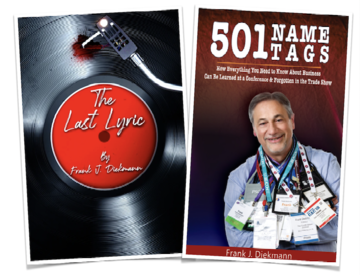
Frank J. Diekmann is Cooperator in Chief of CUToday.info and can be reached at Frank@CUToday.info. Mr. Diekmann is also author of several new book, including the brand new “The Last Lyric,” a humorous satire about a murder investigation at the Rock & Roll Hall of Fame in which every line of dialogue is either a classic pop/rock song title or lyric. Available on Amazon, Apple iBook, Barnes & Noble and Smashwords. Mr. Diekmann is also author of a non-fiction compilation of the very best & worst he has seen and heard in covering more than 500 CU meetings and conferences, “501 Name Tags: How Everything You Need to Know About Business Can Be Learned at a Conference & Forgotten in the Trade Show.” It is available on Amazon, Barnes & Noble, Apple, Lulu, and Smashwords