

By Paul Thompson
Community development financial institutions (CDFIs) have discovered that when it comes to fighting poverty there are no easy answers. Success lies in small victories -- finding what works in specific situations.
For example, back in the days of the "war on poverty" of the Johnson Administration, credit unions working in the U.S. and abroad in developing nations found that it was not wise to act as conduits for government aid. Too often, the aid was wasted in bad loans or dried up after a while. Credit unions had to learn to rely on the savings of their members, not on government subsidies.
Finding out what works takes time, effort, and experiment. That's the contention of two MIT economists who have pioneered what might be called "experimental development economics."
In the words of Bill Gates: "Their life's work is traveling to poor countries looking closely at what works and what doesn't work in efforts to fight hunger and disease, improve education, and broaden access to basic financial services."
Abhijit Vinayak Banerjee and Esther Duflo are founders of J-Pal, an organization of academics around the world that conducts randomized evaluations of anti-poverty efforts. The acronym stands for the Jameel Poverty Action Lab. J-Pal's work is providing valuable insights that can boost the effectiveness of programs. Banerjee and Duflo, together with J-Pal, won the 2014/15 Albert O. Hirshman Prize of the Social Science Research Council.
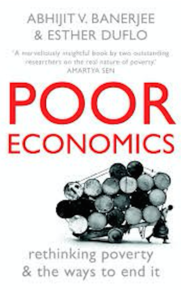
Banerjee and Duflo tell the story of their research in their 2011 book Poor Economics: A Radical Rethinking of the Way to Fight Global Poverty. The title refers both to the economics of poverty and what they consider to be the poor economics on which many anti-poverty programs are based. The book looks at a wide variety of anti-poverty programs, ranging from efforts to fight hunger and disease to microfinance. While focusing on international development, the book contains many lessons for domestic programs.
Community development financial institutions will find the chapters on savings. lending, and entrepreneurship (Chapters 7-9) especially interesting. The authors find that microfinance works but is limited in its impact. The rigid rules needed to ensure financial soundness discourage many people from using this resource and restrict the size of businesses they can start.
In recent years, J-Pal has expanded its research to include the U.S. For example, one project found that explaining the true cost of payday loans to borrowers reduced their reliance on such lenders. To learn more about J-PAL and its projects, you can visit its website: www.povertyactionlab.org. To learn more about the book Poor Economics, visit www.pooreconomics.com.
One strength of CDFIs, including credit unions, is that they freely exchange information about what works and what doesn't. The U.S. credit union movement in addition has its own research arm, the Filene Research Institute, which has commissioned many interesting and important research projects. More information about the Institute and its work can be found at https://filene.org.
Paul Thompson, CUDE, is the author of Development of the Modern U.S. Credit Union Movement: 1970-2010 and What You Need to Know About Today's Credit Union, available from lulu.com.