By Frank J. Diekmann

Do you still have your luggage? Or at least most of it? Waking up in the middle of the night uncertain which hotel or city you’re in (and unsure if it really matters)? Do you now favor capital punishment for those guilty of one of the rudest travel practices in history, the reclining of one’s airline seat?
Then welcome to part II of this travelogue of recent credit union meetings and events, including observations and lessons you might have missed.
Today we’re going to unpack some of what was heard and seen at Co-op Solutions’ recent THINK meeting in Tucson. If you missed your ride to the airport, you can find part I here.
That-Not-So-Fresh Perspective
There are benefits, of course, from being a credit union veteran. You’ve been there, done that. The problem? You’ve been there, done that, according to Stephen Wunker, author of the book “Cost-o-vation” and founder of New Market Advisors, which consults with a number of well-known brands.
Wunker gave THINKers something to think about when he observed, “I imagine many of you have been in your credit unions or financial services for a long time. That’s great and useful in many ways. But it’s not always helpful in taking a fresh perspective. It’s not great for answering what do members really want. It’s not great for a fresh perspective on what matters to them.”
Later, as CUToday.info reported here, Wunker observed that a lot of organizations innovate around the way they are organized, function by function by function.
“The customer doesn’t particularly care how you are organized,” he said. “You need to blur boundaries in ways that other companies won’t do because that is inconvenient for the way they are organized.”

Finally, Wunker also shared this photo of the inside of a Capitec Bank branch in South Africa (at right), where there are no teller stations, but instead benches where the bank rep and the customer sit on the same side of the computer to review accounts and options. And if you’re wondering about security issues, the branches are cashless.
There is a New PFI in Town
It’s one simple word, two syllables: payments. Who would know there could be a Library of Congress’ worth of information, research, data and opinions behind that word? And that it adds new volumes every day? And yet that estimate seems almost conservative after the recent meetings hosted by PSCU and Co-op Solutions, respectively.
The word “payments,” of course, is now intricately interwoven in the lives of everyone but those so far off the grid the Amish can’t see them, and in the wake we all leave long and detailed data trails.
Just how much there is to know about payments and why it can be a foundation for credit union growth was evident at that Co-op meeting, where the company unveiled the latest research it has conducted along with EY and Mastercard and which involves surveys of more than 3,000 consumers (2,000 of whom are CU members).
Frankly, that research has produced so much information Plastic Man couldn’t wrap his arms around it. But some of the highlights of that research, as shared by Co-op’s chief experience officer, Samantha Paxson, includes:
- “Fintechs made it happen. Are now our primary competitors in tech are in the market,” said Paxson. She noted the research continues to confirm that payments are the best opportunity for any credit union to grow wallet share among members, while helping members at the same time.
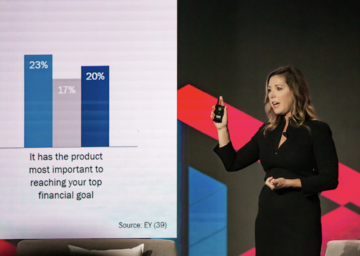
Samantha Paxson at THINK.
- Consumers expect a dynamic, needs-based ecosystem of solutions anchored by life goals and financial health priorities,” said Paxson. “This is truly the Amazon application of financial services…They want to be delivered financial solutions based what I'm trying to do in my financial life, my short-term goals and my long-term goals.”
- Paxson said the research makes clear the old definition of being a primary financial institution, the much discussed and sought-after “PFI,” has been replaced by a new PFI. “Where we are today is we are looking to win the primary financial interaction. We are competing for members’ attention and their loyalty on a daily, moment by moment by moment basis,” Paxson said. “It isn't just day by day, it's hour by hour. Which card are they going to use? Which app are they going to open? How are they going to pay? How are they going to check where they are in their financial life? You're trying to win that next-best-action interaction and this is our opportunity do so.”
- Paxson said the research found 45% of respondents indicated engagement is their top reason for relationship primacy, and yet credit unions are not considered for highly interactive products.
- Paxson said credit union primacy is “really based on character and critical products. They believe in you. They trust you. Banks and fintechs earn this spot based on interactive convenience. However, respondents who consider a credit union as their primary financial relationship have three times the relationships of other respondents. This is interesting. They don’t quite believe they can get everything they need to get done at their credit union. This is the paradigm we need to understand. Ninety-one percent of members have a deposit account with a credit union; 84% of members have a deposit account with a bank.”
You can read a lot more about all of that here.
The New Definition of Service
The Co-op Meeting was themed the “Invisible Revolution.” What does that mean?
“I’ve worked in credit unions for 18 years and I say while we have the best service, what we're finding (in surveys of Americans) is that service as (credit unions) defined it in their original operating model--the in-person service model--is terrific,” Paxson explained. “But what we're talking about is embedded finance, banking as a service. This is the invisible revolution. They're expecting us to know how to personalize services for them, to understand who they are. We should be able to deliver them solutions based on their financial journey. What we're passionate about at Co-op is helping you to get that interaction in that engagement.”

A Branding First for Credit Unions
At right is what I believe is a branding first in credit unions. Mt. Co-op, in Tucson.
No Easy Prescription
In a signal of just how challenging it is to resolve issues around improving health care in the U.S., Amazon actually gave up its ambitious efforts to do so. If you want to know why even a “magic glove” wasn’t enough to fix what ails health care, as well as where there are lessons for credit unions in what was learned, go read what Jennifer Becker had to say about it here.
Give a Crap and Close the App
A few weeks back I had the (great) opportunity to take a couple of young children to a playground, something I haven’t had the good fortune to do in some time (and no, a restraining order did not expire). While we’ve all witnessed (been a part of) this almost-default behavior in every other aspect of our lives, I’ll admit to being pretty stunned by the number of parents lost in their devices while their kids were left to their own devices, if you know what I mean.

Frances Haugen at THINK.
This was sad to see for a pair of good reasons: 1) These moments pass so much more quickly than you realize and the universe doesn’t give them back, and 2) Um, this is dangerous. I watched as one toddler climbed a ladder to a treehouse a good 12 feet off the ground with his nearby mother/guardian absorbed by that screen in her face, oblivious to it all. Another parent had to climb up and bring the child down.
And yet as one of the most sobering presentations to credit unions I’ve heard in some time made so clear, it was actually the devices in those parents’ hands and the hands of teens and even children that are even more dangerous than unaccompanied kids on playgrounds.
As CUToday.info reported here, Frances Haugin became alarmed while working at Facebook to discover the company’s public statements that its platform wasn’t harmful were completely undermined by its own research that showed what critics and psychologists and others were warning about the dangers of Facebook were, if anything, not strong enough.
In 2021, Haugin provided the Wall Street Journal and Congress with tens of thousands of internal documents from Facebook showing Facebook knew its algorithms can do to its users, including driving them to political extremism, self-harm, suicide, sexual trafficking, bullying and more.
The piece is worth a read, even if you’re doing it on a device.
Shoulda Bet on the Blue Duck
Co-op and Children’s Miracle Network put the hotel pool at the J.W. Marriott Starpass in Tucson to some good (and unusual) use.
In what I believe was a first for not just CMN but for pools in the middle of the desert, representatives from CMN sold rubber ducks as a fundraiser during the THINK meeting, and then held a race in the hotel’s lazy river for those ducks, beginning with a launch from the water slide.
For those of you betting at home, “Blue Duck” won (as did the kids, of course).

Frank J. Diekmann is Cooperator in Chief of CUToday.info and can be reached at Frank@CUToday.info. Mr. Diekmann is also author of several new book, including the brand new “The Last Lyric,” a humorous satire about a murder investigation at the Rock & Roll Hall of Fame in which every line of dialogue is either a classic pop/rock song title or lyric. Available on Amazon, Apple iBook, Barnes & Noble and Smashwords. Mr. Diekmann is also author of a non-fiction compilation of the very best & worst he has seen and heard in covering more than 500 CU meetings and conferences, “501 Name Tags: How Everything You Need to Know About Business Can Be Learned at a Conference & Forgotten in the Trade Show.” It is available on Amazon, Barnes & Noble, Apple, Lulu, and Smashwords