By Glenn Christensen
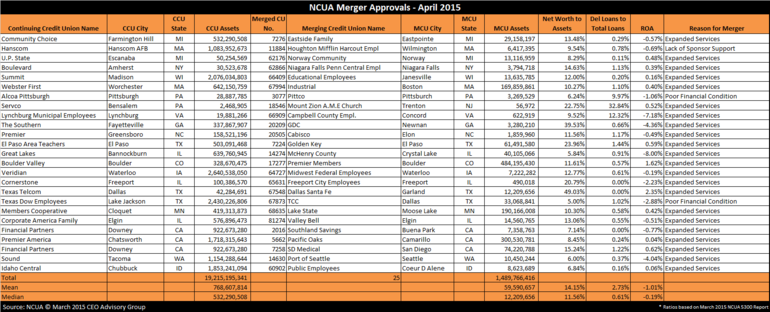
For the third month in a row the number of mergers is down compared to last year. The NCUA approved 25 mergers in April 2015, which is down from the 32 mergers in April of 2014.

Glenn Christensen
While the number of mergers was smaller, the combined assets was larger. Total assets of the merged credit unions is nearly $1.5 billion, nearly triple the amount from last year ($593 million). The mean and median assets of merged credit unions are $59.6 million and $12.2 million, respectively. In contrast, last month the mean assets were $18 million.
Driving those numbers were Driving those numbers were four mergers with credit unions exceeding $100 million in assets.
The largest merger was the $484-million Premier Members Credit Union’s merger into the smaller, $329-million Boulder Valley CU. Both of the credit unions showed strong financials, with Boulder Valley CU to be the surviving charter and Premier Members to be the surviving name. Premier Valley said on its website that “The credit union world is becoming increasingly competitive and consolidated. This is a proactive step by two financially sound institutions to capitalize on their strengths, and position the new organization to move into the future.”
The credit unions created a video celebrating the history of both organizations.
In Camarillo, Calif., the $300-million Pacific Oaks CU merged into the $1.7-billion Premier America Credit Union in Chatsworth, Calif. The reason for the merger, according the Pacific Oaks’ website: “Very simply, we want to bring members more value from their credit union. Unlike bank mergers that are designed to make money for stockholders, this exciting partnership is solely to benefit you. It would take us decades to grow to the point where we could offer members the branches, products, services, technologies and great rates this partnership will immediately bring”.
The $190-million Lake State Credit Union in Moose Lake, Minn. was approved to merge into Cloquet, Minn.-based Members Cooperative Credit Union, which has $419M million. Lake State was profitable, 0.4% ROA, and well capitalized with a net worth to asset ratio of 10.3%. According to Tim Smith, president/CEO of Lake State CU, “joining with MCCU will allow us to serve our members better, which is the cornerstone of the cooperative mission.”
Boston-based Industrial Credit Union, with $170-million in assets, is merging into Worchester-based Webster First Credit Union, which has $642 million. Industrial CU was also profitable, 0.4% ROA, and well-capitalized at 10.3%.
“I’m proud of the success ICU has achieved during the 40+ years that I have been here and I want to protect its future,” said ICU President/CEO Roy Campana in a press release. “I felt the best benefit to the members, staff and community would come with a merger. Bringing Webster First Federal Credit Union to Boston is an absolute win-win for all. They are technologically on point, financially strong, and intellectually and professionally sophisticated.”
Credit Union Merger Stats
The median size of acquiring credit unions during April was $532 million. There were seven credit union acquirers with assets exceeding $1 billion. With $2.6 billion in assets Veridian Credit Union, based in Waterloo, Iowa, was the largest acquiring credit union in April, merging $7-million Midwest Federal Employees Credit Union. Lake Jackson, Texas-based Texas Dow Employees Credit Union, which is merging the Dallas-based, $33-million TCC Credit Union with $33 million in assets, was the second largest acquirer with $2.4 billion in assets.
The acquired credit unions on average represented only 8% of the assets of the acquiring credit unions. There was one merger of equals, that between Boulder Valley Credit Union and Premier Members Credit Union.
Three credit unions with less than $1 million in assets were acquired. The smallest credit union was Mount Zion A.M.E. Church CU, based in Trenton, N.J., with $56,000 in assets, which is being acquired by $2.5 million Servco CU.
Reasons for Credit Union Mergers
“Expanded services” continues to be the primary factor listed as the reason for mergers. “Poor financial condition” was cited by two of the credit unions, while “Lack of sponsor support” was also cited as a reason for the merger.
Financial Performance of Acquired Credit Unions
The median net worth ratio of the merging credit unions was 11.6%. Five credit unions had net worth ratios below 7.0%.
The delinquent loans-to-total loans ratio averages 2.7%, which is primarily attributed to two credit unions with delinquency ratios exceeding 10% of loans, including the 33% delinquency ratio reported by Mount Zion A.M.E. Church CU.
Half of the credit unions reported positive earnings year to date. Despite this number of credit unions reporting positive earnings the mean return-on-assets (ROA) is -1.0% through March of this year.
Below is a chart of the NCUA merger approvals for April 2015:
Glenn Christensen is with CEO Advisory Group. For more info: www.ceoadvisory.com.