

By Frank J. Diekmann
ALEXANDRIA, Va.–All of the hubbub and breathless warnings leading up to the NCUA vote on the revised risk-based capital proposal last week, which was just short of that you’d see at a Joe-Biden-Will-He-Run-Or-Not? press conference, had Vice Chairman Rick Metsger paraphrasing another politician: Winston Churchill. “Never have so many commented on a rule that affects so few,” he said just prior to casting his vote in favor of the RBC plan.

At several points in his comments Metsger expressed consternation at all the noise, comment letters, and even the misinformation in the more than a year of debate that preceded the board vote and in the five years of discussion at NCUA around risk-based capital metrics.
He has a point—as it currently stands the RBC rule affects 16 credit unions—and they have three years to get in compliance.
Like Dennis Dollar used to do between Norm D’Amours and Yolanda Wheat (pause while I wipe away a nostalgic tear), Metsger has been forced into a middle ground in the he said/she said tension between NCUA Chairman Debbie Matz and Board Member Mark McWatters (the latter has been very effective in his “why do we do it this way?” rhetoric). Metsger has often used the podium (when he gets it) to offer a different view on issues that are up close and personal to CUs (even if he does always vote with Matz). That included at last week’s meeting, when the vice chair observed the irony that the risk-based capital bill is the subject of a so-called “Stop and Study” bill in Congress, when there has probably never been an NCUA proposal that has been stopped and studied more often than RBC 2.0.
“We have stopped-and-studied so many times I’m beginning to get whiplash,” joked Metsger. “I’ve lost track of how many times we have stopped and studied during this five-year period. Either those in the industry who continue to ask us to ‘stop and study’ haven’t read our preambles and rules, or they really want us to stop and bury.”
Some other bigger picture observations, courtesy of Metsger:
- Many people urged NCUA to simply adopt FDIC’s RBC rules, including the definition of “small.” If NCUA had heeded that advice, there would be no exemption for CUs below $100-million in assets.
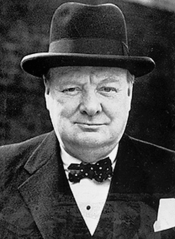
Winston Churchill, statesman, prescient observer of credit union behavior.
- Metsger said he didn’t understand why credit unions would turn their backs on a plan that provides a clear “advantage” over banks. It is the higher capital levels at credit unions, for instance, that have protected many from the losses that led to the downfall of numerous banks, he said. “Credit unions should be champions of capital, not detractors? Why would credit unions want to give up this advantage?” he asked.
- With critics asking if the new rules are too tough, Metsger said it’s probably the opposite. “Is the rule too tough? I’m not sure the rule is strong enough,” said Metsger, before citing some of the requirements the revised rule does not include, such as an interest rate risk component, authority for examiners to set standards, a reduced number of risk weights, and a lengthy grandfathering of goodwill through 2025.
- Metsger, who voted in favor of the proposal, said he is particularly concerned with changes that have been made to risk weights and concentration risk. Although he didn’t cite it by name, Metsger made reference to Montauk Credit Union, the CU that specialized in taxi medallion loans and which was recently placed into conservatorship, as a good example of the risk from “putting all your eggs in one basket.”
Metsger noted that the CEO and treasurer of the credit union had sent a comment letter to the agency prior to the conservatorship saying that there was no risk, that all was safe and sound, that the credit union had never suffered a loss, and that it deserved to be exempted from any proposed RBC rule. “That was 16 months ago, and today NCUA is acting as that credit union’s supervisor,” Metsger said.
You can find Metsger’s entire statement to the NCUA board, as well as those of Matz and McWatters, here.
Getting The Love & Getting A Response
- Credit unions that wonder why they don’t get more love in Washington ought to pause sometime and look around at all the other industries placing personal ads seeking some love of their own. Example: During NAFCU’s Congressional Caucus in Washington there were three other events going on in the hotel at the same time, and you can bet every one of them was hiking their own Hills and demanding relief/favors/you name it. And that was during just the three days NAFCU was in town. Imagine you’re a congressman and you’re getting that kind of barrage every day. It’s a testament to credit unions’ dollars and message that they are able to get the caliber of congressman that they do at meetings such as Caucus and GAC.
- Riding in a taxi while in DC I swiped my debit card for payment and instead of giving the driver a 20% tip, I somehow managed to give him two cents. If you ever want to see your up-to-that-point disengaged taxi driver suddenly morph into Mr. Personality, give that strategy a try
- We’ve all seen utterly forgettable television commercials apparently created by committees, and credit unions can be as guilty as any advertiser. It often seems each member of the board and management, plus their spouses, ave had some input into 30-second ads with what feel like 50 different messages. (If one of your marketing messages, btw, is “quality service” or “trust,” you are seriously wasting dollars in a world of micro-attention spans and remotes). That’s why ORNL FCU deserves so much credit for a very simple, and very effective creative approach to mortgages. You can find the spot in CUToday.info’s “The Vids” here under the headline, “ORNL ‘Leaves’ Mortgage Problems Behind.”
- During the recent CUNA OpSS/Tech Council meeting in Orlando, one speaker was asking for a show of hands from audience members related to familiarity with a host of different tech/digital solutions. Then he asked, “How many of you have heard of Google Stuff?” There were a few tentative hands raised, but no one went to full arm-up mode, which was good, because he then added, “Well, there’s no such thing, but Google keeps coming up with stuff.” When it comes to marketing by the way, and in the spirit of the ORNL TV spot referenced above, he added, “Instead of saying ‘My credit union is awesome,’ talk about who you do stuff for.”
Frank J. Diekmann is Cooperator in Chief at CUToday.info and can be reached at Frank@CUToday.info or @FrankCUToday