

By Michael G. Hales

It’s been 46 years since the actor Peter Finch, playing the crazed news anchor Howard Beale in the 1976 film Network announced, “I’m mad as hell and I’m not going to take this anymore!”
What was 1976 like? A Big Mac cost 75 cents. The average price for a gallon of gas was 59 cents. The U.S. average family income was $16,000 and a new house could be purchased for around $43.000, or about 2.6 times annual income.
What has changed? Some call it “economic growth.” Others call it a recession. Some blame the pandemic, others blame the Russians. One thing is certain: Inflation is at a 42-year high and CU members are suffering. The price of a Big Mac is now $5.94. Average U.S. household income is now $63,214, and the average home price in the U.S. is nearly $500,000, or roughly eight times annual income. Nothing has changed for the better. In fact, things are getting worse and American consumers, including your members, are as mad as hell.
The Lull Before the Storm
What does this mean for credit unions? Potential credit losses have been masked by the effects of the pandemic which simply delayed the inevitable by a couple of years. Industry wide, total reported loan charge offs for the year 2021 were $1.75 billion lower than 2020 and $2.56 billion lower than 2019.
As illustrated below, year to date loan losses as of the second quarter of 2022 were $2.26 billion lower than the prior year. Second quarter 2022 reportable delinquency was $4.82 billion lower than the same period last year3. Does this mean that the industry has miraculously solved all of its credit problems? Just the opposite.
We are headed into a perfect storm of pandemic-related delayed delinquency and loss resolution fueled by record inflation and a looming recession.
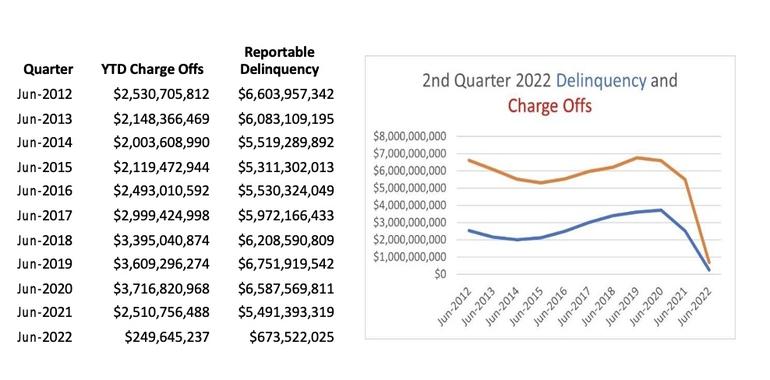
In addition, the current economic instability is playing havoc with automobile, mortgage, and credit card lending. It is time to face reality.
What You Can Do
Here’s what has happened and what you can do about it.
Automobile Lending
“It’s hard to read automotive news without hearing stories on rising car prices and gouging car dealers. That’s one side of the story, and while it’s important, there’s a whole other thing happening on the financial side of the market that has experts worried. Vehicle repossessions are on the rise, Barron's reports, meaning many people who bought cars in the past two years are running out of ways to pay for them.
According to Kelley Blue Book, the average price of a new vehicle rose 13.5% year over year to $47,148 in May. Combined with record-high monthly payments, it’s easy to start piecing together the story. Edmunds data showed that a whopping 12.7% of new car buyers are on the hook for payments of $1,000 or more per month.
Prices are part of the problem, but as Barron’s points out, many buyers are defaulting on loans purchased those vehicles in 2020 or 2021, when they received stimulus money or temporary bumps in pay due to the pandemic. As those benefits recede, some are left holding the bag with a monthly auto loan payment that eats up a significant portion of their monthly incomes.
Just take a look at these current repo statistics:
- 2.2 million vehicles are repossessed every year (2022 updated data)
- 5,418 repossessions every day
- 226 car repossessions each hour
- 3.76 repossessions a minute
With yearly repossession rates at 65% compared to yearly new car sales, this means that for every 2.4 cars sold, one existing vehicle on the road will be repossessed each year.5
Mortgage Lending
The number of foreclosure starts — which is when the first public foreclosure notice happens — is up 219% since the start of the year, according to real estate data analytics firm ATTOM Data Solutions’ midyear 2022 US
Foreclosure Market Report
What’s more, the number of properties that had foreclosure filings (this number includes foreclosure starts) is up 153% from the same time period last year.
What’s more, 96% of major metro areas saw an annual increase in foreclosure filings, with foreclosure rates highest in Illinois, New Jersey, and Ohio. And when it comes to the number of foreclosure starts, California topped the list, followed by Florida, Tennessee, Illinois and Ohio.
“It’s important to note that many of the foreclosure starts we’re seeing today — in fact, much of the overall foreclosure activity we’re seeing right now is on loans that were either already in foreclosure or were more than 120 days delinquent prior to the pandemic,” says Rick Sharga, executive vice president of market intelligence at ATTOM.
Indeed, many of these loans were protected by the foreclosure moratorium put in place by the government during the pandemic — therefore just halting the inevitable by a couple of years. Kicking the can down the road only creates a bigger can.
Student Loan Debt

The latest student loan debt statistics for 2022 show that there are 45 million borrowers who collectively owe approximately $1.7 trillion in student loan debt. Student loan debt is now the second-highest consumer debt category – second only to mortgage debt and higher than debt for both credit cards and auto loans.
The resumptions of student loan payments following a payment pause of more than two years about that began during the early days of the pandemic, will end on August 31, 2022. Unless U.S. lawmakers step in to extend the pause yet again, payments will resume a day later.
The student loan debt burden is not a problem just for new college grads. The majority of student loan debt is owed by adults ages 35 and over whose aggregate outstanding balances have increased by over $12 billion since the beginning of FY 2022.
Household Debt and Credit
Aggregate household debt balances increased by $312 trillion in the second quarter of 2022, a 2.0% rise from 2022Q1. Balances now stand at $16.1 trillion, and have increased by $2 trillion since the end of 2019, just before the pandemic recession.
Credit card balances saw a $46 billion increase since the first quarter – although seasonal patterns typically include an increase in the second quarter, the 13% year-over-year increased market the largest in more than 20 years. Auto loan balances increased by $33 billion in the second quarter, continuing the upward trajectory that has been in place since 2011. Other balances, which include retail cards and other consumer loans, increased by a robust $25 billion.
In total, non-housing balances brew by $103 billion, a 2.4% increase from the previous quarter, the largest increase seen since 2016.
Dam is About to Break
Credit union lenders who are caught between a rock and a hard place of serving their members while meeting compliance standards are facing economic uncertainty. Credit moratoriums have expired, the dam is about to break on consumer delinquency, losses are looming on the horizon and the time to act is now.
More than ever before, it is time to be proactive and deploy a strategy to solve your mutual problem by teaming to team-up with your delinquent and charged off members.
It is essential to proactively identify the vulnerable. It is worth repeating that collections departments are now tasked with dealing with thousands of consumers who are not in arrears to do the usual reasons and without the usual market data to help identify and segment them. These consumers have been furloughed with a rapid, surprising, and significant reduction in income and these dramatic changes in circumstance have yet to be detected by credit bureaus.
As an industry we have always been proactive about predelinquency. But now we need to dig deep across our organizations to capture data and find the vital information needed to clearly separate the economic victims from the steady state of collections consumers.
Are your borrowers “loading up?” Are they borrowing from Peter to pay Paul? Are late charges accumulating? Has there been a recent job change? Have they relocated? Divorced? Is there a medical issue? Are there changes in payment habits to other lenders?
Before you reach out to a pre-delinquent, delinquent, or charge-off member, learn everything possible about their current circumstances and consider options that will help your member satisfy their obligation to the credit union.
Early Intervention

Borrowers with no history in delinquencies will start entering collections buckets due to COVID-19. It will be essential to identify these customers from perennial defaulters and treat them separately. Traditional risk models have been built on historical data to predict a borrower’s propensity to pay. Given that COVID-19 is an unprecedented event, historical data in financial institutions will not reflect the current crisis or anything similar to what the model can learn from.
Credit unions will need to identify customers who are at risk and in need of assistance. In the wake of the current crisis, CUs need to be extremely proactive and empathetic to their customers. Members will need to be respected and receive personalized treatment.
Data analytics and advanced intelligence can help collection organizations make more informed decisions.
Approach your member-borrower with options to help create a mutual plan for resolution. Remind the member that your primary goal is to help them preserve their relationship with the credit union. Establish a positive rapport by determining a mutually acceptable communication method and schedule.
Require Third Party Performance Accountability
If it ain’t broke, don’t fix it. However, credit unions should recall accounts from agencies that have made no contact with borrowers within the last six months. Consider additional member-centric third party recovery sources. Accounts that have not been contacted within the last six months probably won’t be contacted during the next six.
Treat Collections as a Credit Function
Loss recovery is the tail end of the lending process and collection is a lending decision. Collection managers are required to quickly come up with qualification criteria for these at-risk customers and treat them differently through intuitive payment plans and restructuring. Charged off debt can be refinanced with flexible repayment terms that benefit both the CU and the member, but remember the new CECL rules.
In lieu of the TDR accounting model, creditors now will apply the general loan modification guidance in Subtopic 310-20 to all loan modifications, including modifications made for borrowers experiencing financial difficulty. Under the general loan modification guidance, a modification is treated as a new loan only if the following two conditions are met:
Let’s take off the rose-colored glasses and face the facts: the negative financial effects of the pandemic are still with us, cash-strapped consumers are increasing their debt, the economy is not under control and consumer confidence is at a 18-month low. Many Americans have to choose between filling the tank and feeding the family.
Mad as Hell
Bad things, such as pandemics, inflation, recession, and other external forces, happen to good people. Many of your members are frustrated and embarrassed. They are as mad as hell with their current situation and they are searching for a solution. They need your help.
The key is to remember that collection and recovery efforts are credit decisions. It doesn’t matter if a loan, mortgage, or credit card balance is formally restructured or placed on an informal repayment plan, the REVEST goal is to RESTORE member dignity and self-esteem, REINSTATE member privileges and RECOVER capital.
By eliminating the embarrassment of delinquency or charge off and restoring the member’s sense of dignity and helping reinstate creditworthiness, the recovery of past due payments or charged off balances becomes a common TEAM goal of the credit union and the member. This is, in its most perfect sense, people helping people.
Michael G. Hales is executive vice president with CU Revest.