

By Mike Brown

The burden that student loan debt places on so many Americans, especially those from younger generations, is no secret.
Recent borrowers owe $28,565 in student loan debt, nearly doublethe credit card debt that is held by the average American household. And keep in mind that student loan debt figure is owed by a single person, while the credit card number is owed by an entire household.
The reality is that many of our nation’s young consumers will still be saddled with student loan debt long after they walk away from college campuses. For most, that debt from higher education will be commanding monthly payments for a decade at a minimum.
It’s no wonder the stories of Millennials not buying enough houses, starting enough families, or investing enough in the stock market are so abundant. How can that generation, and other recent college graduates, accomplish any of those things in their twenties when each month they need to set aside hundreds of dollars for student loan debt payments?
The task becomes doubly hard when you factor in other recurring payments, like those made for rent, credit card debt, or groceries.
So, exactly how much are Americans putting towards their student loan debt each month?
LendEDU, with the help of personal finance management company Truebill, answered that in a recent report that found the average student loan debt payment by state.
The Range from State to State
LendEDU’s report was based on an aggregated analysis of anonymized data from Truebill users that featured nearly 150,000 student loan payments. Nationwide, the average monthly student loan payment was found to be $210.73.
Seventeen states had a figure that was higher than the national average, while the respective numbers for 33 states fell below the U.S. average.
When it came to specific state-by-state student loan payments, Massachusetts had the highest average monthly student loan payment, $229.02. New Jersey immediately preceded Massachusetts with an average monthly payment of $225.56.
States that rounded out the top five for highest monthly payments included Connecticut ($225.26), New York ($223.10), and California ($221.17).
On the other end of the spectrum, Wyoming’s figure of $176.46 was the lowest average student loan payment in the country. States that filled out the bottom five included Idaho ($176.98), Nevada ($190.57), South Dakota ($191.74), and Louisiana ($192.62).
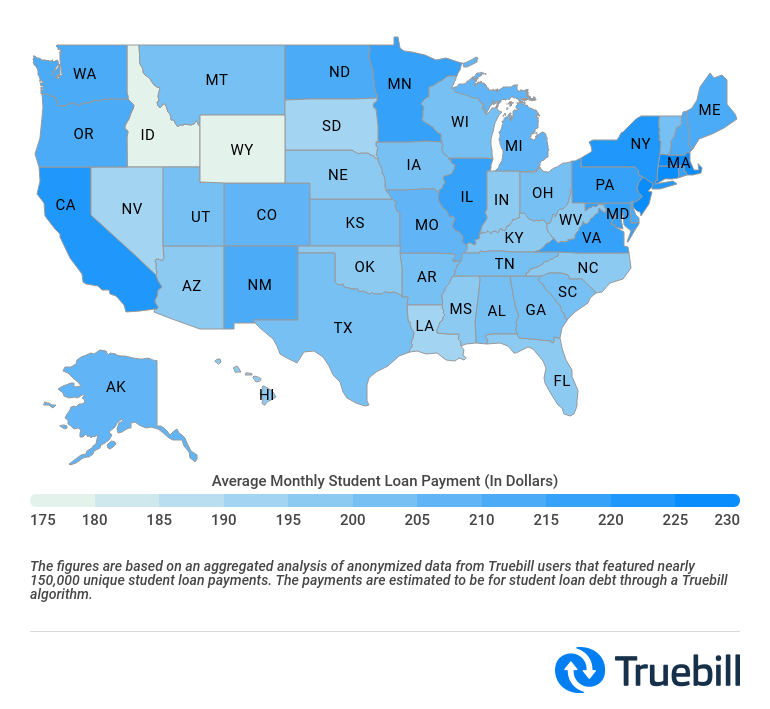
Some regional trends that emerged from the data included states in the Northeast making amongst the highest monthly student loan payments. Amongst the 10 states that made the highest payments, seven hailed from the Northeast.
With a number of major cities that offer an abundance of high-paying jobs stretched along the Northeast corridor, such as New York City, Philadelphia, Boston, and Washington D.C., it’s of little surprise that residents from this area were able to afford the highest student loan payments.
Comparatively, states in the South, one of the least prosperous areas in the U.S., were typically found at the bottom of the rankings. For example, Louisiana’s monthly student loan payment of $192.62 placed it 46th, while Oklahoma (45th - $195.25), Florida (44th - $195.98), Mississippi (43rd - $198.17), and North Carolina (40th - $199.32) were close by.
Many states in the West, such as Wyoming, Idaho, Nevada, South Dakota, and Nebraska, were also at or near the bottom of the list when ranking states from highest to lowest according to the size of each one’s monthly student loan payment.
Estimated Repayment Times
The second half of LendEDU’s report featured an analysis that used average student loan debt by state figures to predict how long it should take borrowers from each state to fully repay their student debt.
The calculations assumed that the monthly student loan payments remained the same until all student loan debt was paid off. Additionally, it assumed that a borrower remained in the same state from where they attended college until the debt was fully paid off.
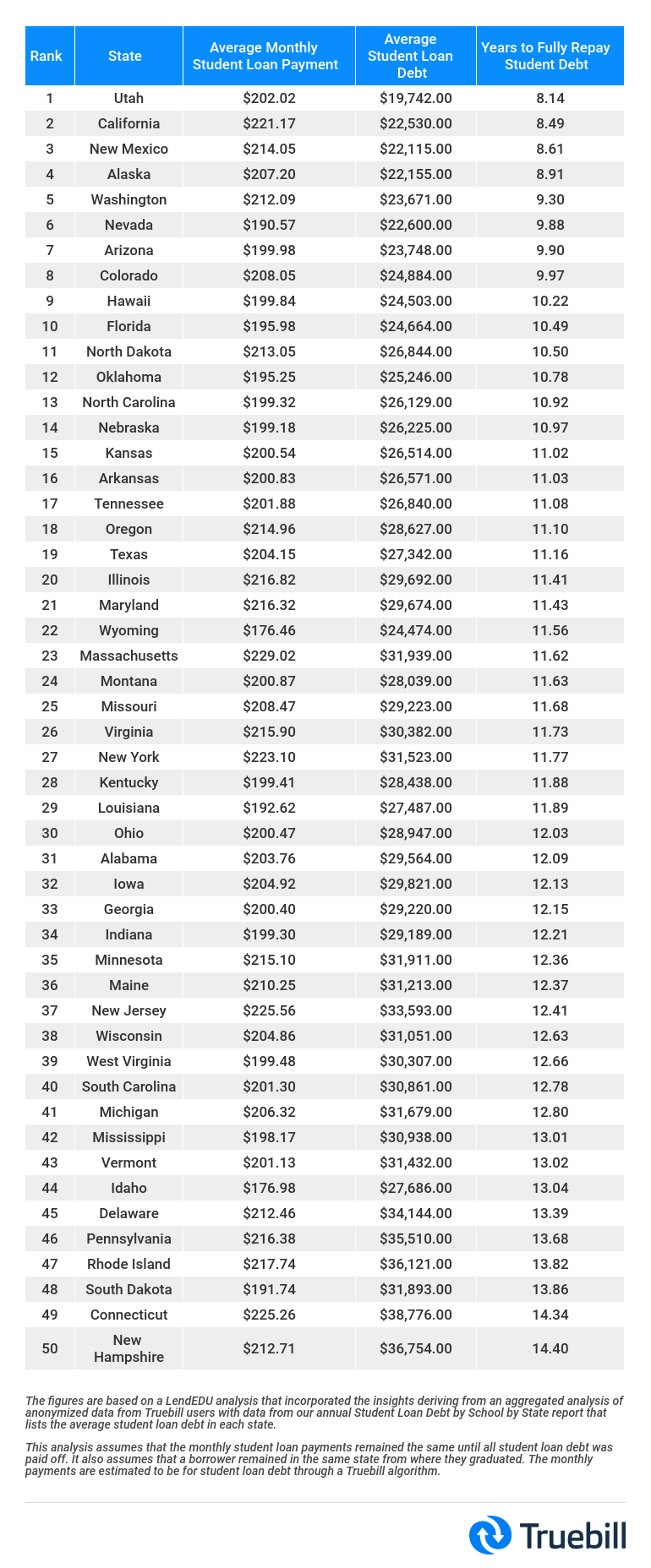
The quickest estimated student loan payoff time went to Utah, where borrowers were calculated to fully repay their student loan debt in 8.14 years. Utah was followed by California (8.49 years), New Mexico (8.61 years), Alaska (8.61 years), and Washington (9.30 years).
Conversely, New Hampshire had the longest estimated student loan payoff time (14.40 years), and was joined by Connecticut (14.34 years), South Dakota (13.86 years), Rhode Island (13.82 years), Pennsylvania (13.68 years).
Nationwide, the average student loan payoff time was 11.30 years, and 19 states had a shorter payoff time than that, while 31 states had a payoff time that was longer.
An Interesting Finding
What was interesting was that states in the Northeast had some of the longest student loan repayment times despite having some of the largest monthly student loan payments. This was in large part due to many of these states in the region having some of the highest student loan debt balances, mainly Connecticut, New Hampshire, Rhode Island, Pennsylvania, and Delaware.
Further, states in the West had some of the shortest repayment times despite low monthly student loan payments due to the low student loan debt balances in these states. This included Utah, California, New Mexico, Washington, Nevada, Arizona, and Colorado.
The biggest factor in determining how long it will take borrowers to fully repay their student loan debt appears to be how much they owe, not how much they pay each month towards that debt.
Michael Brown is a research analyst with LendEDU.