

Editor’s Note: This piece was originally published by Hope Policy Institute, which is affiliated with Hope Credit Union in Jackson, Miss., and is reprinted here with permission.
By Sara Miller

Homeownership is critical for wealth generation and is a key factor in the racial wealth gap. Each additional year of homeownership increases a household’s total net worth an average of $13,700.
Homeowners generally have more wealth than renters. The median wealth of homeowners ($254,900) is more than 40 times greater than that of renters ($6,270). The median wealth gap between homeowners and renters is even starker among households of color. The median wealth of Black homeowners ($113,130) is 60 times greater than that of Black renters ($1,830).
Homeownership is a proven wealth acquisition instrument with research showing that even after the Great Recession, the financial returns of homeownership outperformed stocks and bonds.
While a critical solution for closing the racial wealth gap, Black homeownership significantly lags behind white homeownership due to historic patterns of discrimination and exclusion in housing opportunities. Over three-quarters (76%) of white households are homeowners, while less than half (49%) of Black households are homeowners. This disparity persists for each state within the Deep South.
Complex Issue
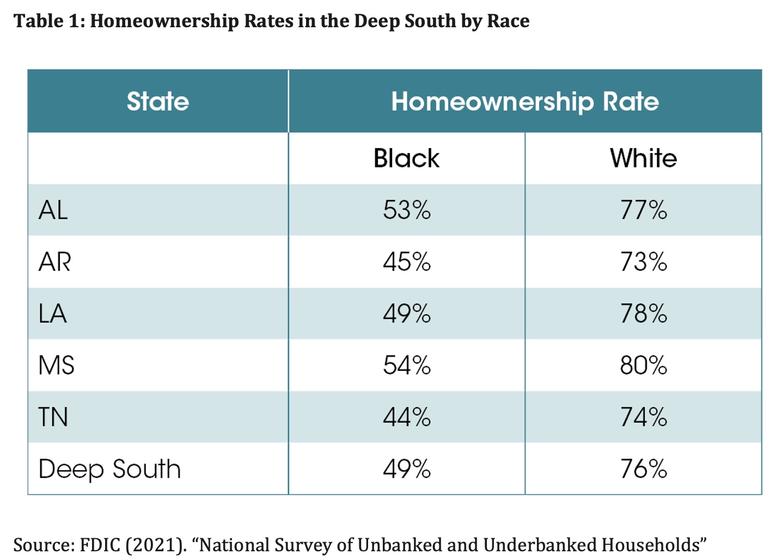
The homeownership gap is complex, and there are several points throughout the life span of a home loan where systemic inequities should be addressed. Some of these disparities show up during the initial home purchase process, such as lack of equitable access to credit. Other structural barriers can make it more difficult for a homeowner to keep their home and build the type of equity that grows generational wealth.
An analysis of mortgage loan denial rates illustrates the failure of financial institutions to ensure equitable access to credit and fair housing. For example, in 2021, the percent of loan originations for Black borrowers in Deep South states was 11%, which substantially trails the 25% of Black residents represented in the population.
The mortgage denial rate for Black borrowers also lags behind White borrowers, even when Black borrowers have significantly more income. The denial rate for Black borrowers in the Deep South earning more than $150,000 was higher than for White borrowers earning between $30-$50,000.
‘Twice the Rate’
Black mortgage applicants in Mississippi have the highest mortgage loan denial rate in the country (40%). This is more than twice the rate of white applicants. Of the total mortgage originations in Mississippi, only 17% of originations were to Black borrowers, even though the state has a Black population of 36%. In contrast, 70% of mortgage originations were to white households. Closing these gaps in mortgage lending is critical to closing homeownership gaps.
How to Overcome Barriers
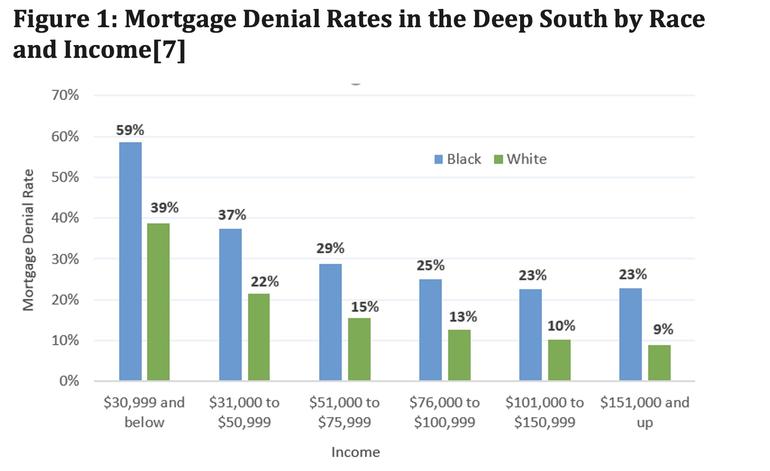
While these structural barriers persist, they are possible to overcome. HOPE has established lending policies that have improved access to credit for borrowers of color and women. Over the last decade, HOPE’s mortgage portfolio nearly quadrupled from about $34 million in 2010 to $130 million at the end of 2022, and the percent of mortgage loans originated for borrowers of color grew from 55% in 2007 to 80% in 2022.
To do this, HOPE designed an in-house mortgage product, the Affordable Housing Program (AHP), to address many of the structural impediments created by the mortgage market. The AHP is one of the single most effective tools available to HOPE to build wealth in the Black community. Through the AHP, mortgages are manually underwritten, and nontraditional indicators of credit repayment history are considered.
‘Of Critical Importance’
The product also discounts deferred student debt, does not require mortgage insurance, and accepts credit scores as low as 580. The credit score is of significance. Borrowers in rural areas are much less likely to have the credit scores typically required from banks to qualify for affordable mortgages than their counterparts in urban areas.
Also of critical importance, the AHP allows for a loan-to-value (LTV) of 100% – eliminating down payment barriers as many low-wage earners have the cash flow for a monthly mortgage payment, but lack the ability to save for a down payment. The success of this product is reinforced by low charge-off rates. Over the last five years, the annual net charge-off rate has never gotten higher than 67 basis points.
Policy Changes
As federal policies contributed to the development of the homeownership gap and racial wealth gap, policy changes can also provide solutions for closing those gaps. One such policy is increasing support for community development finance institutions and minority depository institutions like HOPE that have a strong track record in providing mortgages to the underserved communities and that are located in these communities.
Sara Miller is senior policy analyst with Hope Policy Institute.