

By G. Michael Moebs

Financial services can be difficult to price. Some may jot down observations and quick calculations on the back of an envelope hoping the new price works. As technology advances, more analytic approaches have been developed to help identify and gauge reasonable prices.
Financial service pricing is unique. Banks, credit unions and thrifts can create money, or the raw material of deposits, to make loans and investments.
Even more unique, financial services can be priced or paid with fees, rates, or balances. This pricing troika sets financial services apart from any other service or product in the world. It also complicates establishing the price: which price type, at what time, and with what user type?
Twenty-five years ago we created a special tool to address pricing dilemmas - the “Burger Index.
What is the Burger Index?
Part of the Cost of Living Index (COLI) is fast food prices. The price of a quarter pounder with cheese sandwich (QPC) at McDonald’s represents fast food. Why QPC? Many think there’s not much difference in McDonald’s QPC prices across the county – it is nationwide fast food.
However, McDonald’s QPC prices will vary by market and even vary within the same market. Regionally in the U.S., a QPC price in San Francisco is $6.06, while in Salt Lake City a QPC is $4.60 – a 31% difference. In California, a QPC only costs $3.37 in Bakersfield – that’s 55% less than San Francisco. Even within a city the price can change. In New York City, QPC in Brooklyn $6.91 vs. Manhattan $5.99 – this is 15% less.
Only a McDonald’s quarter pounder with cheese sandwich is used. No meal - just a sandwich. No fries - just a sandwich. No Coke - just a sandwich. Only the burger is used and no other Cost of Living Index items.
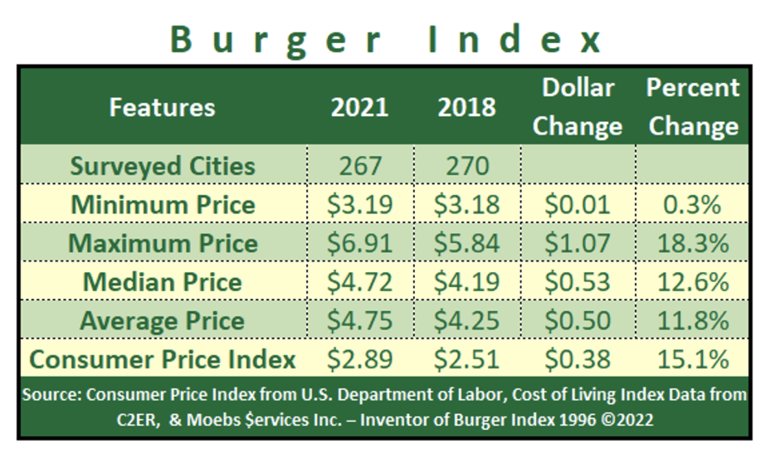
Double-Deck of Data Available
The burger data is available for over 260 cities and towns in the U.S. McDonald’s has 13,683 restaurants in the country, with 82% being franchises. This means the prices charged are mostly franchise ownership, not corporate ownership. The franchisee reflects the local market. The sandwich price ranges from $3.19 to $6.91. All data is for 2021 and updated quarterly.
The Burger Index is not the Consumer Price Index (CPI) nor the COLI. The CPI measures change in prices, or inflation, while COLI measures living costs. Each is very useful information. Yet, the Burger Index combines both these measurements and deals with only one product.
The QPC is a combination of agriculture materials, physical location, equipment, and labor. The price level is middle-class households. Access is walk-in or drive-in. Thus, price behaviors coupled with living costs isolated on one product with thousands of locations assessed homogenously by one accepted brand creates a measure of stability and uniformity – an ideal pricing tool – the Burger Index.
Can the Burger Index Really Help?
The Burger Index is used extensively in Europe, Canada, Australia, and parts of Africa, Latin America and even at one time in Hong Kong, China. Outside the U.S. it is known as the Big Mac Index. The QPC is more suited to U.S. than a Big Mac sandwich.
Financial Institutions can use the Burger Index to help price services. For example, if you are a credit union in San Diego, you can use the Burger Index to compare your overdraft fee in the local market – should you increase, decrease or not change your OD price?
If you are a bank with branches all over Texas, the Burger Index can show if you should vary your deposit rates, adjust more frequently, or what rate level works best in each Texas market.
If you are a savings bank, or thrift with branches throughout New England, the Burger Index is helpful for establishing minimum balances on deposit services and varying balance levels for service price tiers by market within New England.
If you are a fintech and are national, such as Walmart and Chime, your fees, rates, and balances should vary all over the U.S.
Who Will Be First?
This is something that has yet to come in depository pricing. Who will be the first, as the Burger Index is a valuable tool to assist determining prices by market nationwide?
The worst way to price financial services if you are a credit union, is to survey just credit unions in your backyard and determine the price from this small, isolated group. The same holds true if you are a bank and you survey just banks. Include all depositories and fintechs operating in your market, and compare to the Burger Index. You may increase some fees, rates, and balances, reduce others, keep some prices the same while all the time increasing profit.”
Michael Moebs, is economist, CPA, & CEO of Moebs $ervices, Inc., an economic research firm. For info: www.moebs.com.