

By Dave Throndson

A credit union branch without tellers? The premise almost contradicts itself, but it’s exactly the idea behind Coastal Federal Credit Union’s (Coastal) innovative and successful credit union branch concept. But the teller-less credit union wasn’t built overnight. In fact, Coastal has been serving the financial needs of North Carolina since 1967, with a long history of making innovation a priority thanks to the credit union’s visionary leaders.
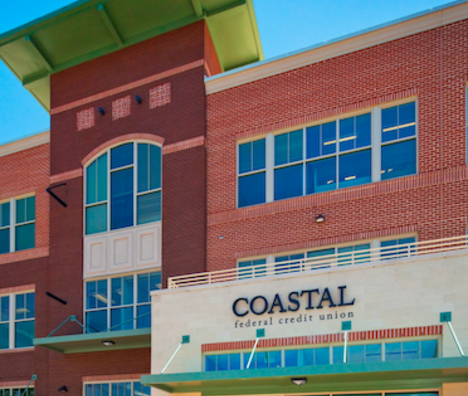
Always looking for ways to continue to improve efficiency and provide better service, the company’s executives experimented with a Remote Delivery System (RDS) in 2003, then pushed further working with uGenius (purchased by NCR in 2013) to become a beta site for the Personal Teller Machine (PTM). By 2011, Coastal fully embraced this video-based technology by centralizing teller operations, reducing the personnel needs within its branches but maintaining face-to-face interactions through this advanced technology.
The credit union’s leaders continued to look to the future and decided it was time to grow again in 2014, tapping La Macchia Group to help them get started with a strategic branching analysis. Willard Ross, senior vice president, chief strategy and talent officer for Coastal, explains, “We wanted to be smart and strategic in the new growth plan, identify gaps in the market and figure out the best places for new branches or transactions.”
An 'Immersive Experience'
La Macchia Group, a national comprehensive consulting and design-build firm, performed a market study and analyzed demographic and competitive data that would allow them to pinpoint the prime location to open this new branch. The goal was to locate a space that expanded the credit union’s footprint, increase membership and introduce consumers to a unique and immersive financial experience. A storefront location in Carrboro, N.C., proved to be the strategic decision that would allow Coastal to take advantage of membership opportunities at the nearby University of North Carolina campus.
“La Macchia Group impressed us,” said Ross. “We liked that they had experience with PTMs, which was important to us. We also liked their focus on credit unions. They are forward-thinking, and really looking at the branch of the future.”
With the real estate determined, the design team was challenged to transform the long, narrow existing space into an easy-to-navigate interior that not only lives up to the Coastal reputation, but also sets a design precedent for future locations.
“While the linear space provides minimal storefront exposure, we maximized brand visibility by limiting visual obstructions throughout the 1,400-sq.-ft. floor plan,” said Joshua Schoenemann, AIA, project architect for La Macchia Group.
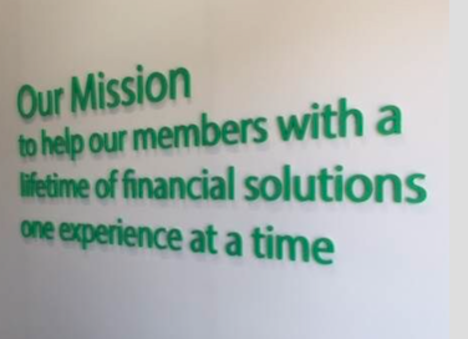
With few visual obstructions, the space offers a clear view of a reclaimed wood feature wall highlighting the Coastal lighthouse (brand logo) in backlit acrylic. This detail creates an iconic beacon from the exterior and an impactful brand statement within the interior. This brand expression continues throughout the modern space with bold applications, such as the mission statement and logo prominently showcased on the wall, a massive video display wall, merchandising casework with tactile marketing boxes and teller signs internally lit in the brand’s signature green hue.
The Most Challenging Aspect
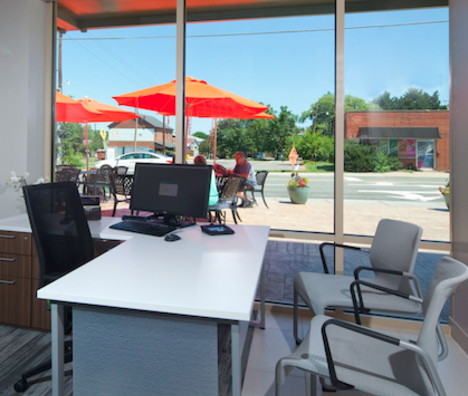
Perhaps the most challenging aspect of the project was making the small space feel both open and safe—especially with no staff on-site during extended teller hours. The design team tackled this dilemma through the use of technology, which was a priority for member access. With a swipe of their cards, members can securely enter the 1,150-sq.-ft. lobby, which is accessible to members from 7 a.m.-7 p.m., seven days a week. It offers a greeter station, coffee bar, two PTMs, two multi-purpose rooms and ample marketing displays. LED lighting offers a touch of brightness, creating a sense of safety while providing energy efficiency.
“Due to the PTMs, we don’t need a big footprint anymore and that was part of the original vision when we adopted this technology,” Ross says. “An important aspect of the 7/7/7 service (member access from 7 a.m.-7 p.m., seven days a week) is having access to the branch lobby and being able to swipe for entry into the vestibule. In Carrboro, we took the opportunity to open the whole lobby as the vestibule.”
When it comes to innovation at the Carrboro location, the team explored a new way to install the PTMs. Typically, the machines are built into a wall in order to accommodate the equipment size and service needs. But for Carrboro, the team worked diligently to create a standalone configuration in order to maintain clear sightlines throughout the interior. By locating the PTMs (the NCR 91 models) in the central island and orienting them so that they can be seen from the main entrance, they have become the featured focal point of the space.
The Driving Forces
“La Macchia Group came up with the center island design,” Ross said. “The way the design turned out has proved to be successful so far, and we are confident this is an element that will be repeated in the future.”
Simplicity, flexibility and functionality were driving forces behind the design as the team worked to maximize this small footprint. From the PTMs to the video screen wall, the design fulfills the Coastal commitment to be a place “where community meets technology.”
With the direction of La Macchia Group, the Carrboro location demonstrates Coastal’s ability to deliver an immersive experience in a small footprint, a solution they will continue to apply in various markets, fulfilling their reputation as an innovator and leader in the industry.
Dave Throndson is Vice President of Business Development for La Macchia Group, Milwaukee, Wis.