By Frank J. Diekmann

"Should auld acquaintance be forgot…”
We’ll all be hearing and perhaps even singing that lyric this weekend, even if our voices quickly trail off by about the third line in what is actually an eight-stanza song, as few of us know any of the words in the last 7.5 of those verses. Maybe that’s what all the New Year’s Eve drinking is for.
But before we forget 2022 and become transfixed by the shiny object that is 2023 and all the related forecasts (full disclosure here: journalists and publications are required to swear on the First Amendment they will write new year preview pieces this time of year), I thought we might take a quick look back at the headlines reported by CUToday.info at year-end 2021 and the first week 2022.
In an industry and marketplace in which all anyone can talk about is the pace of change, it’s remarkable how many similarities there are.
Here’s some of what we reported:
No One Sleeps in This Business
Asked what “keeps them up at night”—the go-to question I seem to hear asked as part of every CU panel discussion—one survey of financial professionals who were asked what they expected in 2021 when it comes to perceptions of regulatory and risk trends, found a 21-point increase over the same survey conducted one year earlier, as financial institution leaders expressed anxiety over disruptions caused by the ongoing pandemic as well as growing compliance and reputational risks.
I feel like those survey results could be released at the end of every year related to what’s ahead and no one would know the difference.
Wasn’t SAFE After All
As the second half of the 117th Congress got underway in early 2021, credit union lobbyists on Capitol Hill were asked what they hoped to accomplish, with one person noting getting any CU-favored legislation passed would now be made even more difficult by the fact 2022 was an election year for the entire House and for more than a third of the Senate.

Among the credit union priorities were the SAFE Banking Act, which credit unions had hoped might pass on its own (“What were they smokin’?,” you’re asking) and when the haze cleared to show that wasn’t going to happen, then attached as part of a larger bill, such as the Build Back Better legislation, then the National Defense Authorization Act and finally the omnibus spending package.
“It has had bipartisan support in the House on multiple occasions. I think there is bipartisan support for it in the Senate. Some of it is caught up in other issues and that has been some of the challenge,” observed NAFCU VP-Legislative Affairs Brad Thaler in January. “Given it’s an election year and a difficult environment, we will see it continue to come up again. It’s not off the table in this Congress.”
Back Off the Table
It's off the table now and even though the SAFE Act’s primary sponsor is retiring with this Congress, it will no doubt be back on the table in the 118thCongress.
Call me jaded, but I will tell you what else has bipartisan support. Funny how two legislative proposals with deep-pocketed Mr. Warbucks constituencies either favoring or opposing them—cannabis banking and the Credit Card Competition Act—didn’t make it through this Congress. I guess the fine members of that august institution will just have to be stuck with taking donations from the pot industry, financial services industry and retailers for another term.
Digital Vision
Thaler also shared his thoughts 11 months ago on digital assets, calling it a “timely and hot topic in Congress.” Congress didn’t act, but Thaler observed at that time, “There is a lot of talk here and maybe it will set up something for next Congress.”
Given the failure of FTX and other platforms, it appears Thaler’s crystal ball was crystal clear.
The CU Challenge That Puts Yours in Perspective

Rafal Matusiak speaking to CUs in Las Vegas.
In January, rumors Russia planned to invade Ukraine, which has a vibrant credit union community, seemed to be saber-rattling. By February when CUNA was hosting its GAC, rumors were reality and the country’s ambassador to the U.S. was addressing the meeting via video. As the year went on the World Council and Worldwide Foundation, Mitchell Stankovic and others were raising funds to help that country’s CUs, while one CEO was personally fundraising and delivering ambulances in the country.
In October, the leader of Poland’s credit union trade association, Rafal Matusiak, shared the defiance of those who are fighting back when he told the Underground Collision meeting in Las Vegas, “In Poland, we are not waiting with folded arms for the bastards from Russia.”
Not So Clear
Beginning in January, CUToday.info featured numerous stories throughout the year on countries making plans for digital currencies. And the trend wasn’t just limited to governments, with one headline reading, “Report Forecasts Big Jump in Use of Digital Currencies by Large Organizations.” That report suggested that by 2024 20% of large organizations will use digital currencies for payments, stored value, or collateral
The Other C Word
Here are two headlines from just a year ago that seem simultaneously recent and so far away:
- “Fintech, COVID Lead to record Number of Branch Closures”
- “Attendees at CUNA’s GAC Will Need to Show Proof of Vaccination”
And Our Lead Story…
If there was one issue that would have to qualify as the lead story of 2022, it would have to be the Fed’s efforts to push up rates amid surging inflation. Rates had been rock bottom and flat for so long that many in CU management had never worked in a rising rate environment.

And in a story that almost seems quaint now, in May mortgage rates in the U.S. hit their highest point since mid- 2020, with the average rate for a 30-year fixed-rate loan at a shocking 3.22%! One year earlier in 2021 mortgage rates stood at 2.65%. Any credit union offering those kinds of APRs right now would be drowned by a tsunami of refi apps.
I Checked: Seven is More Than Four
Headed into 2022, it was a foregone conclusion the Fed was going to begin pushing up rates. The bigger question was how often and how far.
In January, economists at Goldman Sachs issued an advisory to clients predicting the Fed would raise rates four times. For the record, the Fed bumped up rates seven times and as this year begins we hear only cautious forecasts around when the Fed may begin to stop its rate boosts, and certainly not when rates may again be lowered.
For his part, CUNA economist Dawit Kebede offered this forecast, “The Federal Reserve will most likely raise interest rates earlier than anticipated to control inflation. This is in addition to ending its support for the economy in the form of large asset purchases. This will raise the cost of borrowing for consumers and will reduce excess demand for goods.”
Also in the Headlines
A few other headlines from the beginning of this year:
- A warning that given the sophistication of scammers appears to be an annual thing now: Consumers Warned About Bogus Credit Union, Bogus Bank Sites
- Credit unions continue to lag on this fashion trend: Now, You Can Not Just Use Cash App, You Can Dress in the Brand, Too
- A report in January, the accuracy of which seems to depend on the company: “In a study in which he said he had “unearthed clear trends about the future of working from home,” Nicholas Bloom, the William Eberle professor of economics at Stanford University, said, “Working from home is here to stay, with hybrid arrangements fast becoming the dominant strain. By 2022, the typical firm will have everyone in the office three days a week, typically Tuesday to Thursday, and working from home Monday and Friday.
- An early 2022 headline that proved prescient: Chase, United Airlines Intro Another Co-Branded Card With Travel Benefits (If You Can Get a Flight)
- An early 2022 headline that proved prescient 2.0: Survey Suggests BNPL is Buy Now, Pay (the Piper?) Later for Both Consumers and Credit Unions
- A headline that wasn’t so much prescient as it was just plain consistent, including a report in CUToday.info this week: Another Half-Dozen CU Mergers Proposed; Lack of Succession Planning Often Cited as 1 Problem
- And, finally, the headline that likely is to be repeated in 2023, 2024 and beyond: 19 Banks Form Consortium To Tackle Risks Around Climate Change
Be Not Forgotten

Should you wish to be the hit of the New Year’s party this weekend, impress the revelers with this piece of trivia: Auld Lang Syne was originally a Scottish poem and the words translate into English as “old long since.”
And for the rest of you, at least brush up on the first verse as midnight strikes:
Should auld acquaintance be forgot
And never brought to mind?
Should auld acquaintance be forgot
And the days of auld lang syne?
To all, we at CUToday.info thank you for all of your support and readership. Best wishes for the new year.
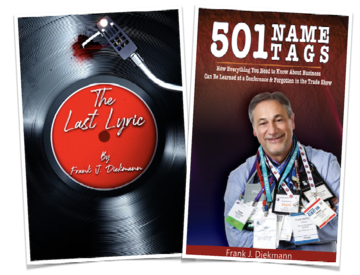
Frank J. Diekmann is Cooperator in Chief of CUToday.info and can be reached at Frank@CUToday.info. Mr. Diekmann is also author of several new book, including the brand new “The Last Lyric,” a humorous satire about a murder investigation at the Rock & Roll Hall of Fame in which every line of dialogue is either a classic pop/rock song title or lyric. Available on Amazon, Apple iBook, Barnes & Noble and Smashwords. Mr. Diekmann is also author of a non-fiction compilation of the very best & worst he has seen and heard in covering more than 500 CU meetings and conferences, “501 Name Tags: How Everything You Need to Know About Business Can Be Learned at a Conference & Forgotten in the Trade Show.” It is available on Amazon, Barnes & Noble, Apple, Lulu, and Smashwords