

By Grant Sheehan
Long before likes, follows, shares, and friend requests, people built networks another way: They showed up for each other.
That simple idea is the foundation of the credit union movement — and perhaps its most overlooked lesson in today’s hyperconnected world.
Credit unions were not created as financial corporations chasing quarterly profits. They were built as human networks rooted in trust, shared experience, and mutual responsibility. In many ways, credit unions were the original social network long before Silicon Valley ever imagined one.

Today, social media companies market connection as innovation. They promise community, belonging, and shared purpose. Yet more than a century ago, credit unions were already creating those very things — only they did it face-to-face, in neighborhoods, workplaces, churches, military bases, and school districts across America.
Teachers organized with fellow teachers. Factory workers pooled resources with coworkers. Church members supported fellow congregants. Military personnel helped military families. Firefighters stood beside fellow first responders. Police officers strengthened the communities and departments they served.
These were not digital communities driven by algorithms.
They were real communities driven by a common purpose.
Common Bond
That “common bond” became the heartbeat of the credit union movement, and it remains one of the most powerful ideas in cooperative finance today.
What made early credit unions remarkable was not simply that they provided loans or savings accounts. It was how they did it.
Modern financial institutions often rely on transactions and data points. Early credit unions relied on relationships.
Members knew one another personally. They understood each other’s struggles, character, and aspirations. Decisions were not made solely by credit scores or automated underwriting systems. They were grounded in trust and accountability.
Imagine that in today’s world.
A young couple is trying to buy their first home. A worker recovering from illness. A farmer borrowing money to survive another season.
The community stepped in because it believed in them.
That is what credit unions originally represented: people creating systems to support one another financially and emotionally when traditional institutions would not.
And perhaps that is why their story feels so relevant today.
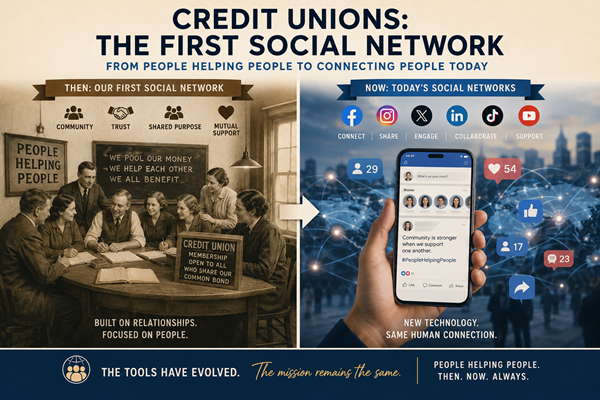
Ironically, at a time when society is more digitally connected than ever, many people feel more isolated than ever. Social platforms generate engagement, but not always a sense of belonging. They monetize attention rather than deepen relationships.
Cooperation, Not Clicks
Credit unions took the opposite approach.
Their “platform” was the factory floor. The church basement. The union hall. The fire station. The school district. The military unit.
The value came from cooperation, not clicks.
Members pooled resources not to enrich distant shareholders, but to strengthen the entire community. In doing so, credit unions created something modern platforms still struggle to manufacture authentically: trust.
And trust matters.
Today’s digital ecosystems battle misinformation, anonymity, and declining public confidence. Credit unions were built in the opposite direction. Their networks depended on reputation, accountability, and personal connection. Members were not strangers hiding behind usernames. They were neighbors, coworkers, and friends whose success directly impacted the wellbeing of the group.
In many early credit unions, a person’s reputation mattered more than paperwork.
That level of trust built resilient institutions and stronger communities.
It also gave rise to one of the most enduring principles in cooperative finance: “people helping people.”
More Than Marketing
That phrase is far more than a marketing slogan. It was social networking before the internet ever existed.
Members shared resources, opportunities, financial knowledge, encouragement, and responsibility. When one person succeeded, the cooperative grew stronger.
That idea may be exactly what modern society is searching for again.
The lesson credit unions offer today is not nostalgic. It is deeply relevant.
The strongest networks are not built on visibility. They are built on trust.
Not on followers, but on belonging.
Not on virality, but on consistently showing up for one another.
The founders of the credit union movement understood something timeless: people are stronger when they work together.
Technology may change how humans connect, but it does not change what human beings fundamentally need from community.
More than a century later, credit unions still represent something increasingly rare: institutions intentionally designed around people rather than pure profit.
That is why their founding story still matters.
Before there were billion-dollar social platforms connecting millions online, there were small groups of ordinary people creating networks of support within their own communities.
And unlike many modern networks, these were built to improve lives, not simply capture attention.
In that sense, credit unions may have been the original social network all along.
Grant Sheehan is CEO and Founder of the National Council of Firefighter Credit Unions.