

By Frank J. Diekmann

As I pointed out here last week, the recent Symposium on board governance was a heck of a lot more interesting than most would have given it credit for ahead of time.
Organized by John Lass of Lass Advisory Services, retired CU exec and regulator Parker Cann, and the law firm Foster Pepper in Seattle, it was a fascinating day-long discussion about the evolving role of credit union directors as demands on both them and the CU grow. (And that doesn’t even count the crisp, clear day they managed to arrange with beautiful views across Puget Sound to the Olympic range).
Here are some of the observations that didn’t make it in our other coverage.
- On CEOs serving on boards. “In my opinion, it’s an inherent conflict of interest to work for and be part of an organization that is supervising you. I don’t know how you can do both.”
- On what one person was told by an (at least at that point) a CU volunteer: “Now that we’re talking about board compensation, we’re going to take our fiduciary responsibilities more seriously,” that board member said. The response from the person who heard the quote was this: “That’s not the way it works.”
The View from the Titanic
Meanwhile, also at the Symposium, Bill Longbrake shared a fascinating insider look at the failure of the former Washington Mutual, which to this day remains the largest-ever bank failure in the United States. You can read Longbrake’s full account here.
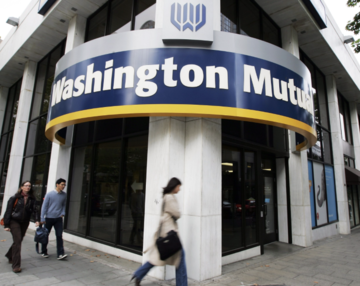
Longbrake’s real point wasn’t to conduct a post-mortem on WaMu; instead, it was to share the hard lessons learned about board failures with credit union boards, which he said may be getting lazy if the 5300s are looking good.
“Washington Mutual was very much like a credit union when I joined it in 1982,” Longbrake said. “It was very much a mutual in culture and orientation. It was member-centric. It converted to a bank charter and success proved fleeting. It failed because its culture was corrupted, its strategy took a wrong turn, its external environment changed, and the board was asleep and did not pay attention. I can’t emphasize enough the importance of the board paying attention. If things are going well and you like the management, don’t go to sleep. The world can change quickly.”
Later, Longbrake shared a couple of other quotes worth printing and putting in your wallet or sticking up on the wall:
- “To reinforce a strong culture, rewards and incentives must reinforce the desired outcomes and can be damaging when they motivate work rather than work well done.”
- “Boards should focus on the vital few rather than the trivial many. It’s easy to get caught up on the trivial many because it lets you check items off a list.”
- No one on the WaMu board ever spoke up until it was too late, with the bank failing and eventually being acquired by Chase. Both Longbrake and John Lass said they agree with the statement that for board members, “If you see something you should speak up, and if you’re not going to speak up, you should resign.”
‘That’s Never Good News’
One person at the Symposium shared the story of a credit union that was visited as part of its exam by 26 NCUA examiners. That’s never good news, one person reminded, as “No good examiner goes home without finding something.”
Why Chemistry Matters
Rafael Stone, an attorney with Foster Pepper who serves on/has served on a number of corporate and university boards, addressed the issue of diversity during the Symposium, but also said in his experience, “The big issue I encounter is boards that are disorganized and not in alignment, often due to one or two strong personalities who are not open to other opinions.

And the result of that is you can’t keep your good staff when there is no good chemistry. You have to make sure whomever you are bringing on board, even if they are brilliant, that they can get along with other people.”
Stone, incidentally, was a 5’10” point guard on the University of Washington’s basketball team who in addition to his other feats earned some fame for driving the lane and scoring against UCLA’s Lew Alcindor, who you may know better as Kareem Abdul Jabbar. After law school he became the first African-American attorney at Foster Pepper, which does considerable work with credit unions.
Frank J. Diekmann is Cooperator in Chief at CUToday.info and can be reached at Frank@CUToday.info or @FrankCUToday.