

By Homer Fager

The Third Industrial Revolution period of the 1950s through 1990s witnessed the beginning of the decline of the small credit unions. In the 1960s the number of credit unions, including state and federal institutions, exceeded 20,000. The 1980s brought new technology to the industry from personal computers to the introduction of the first credit union-sponsored ATM. During the next three decades 10,000 credit unions were lost and in the last decade alone 2,000 havevanished.
Continuation of this rate of decline means the “small entity” credit unions may be lost within the next 15 to 20 years.
These Third Industrial Revolution banking structural changes were the beginning of the decline of the “small entity”credit union.
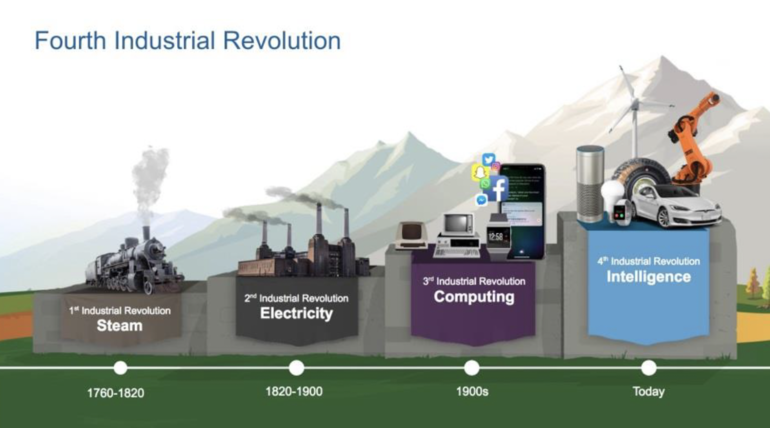
The Fourth Industrial Revolution, also referred to as 4IR or Industry 4.0, has changed the 21st century and will continue to change our society as did none of the other three revolutions. More has been accomplished in the last 250-plus years of human history than during the previous 2,500 years.
According to The World Economic Forum the first three periods included mechanical equipment, electricity/mass production, and electronics/automated production, respectively. The fourth revolution is assumed to have began after the 1990s but before 2013, the year Klaus Schwad first published his book, “The Fourth Industrial Revolution.”
Now, 5G (fifth generation technology of broadband cellular networks) and COVID-19 have advanced the application of the Fourth Industrial Revolution, with “cyber-physical systems” blurring the lines between the physical, digital, and biological worlds of influence. Per Klaus Schwab, “87% of young people in the U.S. say their smart phone never leaves their side and 44% use their camera function daily.”
He further noted how “now the world requires companies to respond in real time wherever they are or their customers or clients.”
The Millennial generation, also known as the “now gen” desires to conduct retail activities in real time, from their purchasing of goods to their retail banking P2P relations. The traditional banking industry faces serious threats from emerging digital modes to accessing banking services to being irrelevant at every stage of 4IR massive technologydisruptions.
What Must Be Understood
The industry, both national and local smaller institutions, must properly understand their customers’/members’ partiality for online services and be ready to offer new digital value-added services in order to meet specific consumer needs. A majority of U.S. financial institutions are under $500 million in assets, with limited capital resourceseligible for investment in 5G, AI or 4IR technologies. In order for these small financial institutions to stay financially stable and to grow their membership, they will need to adapt 4IR technologies now.
In 2017 I authored the article, “Small Entity Credit Unions Must Think FinTech,” noting that U.S. credit unions must adapt 4IR technologies, including quantum computing, for their survival. Four years later these institutions still have not adapted 4IR technologies due their lack of adequate technical knowledge and the required capital resources. To facilitate existing consumers’ acceptance of the 4IR e-commerce environment, peer-to-peer sharing and user-generated content necessitates adapting the super-fast 5G data network systems.
In short, small financial institutions must replace their existing legacy software systems to be competitive in the 4IR 5G/AI marketplace. Their survival is dependent on installing efficient systems to agility manage and process the large volume of data needed to enhance their consumer’s e-commerce experience across 4IR 5G networks.
A Drastic Difference
Many billion-dollar institutions attempting to upgrade their core systems have increasingly realized that data management requirements of 5G networks are drastically different from the earlier 3G and 4G network generations. A new approach to the management of data is required for 5G/AI core networks; it must be built as a cloud-native core designed to connect everyone, everything and anywhere.
Even as 5G cores are different from 4G cores they have many of the same functions as previous generations. As a result of its cloud-native nature, 5G core networks require a new cloud data management approach. 5G cloud data management requires new interfaces and different functional splits between network infrastructure to enable management of the ever-growing data size and the complexity of reality-based systems.
The evolution of the 4IR-5G/AI core will deliver data 25x faster than today's 4G transmissions via cloud-based stateless applications, where data is transmitted without sender or receiver information being retained. These protocols allow 5G/AI networks to deliver enriched mobile broadband and connectivity leading to ultra-reliablemission-critical communications.
The 4IR financial market is an e-commerce landscape where new, more convenient means such as cloud base applications have charged the consumer’s value creation equation. Small financial institutions need to break with their entrenched traditions in order to implement 4IR-5G/AI protocols and personalize their members’ banking end-to-end experience.
Shortening the Journey
Fintechs’ direct-to- consumer model in retail payments has been used to enter new banking fields, such as expensemanagement and lending including auto, mortgages, and cards. Small financial institutions need to level the competitive environment with their Fintech competitors. To realize this leveling strategy of the competitive fieldthey must shorten their technology evolution journey.
The journey requires the adaption of a service -based core architecture to provide the agile environment their potential new markets, including the Millennial generation, demand. This demand by the consumers for seamless agile digital e-commerce experiences is escalating at an all-time high rate. To comply with millennial consumers’ demands small financial institutions must step up their game to enable a richer, digital banking experience through virtual reality-based services.
But small credit unions are struggling just to maintain their growth, let alone replace their legacy systems withvirtual reality-based service due their lack of operational efficiency.
In a 2018 blog, flexcutech noted credit unions with less than $50 million in assets were witnessing a negative growth rate. It also noted that “operational efficiency is becoming more crucial to the survivability of smaller credit unions.” Both negative growth and operational efficiency are the result of an inability to compete with larger instructions in delivering richer digital banking experience.
Three Actions to Take
There are three actions struggling small credit union can take to equalize the completive advantage of largerinstructions. The three actions are:
- Remain independent, collaboration is the first step to merger
- Minimize in-house administrative expenses, convert back-office staff to growth activities
- Convert to subscription-based everything-as-a-service (XaaS), replace legacy systems
Small credit union must lead the industry by leaping past the third generation legacy systems and embrace the 4IR approach to the management of data. In addition, the NCUA, core providers, CUSOs, and the large credit unionsmust change from their third generation legacy concepts for the survival of the small credit unions to the 4IR approach.
The 4IR approach is part of the membership economy and encompasses a cultural shift away from legacy “ownershipof” to the 4IR approach of “access to” services or products. This shift will require a new subscription business environment be created to offer high-value, low ongoing investment designed 4IR services-products specifically forstruggling small credit unions.
Homer Fager is the former president of core data processor FedComp, Inc., a small business owner and advisor, and a multi-million dollar project manager. He began his 40-year career as a degreed aerospace engineer with major U.S. companies. As president of FedComp, where he led a provider of core data systems serving 700 businesses who in turn served over 600,000 members, he led the introduction of digital cloud technology to its non-cloud base core data system.