

By Frank J. Diekmann

Everyone has an “I remember where I was” moment that is involuntarily tied to some dramatic event in the news or your life—and if you’re young enough that you don’t yet, you will.
For older readers it may be when they heard the news of John F. Kennedy’s assassination (those who were in school were sent home) or where they were when they watched the moon landing. Others will recall their exact whereabouts on Sept. 11, 2001 (I was moderating a credit union conference) or, later, not so much a where as a when, as in when COVID changed their lives.
There are a few “I remember where…” moments in credit union history, as well, such as where folks were when the Supreme Court ruled against CUs on field of membership.
And for some, including myself, there was April 19, 1995, when a terrorist whose name won’t get the dignity of being repeated here blew up a truck bomb outside the Alfred P. Murrah federal building in downtown Oklahoma City.
All Americans were horrified by the tragedy that would kill 168 people, including 19 children in a daycare center in the building. Making it a “remember where and when” moment for credit unions was learning there was a CU in the building, where 18 employees lost their lives.
A Hand is Raised
When I learned what was then Federal Employees Credit Union was among those devastated by the bombing, I pulled staff together at the publication I was editing at the time to see if anyone was willing to go to Oklahoma City. Right now.
One reporter grabbed the assignment, was in that city by nightfall, and spent the next week or so profiling the horror and the devastation, the aftermath and the shock, and the glimmer of hope and promise that somehow took seed.
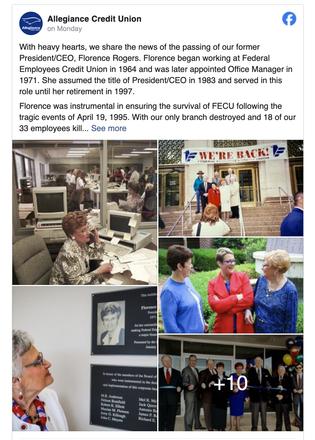
“Credit union spirit” is an overused phrase that is applied too often, but it was perhaps never on greater display than when CUs from across the city, state and country came together to restore operations almost immediately, even though FECU’s offices were completely destroyed.
I share this “I remember where” recollection now because of the passing last week of Florence Rogers.
Rogers was the credit union’s CEO and was leading a meeting in its CU’s third floor offices when the explosion occurred at 9:02 a.m. Central Time. As the result of nothing more than pure luck, Rogers would later be found alive at the bottom of the collapsed building buried under debris. Seven of the people who had been participating in the meeting with her were killed.
An Unfortunate Twist
As CUToday.info reported here, in an unfortunate twist, the Monday morning meeting marked Rogers’ first day back from vacation, having just taken a Caribbean cruise, and she was eager to share pictures. Afterward, she would recall a last-minute decision had been made to move the meeting from the board room on the north side of the building to her own office on the south. The bomber had parked on the street on the north side.
The reason for the move? A printer wasn’t working, so Rogers said she moved the meeting in order to be able to read a checklist from the screen of the computer sitting on an office credenza.
The reporter would go on to develop a close friendship with Rogers, and Rogers would go on to tell her story and that of FECU and its heroic employees to credit union meetings and other gatherings in the years that followed. She even shared photos of her bruised bottom with audiences. You can read more about Rogers and what others had to say here—that story includes a link to a video in which Rogers discusses that tragic day.
Maybe Some Should Try Harder
Perhaps the greatest sign of just how strong that credit union spirit can be is the fact FECU—today it’s known as Allegiance Credit Union—continues to serve members and the community.
There’s another “I remember where and when” moment for many in credit unions today—where some were when they voted to merge. It’s hard not to believe that if one credit union can overcome the most horrific of events, others should be able to find a way to surmount a manager’s retirement or a changing market.
Frank J. Diekmann is Cooperator in Chief of CUToday.info and can be reached at Frank@CUToday.info. Mr. Diekmann is also author of several new book, including the brand new “The Last Lyric,” a humorous satire about a murder investigation at the Rock & Roll Hall of Fame in which every line of dialogue is either a classic pop/rock song title or lyric. Available on Amazon, Apple iBook, Barnes & Noble and Smashwords. Mr. Diekmann is also author of a non-fiction compilation of the very best & worst he has seen and heard in covering more than 500 CU meetings and conferences, “501 Name Tags: How Everything You Need to Know About Business Can Be Learned at a Conference & Forgotten in the Trade Show.” It is available on Amazon, Barnes & Noble, Apple, Lulu, and Smashwords.