By Frank J. Diekmann

A number of larger credit unions have in recent months announced various fee reductions, especially around overdrafts. Now, an analysis recently released by J.D. Power suggests the market may be at a historical “tipping point” when it comes to fee reduction or removal altogether.
That tipping point came on the day “retail banks successfully averted the threat of disruption by putting their customers’ needs ahead of short-term revenue,” J.D. Power said.
But that tipping point could also involve tipping many smaller credit unions right into a merger, as the elimination of overdraft fees by many of the largest banks, and some credit unions, means eliminating a fee income stream that is propping up their bottom lines.
In news that should fall right into the credit union wheelhouse, J.D. Power said its analysis found 81% of retail bank customers say they feel strongly that financial institutions are in a position to help them improve their overall financial health.
That finding comes at the same time as the release of a separate J.D. Power study that found that overall customer satisfaction increases 229 points (on a 1,000-point scale) when customers are offered advice/guidance that completely meets their needs.
But the company also found fees have a strong effect on customer viewpoints.
The results were released, respectively, as part of the J.D. Power Financial Health and Advice Program, and the 2021 U.S. Retail Banking Advice Satisfaction Study.
An Oxymoron?
Meanwhile, as part of its analysis of the response to changing market attitudes by the nation’s biggest banks, J.D. Power described the new landscape as the “rise of the benevolent banker.”
“Our data shows that retail bank customers are more than twice as likely to switch banks if they’ve been charged a fee of any kind at any point over the last three months versus customers who have not been charged any fees,” J.D. Power said.
And Since Your Brought Up Mergers…
In the event you missed it, CUToday.info recently had updated reporting as we continue to be the publication of record related to credit union mergers, including what members and members of management/boards are getting from the combinations.
Other than the fact most of the CUs merging out are small and that many continue to cite manager retirements and the cost of technology as the primary reasons for merging, there is no one trendline to be found in the disclosure forms credit unions file (although not all do) with NCUA.
Some with decent capital offer distributions to members. Some with extremely high capital do not. One CU even disclosed that it couldn’t payout any distribution because it had decided to make payments to three employees, instead.
You can read more about it here, here and here.
Now That’s Retweetable
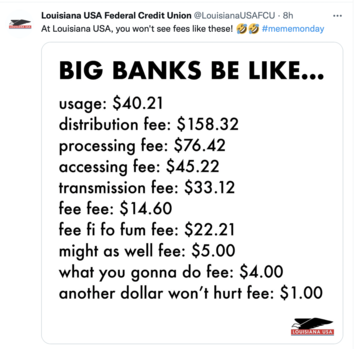
Louisiana USA FCU recently sent this tweet at right.
A Good Time to Have a Cow
These are the kinds of stories that should always be remembered.
As it marked its 90th anniversary, PSCU in Ft. Wayne, Ind. noted it began its life serving According to PSCU, NIPSCO employees and their families. In the beginning years, the credit union had only 25 members and the first loan granted was for $25 to purchase a cow.
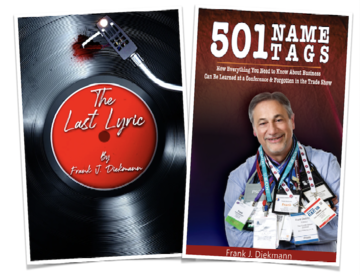
Frank J. Diekmann is Cooperator in Chief of CUToday.info and can be reached at Frank@CUToday.info. Mr. Diekmann is also author of several new book, including the brand new “The Last Lyric,” a humorous satire about a murder investigation at the Rock & Roll Hall of Fame in which every line of dialogue is either a classic pop/rock song title or lyric. Available on Amazon, Apple iBook, Barnes & Noble and Smashwords. Mr. Diekmann is also author of a non-fiction compilation of the very best & worst he has seen and heard in covering more than 500 CU meetings and conferences, “501 Name Tags: How Everything You Need to Know About Business Can Be Learned at a Conference & Forgotten in the Trade Show.” It is available on Amazon, Barnes & Noble, Apple, Lulu, and Smashwords