

Editor’s Note: The following was shared by Brian Branch, the former president/CEO of the World Council of Credit Unions, following a trip to Poland and Ukraine, to deliver an ambulance to a children’s hospital that had been purchased by Americans and American CUs. Mr. Branch traveled to Ukraine with Bruce Foulke, president/CEO of American Heritage Credit Union, as CUToday.info reported here.
By Brian Branch
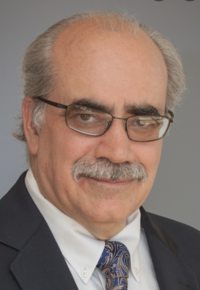
On Oct. 25th, Bruce Foulke and I returned to Warsaw to meet with our Polish partner, Rafal Matusiak (president & CEO of Poland’s trade association, the National Association of Credit and Savings Unions). We were delivering an ambulance and supplies to the Children’s Hospital in Lviv, Ukraine.
At 4:00 the next morning on the 26th, Rafal and Magda picked us up and we went to collect the ambulance. We met Lukasz, a paramedic who networks with paramedics of Ukraine and around Europe to identify available ambulances, assess them, refurbish them, re-equip them, repaint them and get them into the hands of those in Ukraine who needed them. Lukasz had made the border crossing many times delivering ambulances to his Ukrainian colleagues.
Today, we were transporting a large yellow Mercedes ambulance. We had purchased the ambulance from Denmark, rebuilt the engine, acquired the technical certifications required of ambulances and painted the interior in flowers of blue and yellow, the colors of Ukraine. We filled the large vehicle with medical equipment, diapers and children’s food.
Rafal took the wheel, I sat with him in the shotgun seat and Bruce sat in the back among the piled boxes. Magda followed us in the chase car. Lukasz sent us off for the border-crossing at Medyka, 4 ½ hours from Warsaw and two hours from Lviv. A half hour later I looked into the back and found Bruce asleep on the floor.
The number of Ukrainian refugees in Poland is approaching four-million. Some city populations have swelled 20%. “We still will not put them into refugee camps” Rafal noted.
The Polish credit unions continue to provide rent grants to refugee families to help them get into stable housing, get their children in school and find jobs. “Inflation is very high, and the Central Bank keeps raising interest rates” Rafal explained, “but there are many jobs available for refugees.
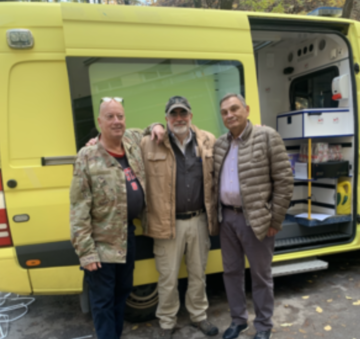
From left, Bruce Foulke, Brian Branch, and Dr. Dmytro Kvit , Director of Hospital.
Winter is Coming
“Winter is coming” he continued. “Poland was very determined not to depend on Russian oil, so we will be OK, but Ukraine is facing serious threats. The Russians have bombed and destroyed more than 40% of Ukrainian electricity infrastructure. We have received requests from the Ukrainians for the Foundation to help them with acquiring generators.”
“Yes, we have to explain the context; Winter is coming,” I repeated.
The tall pine forests gave way to the rich flat green farmlands, The darkness receded and along with it the mists and rains of the Polish fall. The sun illuminated copses of glowing fall-gold birches and hardwoods.
“Meet Igor at the Biedromka store before the border crossing,” our contact in Lviv, Tetyana, texted us. Among the small crowds waiting for rides at the corner store, just inside the border, was smiling, enthusiastic Igor, who would drive the vehicle across the border and into Lviv. Rafal and Magda turned over the keys and paperwork to Igor and headed back West for the seven-hour journey to their homes in Sopot. Bruce replaced me in the shotgun seat, and I rode in the back as we started across the border. My turn to catch up on sleep.
A Long Line and Then…
The line of trucks waiting to cross the border extended for miles. We only saw one car in the queue. Ambulances get fast lane processing so we sped up the road and entered the processing lane. Igor gathered up papers and passports and cheerfully went from one booth to another getting the required approvals. We had been told to expect the crossing to take 2-3 hours. After 45 minutes everything was approved and we considered ourselves fortunate–and then the power went out.
With Russian strikes on the energy infrastructure, Ukraine suffers rolling electricity black-outs. We had been two minutes away from the final entry in the computer registry when the electricity went out and shut the computer down. A van stopped alongside us from the World Central Kitchen, founded by Chef José Andrés. We compared stories and bantered with staff while we passed the time. After another hour the electricity and the computer came back on. With farewells and “stay safe’s, we were on our way again.
In Lviv we pulled up to the Children’s Hospital and were met by Tetyana, the director of the hospital and the medical staff. The local TV station was there; the mood was positive and festive. What buoyed their spirits was not just the donation but the connection with an outside world that had not forgotten and had not abandoned them in their hour of need. Here were friends from far away.
‘Stronger Together’
We explained the commitment of our Polish and American colleagues to work together to support them. “We are stronger together,” Director Dmytro Kvit of the hospital affirmed. We told them of the large number of American homes which today fly the Ukrainian flag to show support for Ukraine.
As we unloaded the ambulance, Director Kvit asked, “Did you bring material for sutures, for stitches?” We had not, but we got in touch with Rafal who began arrangements with our Polish colleagues to acquire such and send them to Dr. Kvit at the Children’s Hospital.
Lukasz, who drove ambulance to Ukrainian hospital.
While there were children present, we took no pictures of the children. Standard protocol was not to publish photos of the children’s faces for their protection. Hospital staff were aghast at the practice of the invaders to take Ukrainian children for adoption and assimilation in Russia.
We heard an air raid siren and then everyone looked to their phones. “Do you know what that means?” they asked me. “Are you afraid? Do you want to go to a bunker?”
“What do you do?” I asked.
“We continue as usual,” they said.
“OK, then let’s continue unloading.”
Five Sirens
During the day there were five air raid warnings. Everyone had the same air-raid app on their phones. The app would go off and it would show on a map of Ukraine, what the endangered areas of the country were, whether it was a missile or drone and from where it was coming: the Black Sea, Belarus or Russia. In Lviv, everyone would pause look at the app and then go back to their business.
“We stay in the center of the city,” they explained, “because when we are bombed it tends to be the electrical infrastructure outside the center city areas. We are more fortunate than our family and friends in Kiev or in Eastern Ukraine, who are bombed indiscriminately. But we are worried about the electricity. Winter is coming.”
After unpacking, we sat down for lunch at the church that supports the hospital. Tetyana and Bruce worked through plans to provide more safe-cars for evacuation from the front lines. We provide ambulances to the hospitals and paramedics in Ukraine, yet the Russians target the ambulances for destruction when they can find them so the Ukrainians keep the ambulances back behind the front lines. Tetyana and her colleagues acquire SUVs, reinforce them with armor plating and paint them camouflage colors. They use the safe-cars to evacuate the wounded from the front lines and get them back to hospitals where they can be treated or be further evacuated in the ambulances.
The Priest & the TP

A popular item in Ukraine.
During lunch a young man came in, tired and haggard yet cheerful and friendly. He immediately consumed large cups of coffee. He was the priest from one of the communities in the Eastern areas of heavy fighting. Many of the families of his flock were reduced to living underground in bunkers or basements and he made regular runs to the church warehouse in Lviv to take food supplies back to those families. We lent a hand packing as much food as we could fit into his car and he was off again, back to the front lines.
We stopped at the marketplace to pick up a roll for each of us and one to take back to Rafal: Ukrainian toilet paper with the face of the invader on it. I had unsuccessfully tried to convince paper makers in the US to produce these to sell and raise money for supporting the refugees from Ukraine. Alas, to them I was just another nut.
‘We Counted Ourselves Lucky’
As dark fell, Igor took the wheel again and drove west back towards Warsaw. At the border, the line of trucks and buses was enormous. We sat still for interminable periods. There were times when the streetlights went out for lack of electricity, but the control crossing point continued working because they had a generator on site. When the phone app indicated a missile alert however, all work stopped until the all-clear arrived.
This time, the border crossing took three and a half hours. Still, we counted ourselves lucky because we could leave and we had a place to go to.
Thank you to all of you have supported the effort to provide relief and support to these people affected by this war. As Rafal says, “Our hearts are big,” and as Dr. Kvit said as we rolled in, “We are stronger together.”
The war continues, and winter is coming.
How to Donate
Information on the Polish American Credit Union Fund can be found here.
Information on the Worldwide Foundation’s Ukrainian Credit Union Displacement Fund can be found here.