By Frank J. Diekmann

I read a book full of short, sad stories recently. Yes, on purpose. And all of the stories were authored by credit unions.
While the authors attempted to paint pictures of new lives and fresh beginnings, each of the stories was actually a death. Deaths caused by inattention to their deteriorating vital signs. Slow withering-aways of once healthy bodies shriveled into gray shadows of what they once were and, often, what they could have been. Fate in a few cases. Suicide in others.
All of these stories can be found in the disclosures NCUA now requires credit unions to publish and make available to members when they are looking to merge. Some might suggest it’s a little like writing your own eulogy before your funeral; others might find the statements more like an autopsy report.
CUToday.info is publishing a two-part series on what's taking place in CU mergers, the first of which you can read here, while the second is here.
However you choose to view the disclosures, all of the stories share the same beginning and end: an origin story of what is almost always working class folks optimistically forming a “union” to pool their savings and extend “credit” to one another; middle chapters of countless volunteer hours and neighbors helped to better lives, fundraisers taped to the windows and teller counters for the local elementary school, marriages and kids and a kind word from a teller helping a member whose spouse has “passed,” as we like to say, and then an ending, an announcement to members about voting on a merger in order to have better “products and services.” It’s always about the better products and services.
Credit unions have always been the ultimate American pull-yourself-up-by-the-bootstraps story, right up until the bootstrap tears off.
Déjà Vu Disclosures
I have read approximately five months’ worth of those short stories reflecting the last half or so of 2021’s credit union merger applications. It doesn’t take long before their stories hit the Deja vu button, because credit unions use the same merger consulting firms and attorneys and they just cut and paste the same text in the field in which NCUA asks for “Reasons for Mergers.” Those are cold and formulaic and frankly, a disservice to their own members and history.
But not everyone kicks their heritage to the curb. Read through those forms as well as their soon-to-be-final 5300 call reports and in between the lines you’ll find 5,300 peeks into what led to the finality of little pieces of history.
If I came away with one impression it was how market forces and competition are undeniable drivers of consolidation, and yet so many of red numbers bleeding from the balance sheets—although to be clear, many of those merging are healthy--seemed self-inflicted.

I didn’t know any of the board members at the credit unions that are being “merged out” in the industry vernacular, but there’s little doubt many gave generously of their time. And yet while I lack the kind of quantifiable research that might qualify me as a Filene Fellow, beyond all the reasons you’ll find cited below, I would hazard to say many CU mergers are trailing indicators of a board that wasn’t up to the job of being “directors.”
Astounding & Inexplicable
Too many CUs hired “managers,” not leaders, people who were quite adept at “managing” the credit union, not growing it. Too many board chairs were focused more on the chair and its perks than who else ought to be sitting—and heard from—around the table. The league meeting was a nice time to get away, instead of being a place to go to and learn.
Read through all those disclosures (you’re thinking, ‘Thanks, Frank, but we have lives’…) and you’ll find multiple CUs with capital in excess of 30% and even 40% that could have been invested to better serve the membership.
Somewhat astoundingly, many of the credit unions with the highest levels of capital said they had/have no plans to give some of it back to the members who own it, explaining, inexplicably, that the surviving CU has better—and here are those words again—products and services. What?
In at least one case a credit union that suffered losses and had capital below 4% paid out bonuses to outgoing management, while in other cases credit unions that were in the black paid out nothing. The review also found at least one case in which the payout to management was larger than the sum total being distributed to members.
What you will also find below are credit unions saying—and this is by no means new--they are merging because there is no succession plan in place and Gary or Dottie or whomever is retiring and, well, it’s just easier, I guess.
A Reading from the Book of Mergers
Here’s some of how credit unions explained why they are taking down the sign:
- Sheron E. Newsome, chair of the $5.9-million FIAFE FCU in Baltimore, which had 36% capital and which is merging into Securityplus FCU, wrote that the cost of offering things like online banking, free checking, debit cards, mortgages and more is “too expensive to be carried by a credit union of our size.”
- The $7.1-million SUNY Geneseo FCU, which is merging into Genesee Valley CU and which had 23.3% capital, explained—and I assume without irony—that GVCU had “invested a significantly larger amount of its equity in building the infrastructure our members will be able to access.” SUNY Geneseo did return 6% of its capital to members.
- In Washington, the $2.5 million NAPFE FCU, which is merging into US Postal Service CU and which had 40.14% capital, wrote that it will not distribute a portion of its net worth to its members in the merger. “Because of broader services in the loan, share and convenience line and what have in recent years been lower loan rates and higher dividend rates at the continuing credit union and a recognition of these factors by both boards led to no recommended adjustment in shares.”
- A frequent refrain, White Gold CU in Louisiana, which had very little gold and $439,847 in assets and which is merging into Pelican State CU, said it simply couldn’t afford the compliance and regulatory expenses.
- Similarly, the $10-million Dor-Wic CU in Maryland, which reported losses of $369,875, said, “the complexity of running a financial institution has, in the opinion of the board of directors, made it very difficult for a credit union of our size to go forward.”
- The $32.4-million Elm River CU in North Dakota noted its CEO of 32 years was retiring and it sought to merge as a means of keeping its two branches open. “Especially in small towns, members like to deal with staff that they are familiar and comfortable with…” the credit union stated.
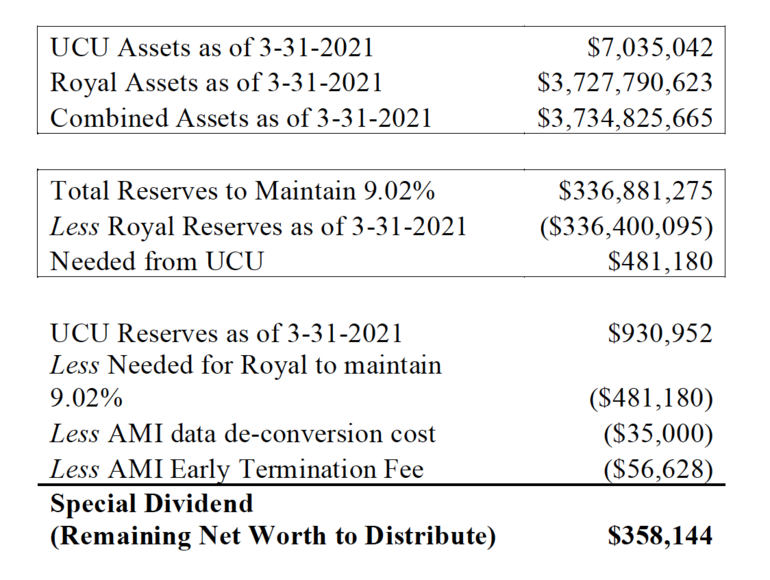
- The new gold standard for disclosing everything to members and returning some of the capital has been set by the $6.8-million Utilities Credit Union in Eau Claire, Wis., which is disappearing into the $3.7-billion Royal Credit Union. It included this chart with its disclosure to members.
- In West Virginia, the $20-million Tin Mill Employees CU, which is merging into First Choice America Community CU, was succinct in explaining why it is combining with another, saying it was struggling to find staff and “qualified, willing volunteers to replace those who have left the credit union.”
- The $8-million Essex County NJ Employees CU didn’t really need to provide many reasons for merging: it had capital of 2.4%.
- In California, the $73-million Chabot CU, which is merging into the $920-million University CU, said that since 2016 it has “witnessed a 20% decline in membership, due primarily to an aging membership base.” Chabot had capital of 14.75%, while University CU reported 7.7% capital, yet in its disclosure statement Chabot CU cited “increased capital” as among the reasons for seeking to merge.
Naked Credit Union Stories
The 1948 movie The Naked City made popular the line, “There are eight million stories in the naked city.” Credit unions may not be able to claim so many, but there are many and they are as varied as they are hopeful and inspiring and frustrating and sad.

It’s a tradition at some credit union conferences to pause and share a PowerPoint presentation of “some of the credit union people we’ve lost in the last year.” It’s a nice touch. And while I wouldn’t bet my drink tickets on it being added to the agenda anytime soon, what every national and state credit union meeting really ought to feature is a reading of the last will and testament of all the credit unions that were lost in the last year, as well. You may not be able to do anything about your own demise, but you can certainly do something about your credit union’s—boards should be required to watch it.
Words to Live By in a Death Notice
Last week I sat in Las Vegas with some folks who are leading an effort to launch de novo credit unions. Their optimism is admirable, their intentions good. Even NCUA board members have voiced their support. Getting a credit union off the ground is considered a success story if there is a million or two bucks in reserve. And yet as all of those disclosures make oh so clear, it’s CUs considerably larger than any de novo saying they lack the resources to remain viable.
It seems like the far more effective strategy would be to focus on those CUs that are still with us. Hey, we all love the hope and joy and optimism to be had in every birth announcement, but the best advice for making that joy and optimism a reality can be found in the life's lessons often shared in death notices.
Frank J. Diekmann is Cooperator in Chief of CUToday.info and can be reached at Frank@CUToday.info. Mr. Diekmann is also author of several new book, including the brand new “The Last Lyric,” a humorous satire about a murder investigation at the Rock & Roll Hall of Fame in which every line of dialogue is either a classic pop/rock song title or lyric. Available on Amazon, Apple iBook, Barnes & Noble and Smashwords. Mr. Diekmann is also author of a non-fiction compilation of the very best & worst he has seen and heard in covering more than 500 CU meetings and conferences, “501 Name Tags: How Everything You Need to Know About Business Can Be Learned at a Conference & Forgotten in the Trade Show.” It is available on Amazon, Barnes & Noble, Apple, Lulu, and Smashwords.