








WASHINGTON—CUToday.info is providing extensive reporting out of this week's CUNA Governmental Affairs Conference and is compiling all of it here.
Coverage will be regulary updated as its reported. Below is a compilation of all the reporting to date.
GAC Coverage: CU-Backed Bills Related to How Often Boards Must Meet, Loan Maturities Introduced
WASHINGTON–Two more pieces of pro-credit union legislation were announced by members of Congress during CUNA’s GAC here, bringing to four the CU-backed bills introduced while credit unions were in town.
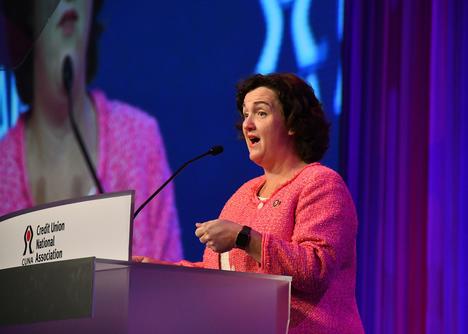
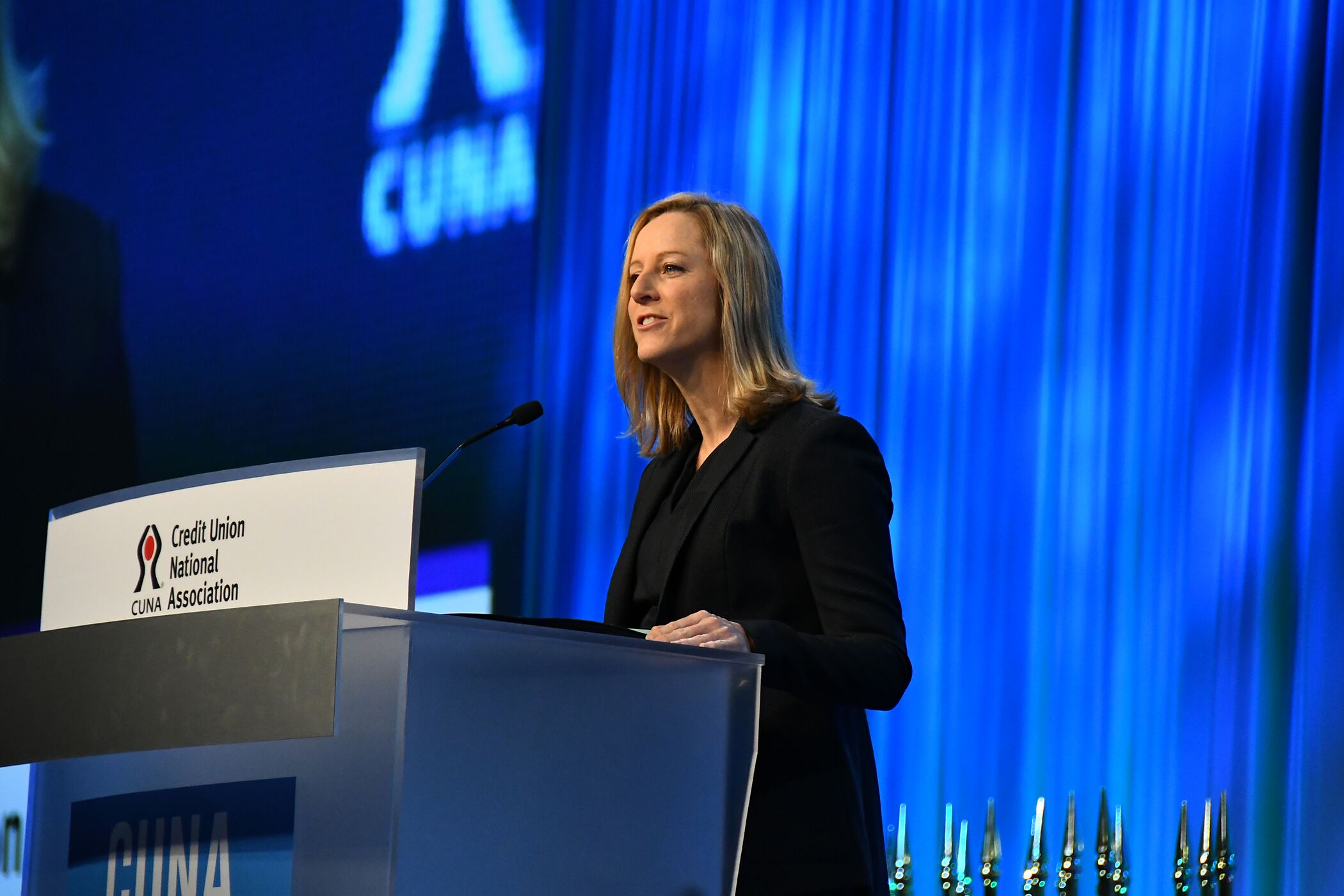
Katie Porter addresses GAC
The first was announced by Rep. Katie Porter (D-CA), who introduced the Board Governance Modernization Act, which would modify the Federal Credit Union Act requirement that credit union boards meet once a month to not more than six times per year. It is co-sponsored by Rep. Mark Amodei (R-NV).
“Credit unions play an essential role in our banking ecosystem,” said Porter. “We need to help credit unions continue to thrive and provide necessary services to our communities, which means that we need to tailor regulatory requirements to their unique size and needs. I’m proud to introduce legislation to do just that.”
CUNA said it and the California/Nevada Credit Union League have been working closely with Porter and Amodei on the bill. The trade group said modernizing the Federal Credit Union Act is a focal point of the CUNA/league 2020 advocacy agenda.
“CUNA and the leagues have prioritized these types of bills this year because Main Street communities stand to benefit greatly from important credit union governance modernization,” said CUNA President/CEO Jim Nussle. “We thank Reps. Porter and Amodei for working across the aisle on this important subject, and CUNA and the leagues will continue working directly with legislators to move this bill and others like it through the legislative process.”
Added Jeremy Empol, VP-federal government affairs with the California/Nevada CU Leagues, “Advancing modernizations to the Federal Credit Union act in all shapes and forms is vitally important to the movement. We greatly appreciate Representatives Porter and Amodei for their collaboration and effort to further advance our efforts.”
Senate Bill on Loan Maturities
The second bill announced during GAC on Wednesday would raise federal credit union loan maturity limits on non-mortgage loans from 15 to 20 years. It was introduced by Sens. Tim Scott (R-SC) and Catherine Cortez Masto (D-NV.).
Federally chartered credit unions are prohibited by statute from making loans with maturity limits in excess of 15 years except for mortgage lending. Oklahoma is the only state that has a similar restriction on state-chartered credit unions. No such constraint exists for banks.
CUNA noted it has been a longtime proponent of efforts to raise the current 15-year limit for non-mortgages, and has called on both NCUA and Congress to make such a change.
“We thank Sens. Scott and Cortez Masto for their bipartisan legislation that would open increased consumer access to safe and affordable credit union loan products,” said Nussle. “By reducing barriers to credit for those borrowers seeking longer term loans, this legislation will help credit unions provide new opportunities for those seeking to write their own financial futures."
League Support
In addition to CUNA, the legislation also had been pushed for by the Carolinas Credit Union League and the Nevada Credit Union League.
“Having served as a volunteer for Heritage Trust FCU, Sen. Scott understands how unnecessary barriers inhibit the ability of credit unions to serve their members," Carolinas League President and CEO Dan Schline said. "We appreciate his leadership in announcing this legislation that will provide credit unions greater flexibility by addressing the loan maturity limit in the Federal Credit Union Act. We thank Senator Scott and his team for their efforts, and we look forward to continuing to work with South Carolina credit unions and our partners at CUNA to advance the legislation.”
“This bill is another modernization that strengthens the dual charter system and brings more opportunities for credit unions to change their member's lives,” said Diana Dykstra, president/CEO of the California and Nevada Credit Union Leagues.
A similar, CUNA-supported bipartisan bill was introduced in the House last year by Reps. Lee Zeldin (R-NY) and Vicente Gonzalez (D-TX).
Other Bills Introduced
As CUToday.info reported, earlier this week, Sen. Thom Tillis (R-NC) and Richard Burr (R-NC) introduced the Credit Union Fairness Act (S.3326), which would remove outdated duties for credit union boards and remove the requirement for credit unions to provide NCUA with the names of its loan officers from the Federal Credit Union Act.
Separately Sens. Tina Smith (D-MN) and Ben Sasse (R-NE) introduced the Credit Union Governance Modernization Act (S. 3323), a bipartisan bill that would allow a credit union board to expel a member for just cause. In addition to CUNA, the Minnesota Credit Union Network and the Nebraska Credit Union League had also worked to secure its introduction.
GAC Coverage: Senators Introduce CU-Supported Legislation
WASHINGTON—Sen. Thom Tillis (R-NC) and Richard Burr (R-NC) have introduced a credit union governance modernization bill, one of four such bills to be introduced this week.
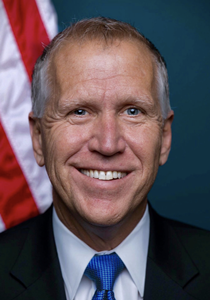
Thom Tillis
As CUToday.info reported, earlier this week Sen. Tina Smith (D-MN) and Ben Sasse (R-NE) have introduced the Credit Union Governance Modernization Act of 2020, legislation designed to help protect credit unions, members, and employees.
The new Credit Union Fairness Act would remove duties CUNA has called “outdated” or credit union boards and further remove from the Federal Credit Union Act the requirement for credit unions to provide NCUA with the names of its loan officers.
CUNA said it supports both of the bills submitted this week, when representatives of credit unions are hiking the hill as part of the trade group’s GAC.
“By helping to bring credit union governance into the 21st century, Sens. Burr and Tillis are strengthening consumers’ access to Main Street financial partners that are dedicated to empowering their financial well-being,” said CUNA President/CEO Jim Nussle.
In a statement, Tillis added, “Credit unions are in an important part of the U.S. banking system and provide important services to local communities across the country. Unfortunately, they still face burdensome requirements that make it harder to compete on a level playing field with other financial institutions. This legislation would remove red-tape created by bureaucrats in Washington and amend the board of director’s role in operating credit unions.”
GAC Coverage: NCUA Board Member Harper Discusses 3 Issues to be Watched Moving Forward
WASHINGTON–NCUA Board Member Todd Harper told CUNA’s GAC vendor oversight authority and DEI remain important to him, and that looking forward he remains concerned over liquidity, consumer debt and succession planning.
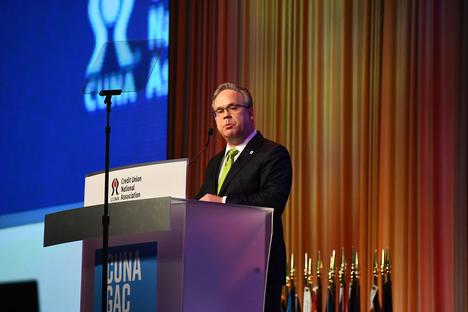
At GAC, Todd Harper outlines his four priorities as an NCUA board member.
Unlike his two fellow board members who preceded him at GAC, Harper did not touch upon NCUA’s sale of its taxi medallion loan portfolio. Harper had earlier expressed support for some type of public/private partnership on the loan portfolio.
In his remarks Harper told credit unions his four priorities as an NCUA board member remain capital and liquidity; cybersecurity; diversity, equity, and economic inclusion, and consumer financial protection.
Moreover, Harper said he does have some concerns, including the “increasing exposure of our financial system to malware, ransomware, distributed denial of service attacks, and other forms of cyber intrusion, which affect financial institutions of all sizes. The NCUA needs to work with credit unions, their vendors, and service providers to anticipate and protect against these threats. In that regard, the addition of cybersecurity policy staff as part of the agency’s 2020 budget is an important step toward preparedness.”
Harper also said he continues to support giving the NCUA regulatory authority to resume oversight of third-party vendors, an authority opposed by the credit union trade associations.
“Closing this regulatory blind spot would better protect the credit union system from cyber-threats and place the agency on a more level playing field with the other financial institutions’ regulators,” he said.
It would also provide a measure of regulatory relief.”
Other points made by Harper:
Diversity, Equity, Inclusion
According to Harper, “diversity, equity, and inclusion are highly important to the continued health of the credit union system. The NCUA must foster an environment that promotes inclusion, which will lead to economic dignity for all.”
He urged CUs to participate in the diversity self-assessment available at cudiversity.ncua.gov.
Small CUs
Harper called on the agency to support the work of small credit unions, minority depository institutions, and low-income credit unions, which he said “are often the ones reaching the underserved and who face the challenges of increased competition and difficulties in achieving economies of scale.”
Low-Income Designations
Harper said “everyone” must be counted when determining whether a credit union meets the low-income designation, and he wants NCUA to modify its rules to better account for service members who live on military bases, including abroad. He said agency staff is working on the issue and he is hopeful of making a related announcement in the near future.
Consumer Protection
Harper touched on a theme he has emphasized since joining the board, which is consumer protection. He noted the agency has consumer financial protection responsibilities for credit unions with less than $10 billion in assets (beyond which the CFPB oversees compliance). He said the 319 CUs of more than $1 billion in assets have become “complex” and as a result NCUA “needs to refine its approach to consumer financial protection.”
Harper reiterated his call for NCUA to create a dedicated program for supervising for compliance with consumer financial protection matters.
“In doing so, we will better safeguard member interests and ensure that the credit union system lives up to its commitment to serving members,” he told GAC.
Looking Forward
Looking ahead, Harper said he is focused on three things:
- Liquidity and how federally insured credit unions might respond to the next economic contraction. “When a financial institution holds illiquid assets like long-term mortgages, it may have difficulty selling those assets at normal prices to obtain needed cash during times of economic stress,” said Harper. “The NCUA’s rule requiring appropriate risk-management practices to maintain access to liquidity should help credit unions of all sizes to maintain ample access to cash to withstand unexpected emergencies.
- The growth in Consumer Debt. Household debt now tops $14 trillion, including a record $930 billion in credit-card debt. Despite good economic times, he said “some households are running into trouble,” and Harper expressed concerns over what might happen in a recession.
- Succession Planning. Harper said after learning one of the top two reasons cited for credit union mergers is succession planning, he dug deeper and learned about one-in-five credit unions lack CEO succession plans. With many retirements pending, Harper said it’s time for credit unions to learn from the Scouts and “be prepared.”
GAC Coverage: Global Women’s Leadership Network Marks 10th Anniversary
WASHINGTON—The World Council of Credit Unions’ Global Women’s Leadership Network celebrated its 10th anniversary during CUNA’s GAC here while also focusing on goals for the next decade.
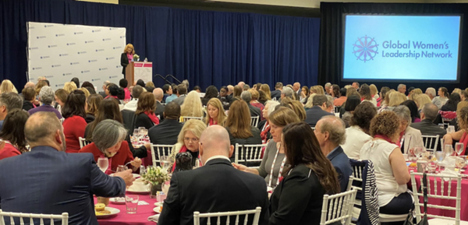
During a breakfast event sponsored by PSCU and Mitchell, Stankovic Associates, GWLN also recognized one of the group’s emerging leaders.
Since 2009, GWLN said it has worked to provide a suite of programming that has provided hundreds of women with “tangible skills, tools and resources to help them grow as credit union leaders.”
The Global Women’s Leadership network has now grown to 26 countries through its network of 109 Sister Society chapters. This year’s GWLN Breakfast at GAC was the largest to date, with more than 350 people in attendance.
“And we’re starting early—empowering girls so they can become empowered women who will make an impact for years to come,” said Eleni Giakoumopoulos, GWLN program director. “Hope Welsh, daughter of our Great Britain Sister Society leader Beth, came into the world only last year, but she’s already a part of the GWLN family. It’s smart for our communities, our credit unions and our families when we invest in women. We will continue with that effort in this new decade.”
Emerging Leader Award
During the event GWLN leaders announced Mai-Linh Hoang, vice president of marketing for Collins Community Credit Union in Dubuque, Iowa, was named the recipient of the 2019 Emerging Leader Award.
The annual award recognizes young women active within the field, making a significant impact on the industry and advancing the values of GWLN’s mission.
Hoang was one of the co-leaders who started GWLN’s Iowa Sister Society in 2017.
“I truly had no idea how far-reaching my work could be when we started this journey nearly three years ago. GWLN introduced me to a sisterhood that I never knew I needed,” said Hoang in a video message played to the breakfast meeting. “Now, my goal is to pave the way for future women and girls across the globe. As they navigate their future careers, I envision a world where they will have the access, resources and tools they need to reach their dreams.”
Collins Community Credit Union CEO Stephanie Rupert accepted the award on Hoang's behalf.
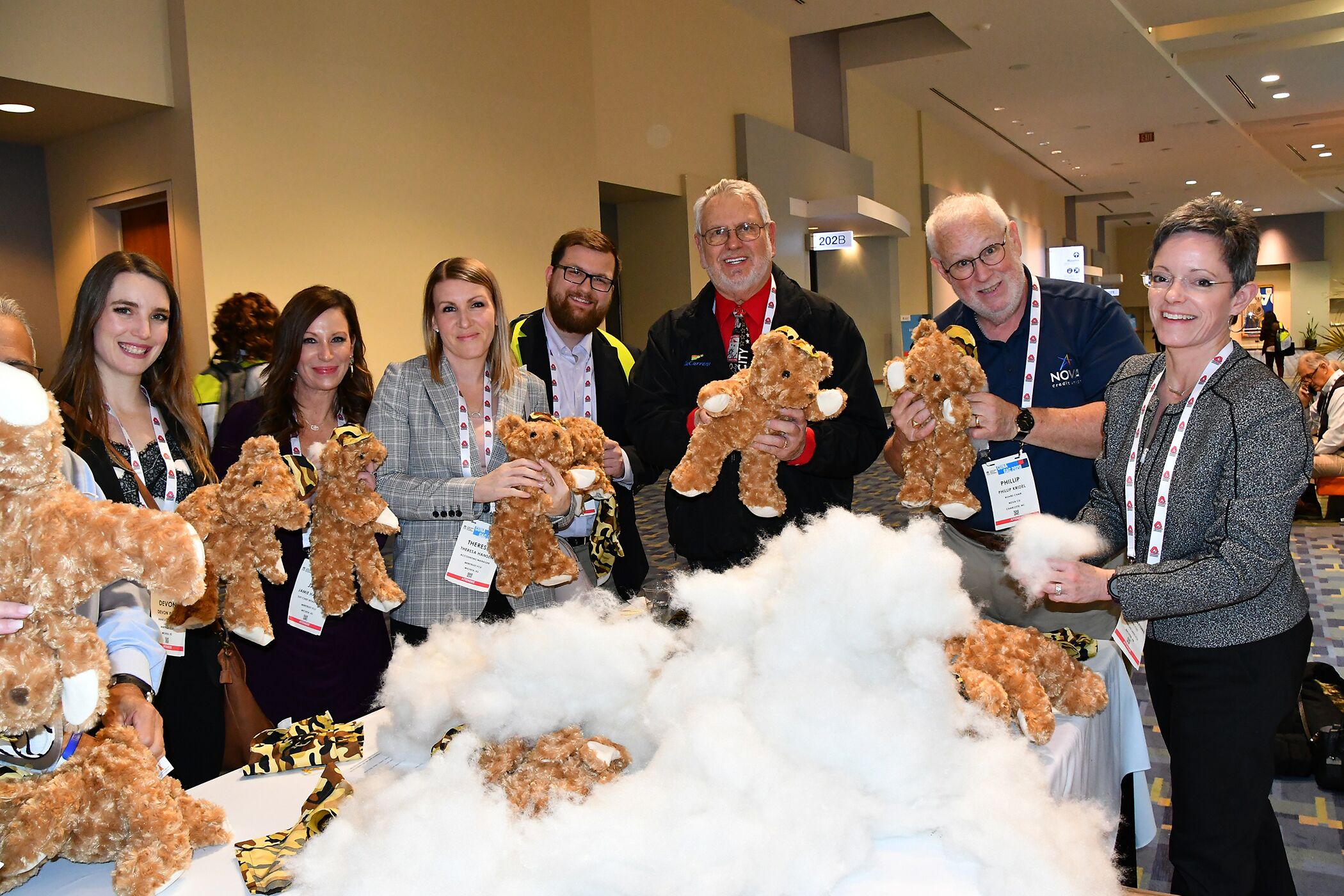
GAC Coverage: Attendees Help to Fill 1,500 Backpacks With Food, Build 200 Teddy Bears
WASHINGTON–Some attendees at CUNA’s GAC came together to help fill 1,500 backpacks with food for children in need while also making 200 teddy bears for children whose parents are deployed overseas.

The event was organized by the National Credit Union Foundation and sponsored by Fiserv.
On behalf of Blessings in a Backpack, GAC attendees assembled bags filled with food for children in the Washington area who rely on school meals and don’t have reliable access to food during weekends. The nonprofit focuses on providing food on the weekends for elementary school children across the United States who might otherwise go hungry.
“GAC advocates for the financial empowerment and wellbeing of all Americans,” said Gigi Hyland, executive director of the National Credit Union Foundation. “Fiserv is a strong credit union partner that believes in the purpose of our movement, and their development and execution of this initiative helped this year’s GAC attendees fulfill the philosophy people helping people.”
Teddy Bears Made
In addition, as part of Operation Gratitude’s Battalion Buddies program, attendees made teddy bears to serve as companions for children whose parents are deployed with the U.S. Armed Forces. The non-profit seeks to forge strong bonds of support between Americans and their military and first responder heroes through volunteer service projects, acts of gratitude, and meaningful engagements.
“Fiserv is committed to giving back to the communities where we live and work,” said Theo Curey, president, Credit Union Solutions, Fiserv. “The spirit of community service and giving back is foundational to credit unions, and GAC attendees from across the United States were eager to help children in need through these two initiatives.”
The company said the Give Back activity at GAC was inspired by Fiserv Gives Back, the Fiserv global corporate social responsibility program. The program supports the local communities where Fiserv associates live and work, with a focus on making an impact in areas of financial health, education, environmental stewardship, and health and wellness.
GAC Coverage: NCUA’s Hood Defends Sale of Taxi Loan Portfolio; Announces New Initiatives, Grants
WASHINGTON–NCUA Board Chairman Rodney Hood used his appearance before CUNA’s GAC to defend the agency’s decision to sell its portfolio of taxi medallion loans to a hedge fund.
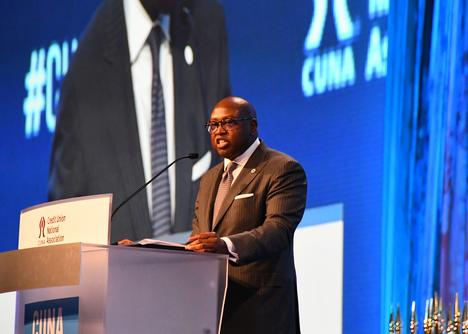
Rodney Hood shares additional details around process leading up to the medallion portfolio sale
Hood also provided additional details around the process leading up to the sale, and responded to some of the specific issues that have been raised.
Separately, Hood noted new grants will soon be available for smaller CUs and the agency will also conduct a comprehensive review of all the NCUA’s guidance letters and legal opinions to determine if they are still relevant in today’s regulatory climate.
As CUToday.info has reported extensively, the agency has come under significant criticism from one of its former executives, several members of Congress and the CU trade groups for its announcement last week that it was selling a portfolio of more than 3,500 taxi medallion loans to Marblegate Asset Management for $350 million, or about one-third of the portfolio’s outstanding loans.
Many had been hopeful the agency would join in some type of public-private partnership that would allow for the loans to be reworked. Many of the borrowers are significantly upside down in the loans for taxi medallions, which have sunk from their one-time seven-figure value to less than a fifth of that. NCUA took over the loans following the failure of a half-dozen credit unions, primarily in New York.
As CUToday.info reported here, NCUA Board Member J. Mark McWatters also dedicated a portion of his remarks one day earlier at GAC to the same issue.
600 Loans Refinanced
“For nearly six years, the taxi medallion crisis has placed enormous financial and emotional strain on taxi medallion holders and their families,” said Hood. “The NCUA has been working to resolve the collapse of several federally insured credit unions that supported the taxi industry for nearly a century. These efforts included protecting member deposits, ensuring that former members could continue to use a credit union for their financial needs, and working with borrowers on an individual basis to keep drivers in their vehicles and to provide relief where we could. This included restructuring loans to reduce payments and interest rates, resulting in more than 600 loans refinanced or modified.”
Hood said he “firmly believes” the sale will help borrowers and their families by providing “greater certainty over the management of their loans.”
“I understand this decision may not be popular or satisfy everyone. But to quote Aristotle, ‘There is only one way to avoid criticism: do nothing, say nothing, and be nothing’,” said Hood. “Additionally, the collapse of the taxi medallion market, and the failure of several credit unions that supported the taxi industry has already cost the Share Insurance Fund approximately $750 million dollars.”
‘Made Without Knowledge’
Hood said he received a Jan. 22 letter that asserted disposing of the assets in a sale to a single buyer would yield lower asset values.
“However, this assertion was made without knowing the portfolio’s size, characteristics, or condition of the assets,” Hood said. “Instead, it suggested NCUA should hold the assets until some future date and allow credit unions to purchase the distressed assets.”
Hood said the agency evaluated a variety of options, including holding and servicing the loans and of asset sales structures including structured sales and securitization.
“But after careful consideration, investor outreach, and consultation with an independent financial advisor, we determined a singular bulk sale would be the best vehicle to resolve these specific cases and yields the best feasible recovery,” said Hood. “While the agency preferred a bulk sale offer, we also advised interested bidders that we would take subset bids on a portion of the portfolio. The sum of the subset bids submitted were not greater than the bids for the overall portfolio.”
Repeating comments he made during the most recent NCUA board meeting, Hood said the agency vetted bidders and only accepted an offer from Marblegate after it agreed to work in a “good-faith manner” with borrowers.
In all, Hood said NCUA reached out to 23 qualified firms with experience in handling distressed commercial assets, and six of those submitted bids. Two firms went through to the final due diligence bid round and submitted two independent offers.
“Holding these medallion assets beyond a reasonable period could have the NCUA repeat these mistakes of the past,” Hood said. “Moreover, a financial advisor team built a comprehensive record as to why we needed to sell these assets in bulk to maximize the value of the assets while treating the borrowers in good faith…We have a duty to protect the Share Insurance Fund, and it is a duty I take seriously. I firmly believe this decision balances our duties and responsibilities to minimize potential losses to the fund with borrowers’ needs for certainty, compassion, and flexibility.”
Other Issues Addressed
Hood, who last appeared before GAC a decade ago during his first term on the NCUA board, praised credit unions for their financial health and the recovery from the financial crisis of a decade ago, as well as for their work in promoting financial well-being of consumers.
But Hood said he also wants credit unions to ask themselves a number of questions, including:
- How can credit unions continue to expand access to affordable, quality financial services to more members, while ensuring the industry’s ongoing safety and soundness?
- What are the challenges the industry is facing?
- What can the NCUA do to support credit unions in the pursuit of those goals and best prepare them for the changes that lie ahead?
“Since becoming NCUA chairman 10 months ago, I have tried to be both innovative and forward thinking,” Hood told the meeting. “To make good on that effort, I’d like to consider these questions more closely and talk about what the industry can do, and what the NCUA can do, to address the challenges credit unions face — and the opportunities available to them — in the coming years.
Help for Rural America
Looking forward, Hood said in the coming weeks NCUA will be announcing a set of initiatives aimed at improving financial services in under-served, rural communities.
“As we all know, these communities have experienced a collapse in the availability of banking services over the last couple of decades as a Federal Reserve report detailed in November,” said Hood.
Separately:
- Hood said the agency will continue to explore ways to make its operations more efficient. To that end, he said NCUA will also conduct a comprehensive review of all its guidance letters and legal opinions to determine if they are still relevant in today’s regulatory climate. “We can make a significant dent in our regulatory burden by removing outdated or duplicative guidance,” he said.
- Announced that effective May 1, $1.5 million in grants for smaller CUs will be available.
CU Trades Respond
Following Hood’s remarks, NAFCU thanked the NCUA chairman “for making changes today that will be well-received by the industry across multiple fronts,” said NAFCU President and CEO Dan Berger. “From updating important guidance, archiving outdated and duplicative guidance, to improving the agency’s overall website functionality, these updates are a testament to NCUA’s commitment to transparent and timely communication with the industry. Credit unions work hard on behalf of their members each and every day, and clear rules of the road will help ensure they can work quickly and confidently in providing safe and suitable services to their communities.”
CUNA President and CEO Jim Nussle applauded NCUA’s attention to reducing regulatory burden.
“Chairman Hood’s announcement today at the CUNA GAC that the agency would conduct a comprehensive review of all NCUA’s guidance letters and legal opinions is an important step toward helping reduce the burden that credit unions face in delivering on their mission to promote thrift and provide access to credit for provident services,” Nussle said. “Consumers turning to credit unions stand to benefit when resources are focused on their needs rather than onerous, repetitive hurdles.”
GAC Coverage: Rep Decries Loss of Community Institutions, ‘Outlandish Rhetoric’ Over Capitalism
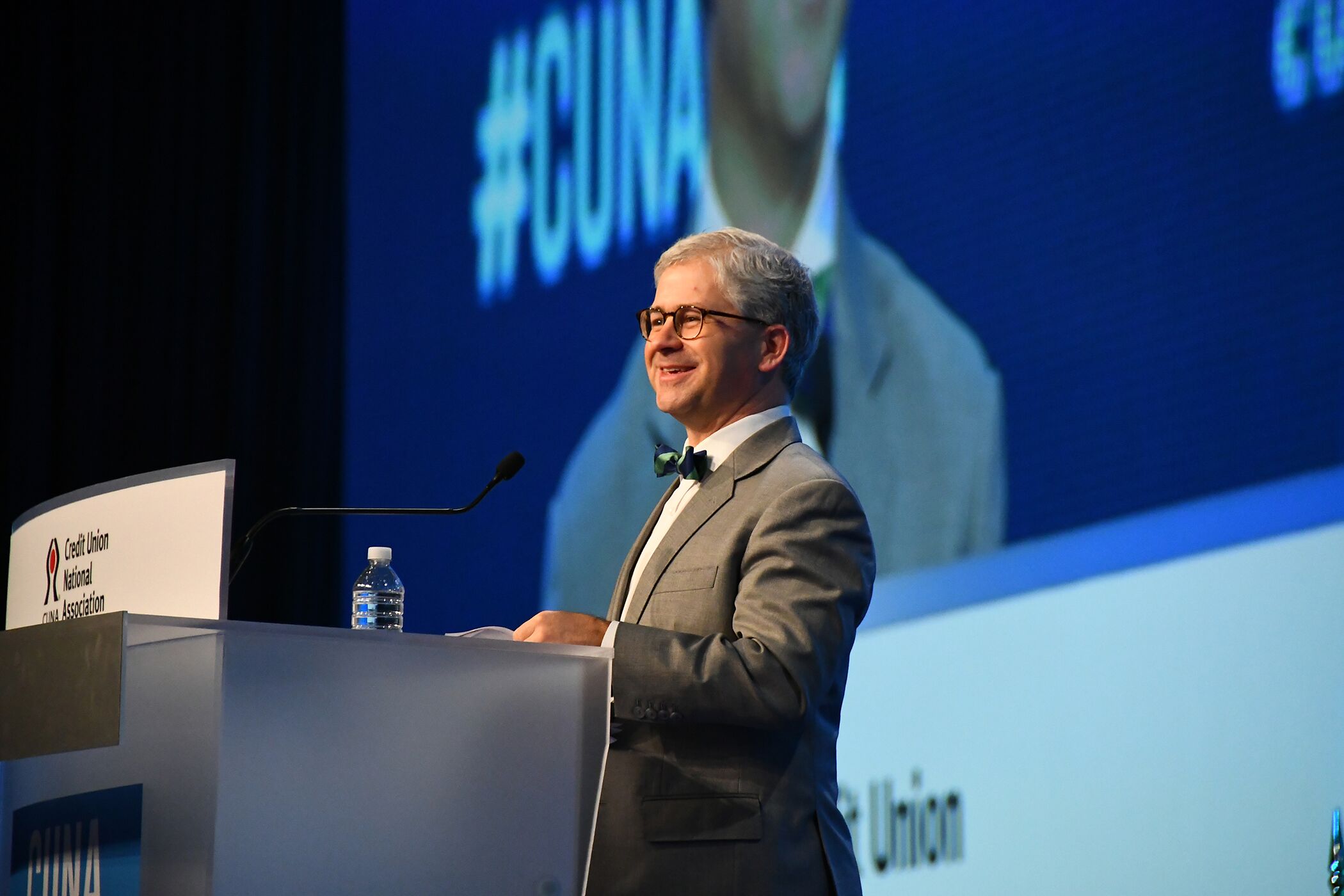
WASHINGTON–Rep. Patrick McHenry (R-NC) told credit unions he thinks of them when he thinks of how his own father started a small business mowing grass and then used a credit card to grow that business.
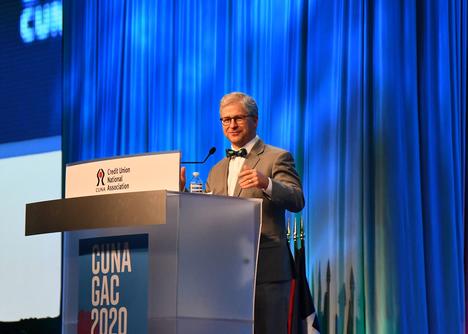
Patrick McHenry talks about his CU roots during conference
In remarks to CUNA’s GAC, McHenry said, “I think of the challenges my father had and why what you do helps small communities and families and individuals to have capacity to help themselves” is so important,” said McHenry. “That’s my motivation for making sure we have healthy credit unions. And I know that’s what motivates you to serve your members every day.”
McHenry said capitalism is under attack in Washington, with some suggesting capitalism is “dead.”
“That’s not what I hear when I’m in North Carolina and that’s not what you hear from your members,” said McHenry. “We are fighting for the direction of our country. There is outlandish rhetoric from a few in Washington. It’s important to remind people it’s our system that works and how we use that system needs to be updated, our responsiveness to our people needs to be updated. That capacity is within us.”
Shrinking Marketshare
McHenry noted that over the past 30 years the marketshare of community financial institutions has gone from holding 30% of assets to just 6.6%. The number of credit unions has declined by 14% over the last decade, he added.
“Last time I checked you weren’t the cause of the financial crisis,” said McHenry. “But unfortunately in the marketplace you’re being held to account for the mistakes of others. We have had bad law and bad regulation that applies to you that should not be applied to credit unions.”
McHenry urged CU reps to head to the Hill and “allow policymakers to put real stories and real lives to these complex regulations.”
GAC Coverage: Senator Says He’s Optimistic About Pot Biz-Related Legislation
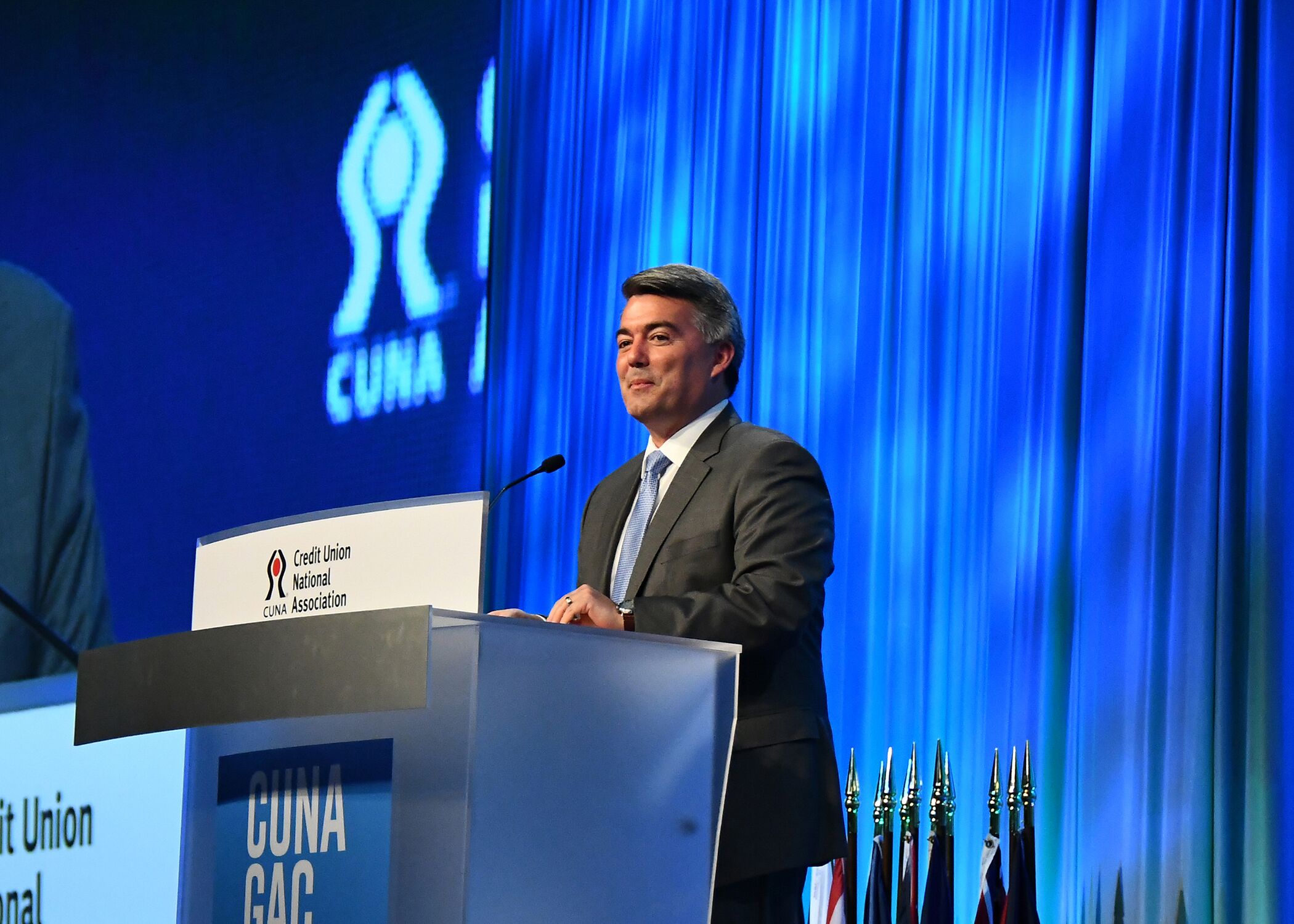
WASHINGTON–There are few politicians who have appeared before a credit union audience who could cite more ties to CUs than Sen. Cory Gardner.
Speaking to CUNA’s GAC, Gardner said he got his first checking account at a credit union; his father served on the board of a credit union; his father’s farm equipment company received a loan from the credit union; he painted a wall at a credit union as part of a fundraiser for a choir; and he received his first car loan through a credit union.
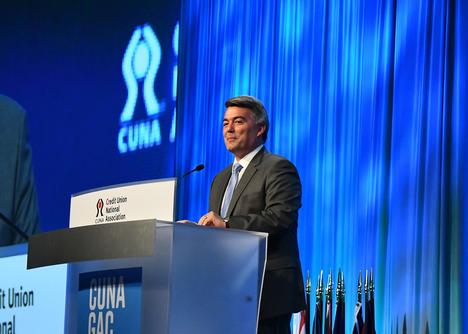
Corey Gardner tells meeting he got his first checking account at a CU
In short, Gardner said he is a credit union supporter.
He said he is also a supporter of federal legislation to eliminate many of the challenges credit unions face in serving marijuana-related businesses. While he acknowledged he has opposed legalization, the state’s voters have strongly supported it, as have 47 of 50 states in some fashion.
Head in Bong, Sorry, Sand
“Congress is really, really good at sticking its head in the sand and hoping a problem goes away,” said Gardner. “This will not go away.”
As a result, he said he has introduced two pieces of legislation, the STATES Act and the Senate version of the SAFE Banking Act, which has already passed the House, to address some of the challenges.
Gardner acknowledged progress in the Senate may be slow. He noted that of the three states that have not legalized marijuana, all have senators who serve on the Senate Banking Committee. Among the biggest opponents remains Sen. Mike Crapo (R-ID).
“You can’t always believe everything you read in the press,” said Gardner. “While some see no opportunity for it to move forward, I see great opportunity for this legislation to move forward. We need to get this all cash economy out of the shadows and into the sunlight.”
GAC Coverage: CFPB’s Kraninger Talks ‘Rules of the Road,’ Offers Update on QM Patch
WASHINGTON–Consumer Financial Protection Bureau Director Kathy Kraninger—whose own job will be the subject of an upcoming Supreme Court hearing—told credit unions she is committed to effectively using the four tools available to the Bureau to protect consumers: Rulemaking, Supervision, Enforcement and Education.
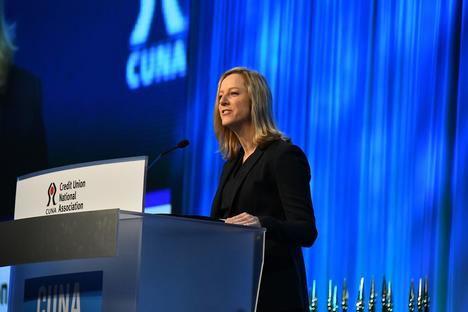
Kathy Kraninger tells GAC she's committed to 'effectively using four tools'
But it will only do so in a prudent and effective way that isn’t burdensome to those it regulates, Kraninger told CUNA’s GAC.
“We are focused on using all four of those tools to prevent harm and protect consumers,” Kraninger said. “Issuing clear rules of the road is our goal. We want the rule process to be transparent, allow for feedback and provide for rigorous analysis.”
Kraninger updated her audience on its review of the Ability to Repay Qualified Mortgage (QM) rule. With the so-called QM patch set to expire in early 2021, Kraninger said the plan is to allow the patch to expire as intended and then to potentially amend the rule by moving away from the 43% ATRQM threshold in favor of a pricing threshold.
Kraninger said the Bureau is working to issue no later than May a proposed rule on the amendment.
Remittance Rule Update
Kraninger also spoke to efforts to improve the remittance rule, which expires in July of 2020. The agency is proposing to increase the safe harbor threshold for company compliance, exempting those making 500 or fewer transfers annually. The CFPB leader said that would remove the burden on 400 banks and 250 credit unions that send a relatively small number of remittances.
Kraninger touched on two other points:
- She said the CFPB will continue working on revising its rules using “fact-finding and data” and by making “evidence-based” decisions.
- Kraninger said the Bureau will continue to advance its “Start Small, Save Up” initiative aimed at empowering Americans to achieve their savings goals.
GAC Coverage: How International Regulations are Affecting Regs in the U.S.
WASHINGTON–Regulatory developments on the international level are increasingly shaping regulations in the United States, according to one panel discussion here.
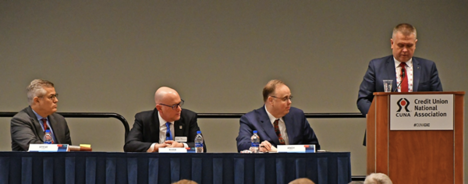
From left: Steven Stapp, Ryan Donovan, Andrew Price Rafal Matusiak.
During CUNA’s GAC a session on the globalization of CU regulation suggested credit unions would be wise to pay attention to what is happening in other parts of the world.
The panel discussion included World Council of Credit Unions’ (WOCCU) Vice President of Advocacy Andrew Price, WOCCU Board Chair Steven Stapp, and the president of Poland’s CU trade group and WOCCU Vice Chair/Secretary Rafal Matusiak. The discussion was moderated by CUNA Chief Advocacy Officer Ryan Donovan.
Among the international regulatory issues touched on during the session:
- Privacy regulations
- Digitization
- Financial inclusion
- Capital standards
“Nearly every new regulatory standard being imposed on credit unions—regardless of which country they’re located in—can be traced back to international standard setting bodies such as the Basel Committee on Banking Supervision, Financial Action Task Force and Financial Stability Board,” said Price. “A great example is the National Credit Union Association’s risk-based capital rule—that is in part designed to implement a risk-based capital component in line with the Basel framework. WOCCU advocated to make sure the concept of proportionality was built into the international standard in order to allow tailoring appropriate for credit unions.”
Continuous Work
Price said he and the WOCCU Advocacy team work continuously to ensure international regulators stress the need for national, regional and state regulators to apply such regulations in a proportional manner for credit unions and other less-complex financial cooperatives.
Stapp, who is president/CEO of Unitus Community Credit Union in Oregon, and Matusiak, president of Poland’s National Association of Cooperative Savings and Credit Unions, agreed the compliance issues their organizations face are heavily influenced by international standards, despite being governed by different regulatory bodies in different countries.
GAC Coverage: A Prediction on Who Will Win Presidential Race, Future of Third Parties & More
WASHINGTON–It’s the question on the minds of many: who will be sworn in as the next president of the United States. One person here offered a prediction, along with thoughts on the future of third parties, overhauling the primaries, and more.
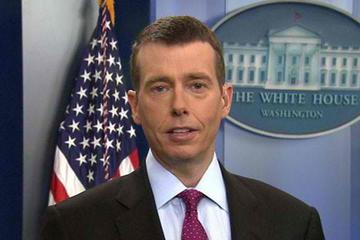
David Plouffe
Political consultant and Obama strategist David Plouffe offered some predictions on how the 2020 race might play out in remarks before CUNA’s GAC here.
“The last election came down to 70,000 votes in three states. This one might be closer,” said Plouffe.
Plouffe said the Trump campaign has undertaken a massive effort to identify everyone who fits the profile of a Trump voter as part of an effort to get out the vote. He anticipates that could lead to 150,000 to 200,000 more votes in some states, such as Michigan.
“The Democrats always have a hard time winning battleground states. Why? In battleground states there are always more Republicans than Democrats,” he told the meeting. “I don’t see a first round pick on that Democratic stage. Incumbents have an enormous advantage: Time. Donald Trump’s team is ready, they are spending hundreds of millions of dollars in social media. They are ready to decapitate whomever the Democrats run.”
Trump’s one disadvantage, said Plouffe, is his personal popularity is in “the danger zone.”
What Rules Today
Another advantage for Trump, according to Plouffe, is memes, gifs and images “rule today,” and Trump is a master of using those media.
“I have spent a lot of time in politics and business. If you have something important to announce, it wasn’t too long ago you thought about who to give the first interview to, what email to send, who to give the speech to,” said Plouffe. “That doesn’t work anymore. Now you have to think about the Instagram post and the Snapchat strategy. This is one of Donald Trump’s strengths. He understands blunt force communicating.
“If you’re not thinking in this way—what is the picture, and ideally a picture that doesn’t require much language?—you need to be. It must be emotional, simple, it can’t bore people. I think this is a challenge for all of us thinking about communicating in one way when the ground is shifting beneath us so dramatically.”
Following his prepared remarks, Plouffe participated in a Q&A with CUNA’s chief advocacy officer, Ryan Donovan. Here’s the Q&A:
Donovan: I am often asked questions with a tone of hope that everything is going to be OK in Washington. Can you tell us it’s going to be OK?
Plouffe: There was not an insignificant number of people during Barack Obama’s terms who thought we were going to turn the country over to Islam. I think it shows the resilience of our system. But I also think our system is fundamentally broken. There are 15% of people on either side and the 70% are the exhausted middle. What gives me hope is you see in city councils and state governments where people do work together. But not in Washington.
I have confidence in the people and in the younger generation, left, right and center, who will not put up with this. My question isn’t whether we’ll have a third party or multiple third parties, the question is when. It’s hard to argue people aren’t getting what they want, especially in Washington. It’s all about maximum positioning today.
And we have a role to play. If (an elected position) steps out and takes a position, even if you don’t agree, send them a contribution.
Donovan: Can a third party candidate win the White House?
Plouffe: Right now, there is not a pathway for a third party candidate to get enough electoral votes. Even the best third party candidate can only get a maximum of 20 electoral votes. Now, can they govern? I think at some point is has to be not just a person, but a movement. Right now a third party could not get to the White House. My feeling is in 10-12 years that could be different.
Donovan: If we can’t change the presidential election process in the short term, is there more opportunity in the primary process? Is the nominating process broken, and could it be improved?
Plouffe: I think you will see big changes now. I doubt we’ll ever see a caucus again. I think we’ll still start with a number of states going first to give a long-shot some momentum. The best idea I’ve heard is change the order each year, so the closest states in the last election go first. If not, what about the four most representative states?
Donovan: You have had opportunity to work for a number of presidential candidates. What are some characteristics you think make a good presidential candidate?
Plouffe: Before qualities, timing is important for a variety of reasons. I’m not sure I’ve ever seen anyone run too early. What if Obama listens to everyone’s advice in 2007 and doesn’t run at all? A lot of people wait for the perfect moment, and I think you should run if you think you have something meaningful to say. Obama, Trump, Clinton, good or bad, they were very authentic people. It’s the ability to be authentic and to inspire people.
Now, there’s a difference between being a good candidate and a good president. Being president isn’t about your agenda, it’s about stuff coming into the building.
Donovan: What about the Electoral College?
I believe we should go to a national popular vote. That’s not going to happen anytime soon. If I were running in a national popular vote I’d spend all my time in Los Angeles, New York, Houston, Miami, all the places where you want to drive turnout. More of the country would see the candidates.
Donovan: Which state will flip its electoral votes in the next election?
Plouffe: It will be Pennsylvania to the Democrats and Minnesota to Trump.
Donovan: Who will standing opposite the chief justice on Jan 20?
Plouffe: Probably an old white dude.
GAC Coverage: What the FHFA Has Planned, League Is Honored and More
WASHINGTON––Credit unions at CUNA’s GAC got an update on what the Federal Housing Finance Agency has planned, saw one state league honored for its international work, and watched a video produced by a former NCUA board member (even if they didn’t know it).
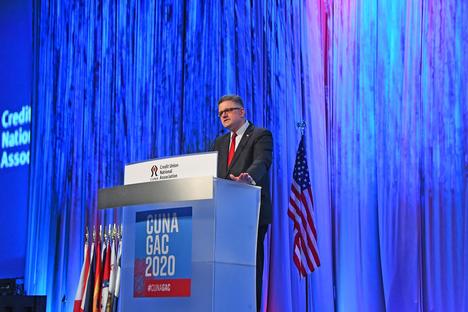
Mark Calabria speaks during CUNA's GAC
FHFA’s Calabria Says GSEs Will Not Discriminate Against CUs
Federal Housing Finance Agency Director Mark Calabria told the GAC his agency is committed to ensuring Fannie and Freddie do not discriminate against lenders based on their size or volume of lending.
As Congress continues to work on a plan to exit the two GSEs from federal conservatorship, both trade groups have expressed concerns credit unions might be pushed aside.
In addition, Calabria noted FHFA is reviewing high-risk lending factors to further promote home ownership that is sound and beneficial to the home buyer.
“The backbone to the mortgage finance system has always been the community lender,” Calabria said.
Calabria added his priorities include facilitating a preparedness strategy for Fannie and Freddie to solidify clear rules in the event of a stressed environment, reducing compliance costs and making the mortgage industry more competitive.
Calabria encouraged credit unions to reach out to FHFA with recommendations on policy changes and ways to streamline regulations.
Resolution Nominates Indiana CU League for WOCCU Honor
The CUNA board passed a resolution Saturday to nominate the Indiana Credit Union League for the World Council’s Distinguished Service Award. The Distinguished Service Award is the highest honor paid to individuals and institutions by the worldwide credit union movement, and was created to recognize outstanding contributions to international credit union development.
“The Indiana Credit Union League champions the credit union model internationally,” said CUNA Chairman Brett Martinez in a statement. “We’re proud to nominate the Indiana Credit Union League for the Distinguished Service Award based on their work advocating for credit unions and their members across the globe. The league is dedicated to ensuring the value of credit unions is understood everywhere, from educating high level international policymakers to ensuring poverty-stricken refugees understand the promise of credit union self-help opportunities through financial education and services.”
According to CUNA, the Indiana Credit Union League has provided financial support, volunteer service, technical assistance and hosted international colleagues consistently over many years in exemplary service to develop international credit union movements across several continents. The league’s work has accelerated the growth of new credit union systems and it has helped disaster damaged credit union systems recover and put themselves back on their feet to serve their members.
Video Produced by Former NCUA Board Member
During Jim Nussle’s opening remarks he showed a video featuring Old West Credit Union, which stepped in to open a branch in Union, Ore., after a bank pulled out. The video featured residents talking about what the credit union has meant to the community. While the video was backed by the Northwest Credit Union Association, it was actually produced by former NCUA Board Member Rick Metsger, who worked in television prior to entering politics and eventually joining the NCUA board.
Nussle ‘Interrupted’ With Reminder in Great Economy Many are Suffering, Including CU Employees
WASHINGTON–CUNA President and CEO Jim Nussle acknowledged credit unions are sick of hearing it, but stressed CU reps must continue to tell their story in Washington and at home—and realize the “home” part includes their own employees and members who are struggling financially.
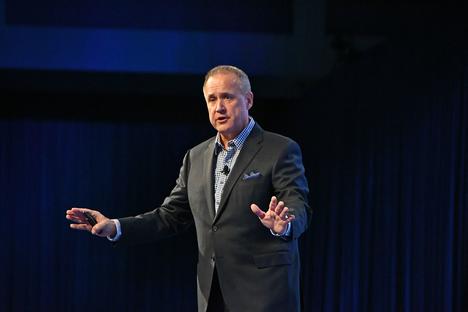
Jim Nussle kicks off day 1 general session at GAC
“Because if we don’t tell it, who will?” said Nussle of the credit union story. “I know there are others who are happy to tell your story for you.”
Nussle began his remarks on stage by extolling the size of GAC, the health of credit unions and the strength of the economy and job market. But he was interrupted by a woman in the audience who stood to say enough was enough. The woman was Nussle’s wife, Karen, who joined her husband on stage as part of a give-and-take that was both humorous and serious.
“All that stuff about how the economy is going great, everything is wonderful and all our phone calls are perfect” isn’t all true,” said Karen Nussle. “Some people are doing well. But if you talk to the front line people, the tellers, they will tell you not everything is going so well. There are record amounts of debt and a lot of anxiety about the future. If you look at the whole picture, all of it, you will see Americans are struggling, credit union members are struggling.”
After sharing three member stories, Karen Nussle exited the stage and Jim Nussle said the point raised was a good one for GAC attendees to keep in mind.
‘More to the Story’
“There is more to the story. Politicians and the media aren’t telling you something that necessarily isn’t true, but they aren’t telling you the whole story. That’s the story you need to be telling on Capitol Hill,” he said. “Eight-in-every 10 workers are living from one paycheck to the next. Let that sink in—80%. And it may be a pretty good paycheck. And that means it might be 80% of every room we are in. It could be eight of every 10 people who walk through our doors. Six-in-10 do not have three months of savings on hand. And we have all heard four-in-10 don’t have emergency savings of $400.
“It’s about how that makes you feel,” Nussle continued. “The research suggests it affects you physically and mentally. It’s how you treat your family and friends and it affects the decisions you make.”
Nussle told the audience they cannot overlook the fact the credit union “workforce is not immune to this.”
Other Statistics Cited
He noted many Americans, including CU employees, are holding multiple jobs. He also cited a number of financial statistics:
- Consumer debt just crested at $14 trillion for the first time in history, with $450 billion of that credit card debt. The average American has four credit cards in their wallet. The average debt-per-household in the U.S. is approximately $136,000.
- 25% of Americans earning over $150,000 don’t have emergency savings.
- A Gallup Poll found 45% of the country said what they feared most financially is they would go bankrupt if they suffered any sort of health event.
- The National CU Foundation found among CU members, nearly 60% admit openly they are financially struggling, and 43% of CU members said they ran out of money at least one time during the last year.

Jim and Karen Nussle
What Is Being Done to Help
Nussle told the meeting credit unions know each person and know each person is different and that no one-size-fits-all solution exists. He further noted that while financial education is good in schools, it needs to occur at all various life stages from college graduation to birth of a child to a new home to retirement.
“It’s our sole motivation to help. We’re not here for the profits. We are here because we know we can make a difference,” said Nussle.
The results credit unions have gotten, according to Nussle, include:
- 115 million stories of how people’s lives are changed
- $19 billion in benefits to credit union members in 2019
- $25 billion in small business loans creating 386,000 jobs
Do Three Things
“Are we always perfect? No. We can always improve, individually and collectively. But we don’t have to do it alone,” said Nussle, touching a theme he has frequently alluded to, “cooperative superpowers.”
Nussle called on GAC attendees to do three things this week:
- “The first is the reason we have a GAC, advocacy. We are going to have more than 600 meetings across Capitol Hill.”
- We need to amplify the CU story and create awareness, especially at home.
- Exercise. “I’m not talking about the treadmill. I’m talking about the credit union and cooperative superpowers.”
McWatters Discusses Taxi Medallion Sale, Regulation, Mergers, and Liquidity
WASHINGTON–In the wake of recent criticism by the agency by at least one member of Congress, a trade group and a long-time CU leader, an NCUA board member addressed the recent sale of the taxi medallion portfolio as well as other issues during remarks to CUNA’s GAC here.
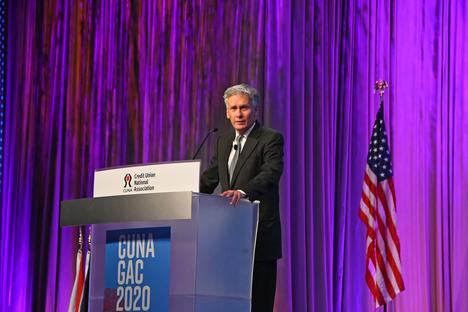
Mark McWatters addresses sale of medallion portfolio during GAC.
McWatters largely repeated a theme he touched on during the most recent NCUA board meeting on the morning after announcing the sale, saying the agency’s statutory requirement to limit losses to the National Credit Union Share Insurance Fund was the primary factor in the decision to sell its portfolio of taxi medallion loans.
McWatters added consumer protection was a major consideration in choosing the winning bidder.
“The NCUA was charged under the Federal Credit Union Act with developing a plan that would yield the least long-term cost to the Share Insurance Fund,” McWatters told the meeting. “We made it very clear to those interested in acquiring the portfolio that the winning bidder must work with the taxi medallion loan borrowers in a transparent, good-faith manner and in full compliance with all applicable consumer protection laws.”
McWatters said NCUA carefully considered a proposal for a public-private partnership to purchase the loans, but said the firm offer already in-hand trumped the fact there was not even a proposed partnership in place, meaning the agency had to act so as not to lose a qualified bidder.
As CUToday.info reported, NCUA sold the taxi medallion portfolio of more than 4,000 loans for approximately $350 million to Connecticut-based Marblegate Asset Management.
$750 Million Loss
McWatters reminded the meeting the NCUSIF has already taken an approximately $750 million loss on the portfolio, and further suggested additional losses would certainly delay future possible Share Insurance Fund distributions to credit unions.
“It is critically important to note we would not have permitted the sale unless we sincerely believed the winning bidder would treat taxi medallion borrowers in a transparent, good-faith manner,” McWatters said. “If we were to have delayed the disposition of the medallion loan portfolio, there is a substantial likelihood the agency would have to forego distributions to credit unions for the immediate future, if not longer.”
Other Points
Other points touched on by McWatters during his remarks:
- McWatters said NCUA has worked to become more transparent and active in reducing regulatory burdens. “We have enacted thoughtfully tailored and targeted rules aimed at the actual risks present by the credit union system to the Share Insurance Fund,” McWatters said. “I am pleased to report we have made substantial progress as an agency in a spirit of collegiality and collaboration.”
- McWatters spoke to the issue of credit unions purchasing the assets of community banks, saying, “It is worth considering whether credit unions and community banks could benefit from a ‘Come now, and let us reason together’ approach.’”
McWatters said a number of misperceptions have arisen, in large part over bankers’ objections to the credit unions’ statutory federal tax exemption, about the purpose and the result of the relatively small number of transactions each year where credit unions acquire bank assets or liabilities.
“We should remain mindful that it is not intellectually possible to discuss the credit union tax exemption in a fair-minded and objective manner without acknowledging the additional statutory restrictions placed on credit unions and the absence of such restrictions on community banks, notwithstanding their ability to avoid corporate-level taxation by making a taxpayer-subsidized Subchapter S election,” McWatters said. “These transactions reflect market forces and are negotiated in an arm’s-length manner. The NCUA should respect the independent, market-driven decisions of the interested parties, unless safety and soundness, consumer protection, and related matters indicate to the contrary.”
- McWatters noted that during his 40-year career he has seen several financial crises, which is why adequate liquidity and capital and the necessity of avoiding concentration risk remain paramount to him.
NCUF’s Hyland Urges Member Financial Well-Being Be at Center of Every Strategy
WASHINGTON–Credit unions really are making members’ dreams come true, but they will only continue to do so by meeting some very real challenges moving forward, according to one person.
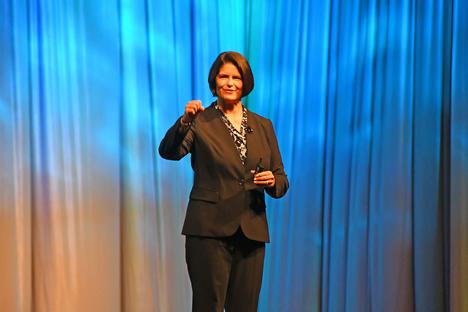
Gigi Hyland speaking at GAC
“It’s all about putting members’ financial well-being at the very center of your strategy,” said Gigi Hyland, executive director of the National Credit Union Foundation in remarks to CUNA’s GAC.
According to Hyland, credit unions are really looking deeply at their employees and members to measure where they really are in their financial lives and then finding ways to meet their challenges.
The challenge moving forward, said Hyland, includes meeting members “where they are in life; not where you want them to be or hope they will be. And that means helping your employees to also understand what it means to be financially well. We come from so many places, with different experiences, but we share a commonality around dreams in life.”
According to Hyland, meeting that challenge also comes down to the “why” that’s true for every credit union.
“You don’t work for bank,” she said. “The cooperative financial model works.”
Three Pillars
Hyland also spoke to the three pillars of the Foundation: ignite, Inspire and Respond.
Ignite. “It’s what you do at home that matters.” Hyland encouraged credit unions to send representatives to CU FinHealth Conference, scheduled for San Antonio in April 29-May 1.
Inspire. “You need to go back to your credit union and think long and hard about what your membership is going to look like in five years, 10 years and 20 years. You need to do a deep dive on your credit union to make sure everyone from your board to your front line staff represent all of your members.
“This is all about financial well-being. It means having the capability to lead the financial life that is the financial life I want,” Hyland continued. “The other challenge is to make absolutely sure that what you are presenting to the community are all of the stories for all of the members you serve, including the financially challenged and the underrepresented.”
Respond
Finally, said Hyland, Respond is about “your moment to do the things you have always done to serve people and your communities—and then to do more. To double-down on your members’ financial well-being. To double-down that you look like your membership and you deeply empathize with your members.”
Filene Officially Launches Center of Excellence for Consumer Financial Lives in Transition
WASHINGTON–During CUNA’s GAC the Filene Research Institute launched its Center of Excellence for Consumer Financial Lives in Transition, with Dr. Lisa Servon as its new research fellow.

Dr. Lisa Servon
According to Filene, the four-year research project will focus on strengthening credit unions’ capacity to adapt to consumers’ changing financial lives and livelihoods as they face new forms of economic struggle and financial fragility. The Center will be led by Servon, who is the Kevin and Erica Penn Presidential Professor and chair of City and Regional Planning at the University of Pennsylvania Stuart Weitzman School of Design.
“I am excited for this opportunity to go deeper into the trigger areas that drive people to alternative financial services,” said Servon in a statement. “People have a right to be financially healthy and the right to safe and quality financial services. The work from this Center will help credit unions serve people facing different kinds of transitions – income volatility, retirement, physical health and inequalities. If we can understand the frequency of these kinds of transitions and when people are going through them, we may be able to help alleviate the financial burdens that have been historically created.”
Servon has previously worked with Filene. In 2016, Filene hosted a special listening session featuring Servon and her book, “The Unbanking of America: How the New Middle Class Survives.”
Goals of New Research
Filene said Servon will lead new research to:
- Study how individuals and families earn, save, spend, borrow, invest and give across their lifecycles
- Prepare credit unions for an increasingly diverse consumer base characterized by heightened fragility
- Build a playbook for credit unions to better serve consumers’ changing needs and expectations
- Document trends in consumer financial services, including auto, mortgage, healthcare, and student lending, as well as savings and personal financial and wealth management
- Identify new member groups through granular segmentation, such as households and communities of color, veterans and military families, incarcerated and recently incarcerated populations, students and multigenerational families, etc.
- Investigate the future of work and business services, from the independent workforce to new forms of small-business entrepreneurship.
Companies Supporting Center
Support for the Center of Consumer Financial Lives in Transition is provided by CUNA Mutual Group, BCU, Digital Federal Credit Union (DCU) and PSCU.
“At CUNA Mutual Group we believe that a brighter financial future should be accessible to everyone.” said Tim McAdow, VP, Go-to-Customer with CUNA Mutual Group, in a statement. “Credit unions grant us the privilege to act as an extension of their institutions to make an impact for members. When I consider the outcomes from this new center it’s clear we will generate fresh consumer insights and trigger dialogue that will help us all design and deliver more relevant and impactful experiences. Research like this will help ensure positive and quality financial services are accessible to everyone.”
Filene members had a chance to hear Servon speak at Filene’s annual Board Chair Breakfast during GAC.
“There is so much to learn about the forces shaping peoples’ lives, from the big transformations remaking our economy to planned and unplanned events across a single person’s lifecycle,” said Taylor C. Nelms, senior director of Research at Filene Research Institute. “Both kinds of transitions introduce a range of new financial and non-financial challenges. Credit unions play a vital role in meeting people’s diverse financial needs. With Dr. Servon’s leadership, we can think creatively on the credit union value proposition and think about what cooperative finance can do through and beyond isolated transactions.”
Six New Centers Planned
Filene noted the Center for Consumer Financial Lives in Transition follows the successful launch of the Center of Excellence for Diversity, Equity and Inclusion in January. In 2020, Filene said it will be launching six new Centers of Excellence focusing on:
- Diversity, equity and inclusion practices and policies in credit unions
- Consumers’ changing financial lives and livelihoods, including new forms of work, entrepreneurship and personal finance
- Best practices in measuring and accelerating innovation and incubation
- Emerging financial technologies and their effects on business strategy and consumer experience
- Impacts of financial services on community well-being and the strategic advantages of social responsibility
- Advancement of credit unions’ capabilities in data governance, management and analytics
Outgoing CUNA Chair Offers Remarks; Stang Elected as New Chair
WASHINGTON–CUNA’s outgoing chairman told credit unions in his final remarks to GAC he exits believing “now is our time.”
Brett Martinez
Brett Martinez, CEO of Redwood Credit Union in California, turned over the CUNA chairman’s gavel to Troy Stang, president of the Northwest Credit Union Association, during the meeting.
But before leaving he told credit unions the experience leaves him a “really a big believer in the three-tier system. CUNA cannot do it alone. We have CUNA in D.C., the leagues at the state level, and all of you at the local level. Please don’t ever underestimate the power of the three-tier system.”
Martinez said advocacy remains at the center of everything CUNA does, which is why it has for the fourth year in a row been ranked as the number-one financial trade organization when it comes to advocacy in Washington.
“History has shown our industry is unbeatable when we work together, and that we are very vulnerable when we don’t,” he said. “Personally, I am very confident in our industry’s future as long as we continue to row together in the same direction.”
Be More Inclusive
Finally, Martinez also urged credit unions to expand their efforts toward becoming more inclusive.
“Now is the time to think and lead by example on DEI. Think about what you are going to do on DEI when you go home,” he said.
Nussle Welcomes Stang
“Troy served the organization well during his tenure as the Vice Chairman of our CUNA board,” said Jim Nussle, CUNA president and CEO. “I want to welcome Troy to his new role. I know CUNA will benefit greatly from the experience and energy he will bring to the position. I also want to thank our outgoing Chairman Brett Martinez for his excellent leadership and contributions to the credit union movement.”
“I am honored to be elected as Chair of the CUNA board of directors, in service to the Movement,” Stang said. “The real tangible value not-for-profit, cooperative credit unions generate and deliver to diverse memberships and communities across our great nation is what makes these financial institutions so different. There is no other financial services model that is directly accountable to those it serves. I am committed to inspiring collaboration throughout the industry to ensure the cooperative charter credit unions operate under is advanced and protected.”
CUNA board of directors executive committee members are:
- Chairman Troy Stang, President/CEO of the Northwest Credit Union Association
- Vice Chairman Brad Green, President/CEO of Listerhill Credit Union
- Secretary Tony Budet, President/CEO University Federal Credit Union
- Treasurer Lisa Ginter, CEO CommunityAmerica
- At-Large Member Caroline Willard, President/CEO of Cornerstone Credit Union League
CUNA Releases Its Preliminary 2019 Financials
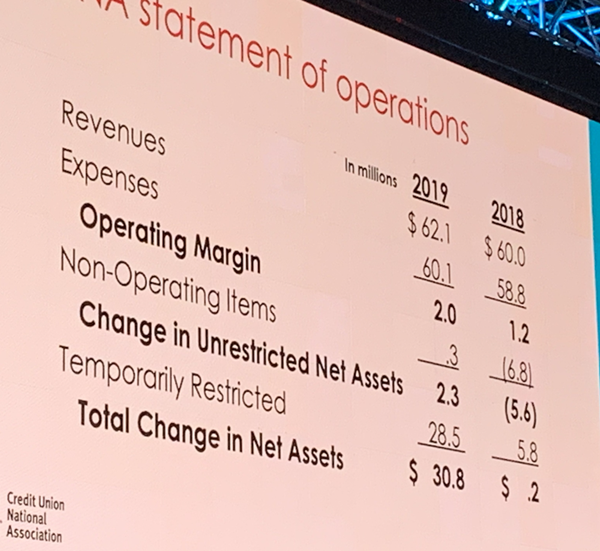
WASHINGTON–CUNA closed 2019 with a net operating margin of $2 million, an increase over the $1.2 million in reported for 2018.
Those figures are preliminary and not officially audited, according to CUNA’ Treasurer Tony Budet, president and CEO of University FCU in Austin, Texas. Budet released the figure during CUNA’s GAC.
CUNA reported a sharp increase in 2019 in total assets of $86 million due primarily to funds donated in support of its Open Your Eyes awareness initiative ($34 million).
For the same reason, it net assets also show a bump to $51 million.
Overall, CUNA had 2019 operating revenues of $62.1 million against expenses of $60.1 million. Dues remain its primary source of revenue at $30.5 million, with $26.9 million in solutions income and $4.8 million in other income.
For 2020 CUNA is projecting revenues of $70.2 million against expenses of $70.1 million. It expects dues income to increase to $32.2 million this year.
Fresh Off Big Year of Fundraising, Worldwide Foundation Celebrates at Italian Embassy
WASHINGTON–Saying it is fresh off its biggest fundraising year in nearly a decade, the Worldwide Foundation for Credit Unions thanked its supporters during a 2020 Champion Celebration here.

Held in conjunction CUNA’s GAC, the event attracted more than 400 people to the Italian Embassy.
“We are so pleased to honor our Champions, who helped us raise over $2 million across all Worldwide Foundation programs in 2019—with $840,972 of that total going to our Priority Fund. The Priority Fund supports World Council of Credit Unions in its efforts to acquire new credit union development projects and extend its existing projects around the world,” said Worldwide Foundation Executive Director Mike Reuter.
WOCCU said it is currently implementing credit union development projects in Haiti, Ukraine, Kenya, Burkina Faso, The Philippines and Indonesia—and is working to build on that success by adding more projects in 2020.
‘No Question’
“There is no question that supporting World Council’s development work is an important and essential part of improving people’s lives through access to affordable, reliable and sustainable financial services,” said Worldwide Foundation Board Chair and SchoolsFirst Credit Union President/CEO Bill Cheney.
The Worldwide Foundation said it is shooting even higher for its Priority Fund this year, with a goal of raising $975,000 in 2020.
To make a donation or get more information, go here.
Lessons Learned for Hiking The Hill After Working on the Hill
WASHINGTON–Ryan Donovan shared a couple of examples of how credit unions were working for him years before he ever worked for credit unions during CUNA’s GAC.
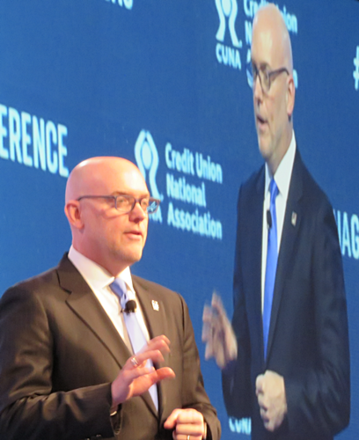
Ryan Donovan speaks to GAC about how CUs have helped him in his life.
Donovan, the trade group’s chief advocacy officer, recalled first moving to Washington to go to work on the Hill when the office manager on his first day at work told him to get down to Congressional FCU so he could get paid.
A few years later, enjoying life in Washington, he said he found himself over his head with credit card debt. Once again, he went to his credit union to get assistance.
Three Lessons
Donovan told attendees they should take three lessons from those stories:
- First, “it’s a pretty common story among the congressional staffers you are going to meet with this week.”
- Second, “a good CU story doesn’t have to be complicated.”
- Third, “these stories humanize the work you do. There is certainly a place for facts and figures, but everybody has numbers and too often Congress gets bogged down in those numbers. Credit unions are in a better position than other financial services providers to humanize their impact.”
Donovan said a key part of the message on Capitol Hill must be how credit unions are there for members in good times and bad.
A Reminder on Data Security
During his remarks he also urged credit union leaders, when meeting with members of Congress, to highlight that data security and privacy is the “top issue for credit unions in 2020 and it is a top issue for Capitol Hill – it impacts everyone. And we need a national data security standard that applies to everyone. You can’t have data privacy without data security.”
GAC Kicks Off With Advice On Leadership
WASHINGTON–In a city known more than ever for divisiveness, one person who has met many of the world’s leading political figures told credit union leaders they would be best served asking themselves if they wanted to be moths, or would their legacies be that of torch bearers?

Platon
The photographer and portrait artist who goes by the single name Platon told an opening session of CUNA’s GAC he has met numerous world leaders, but in many he doesn’t see real leadership. Instead, he said, leadership and change are really driven by a single word, and he urged credit unions to live by that word.
Platon came to meet so many of the world’s best-known figures somewhat by accident. His first-ever photograph of an American president was Bill Clinton, and he got the gig from Esquire after other photographers were not available. He had been given strict orders by the magazine he was to take a standard head shot, and for the first seven and a half minutes of his allotted eight that’s exactly what he did.
‘A Bit of a Moment’
“And then I had a bit of a moment. Have you ever had a bit of a moment when you talk to yourself? When you tell yourself you’re a bit of an imposter?” he asked. “I thought what have I got to lose. I will never have another opportunity to photograph a president. Sometimes we have to roll the dice on ourselves and dare to be authentic.”
So Platon put a wide angle lens on his camera and shot Clinton from below. The resulting image appeared on the cover of Esquire. Not everyone was a fan.

Bill Clinton
CNN’s Larry King called the photo “disgusting.” Famed journalist Bob Woodward appeared on King’s program and said Clinton’s tie was intentionally meant to point toward a specific area. Platon thought his career photographing the powerful and famous was over. But it was anything but.
The Powerful & Famous
First, before sharing Platon’s advice for credit unions and really people in general, here are some of the other world leaders he has photographed, along with his comments about each:
-
Vladimir Putin. Platon shot Putin for the cover of Time after he was named man of the year. He said he arrived in Russia and was driven past the Kremlin, where he thought the photo shoot would take place, and through the countryside until he arrived at Putin’s private dacha. Surrounded by armed guards and with a gun to his temple, Platon said he was led into a room to await the Russian leader. “I said, ‘Mr. President this I a great honor for me.’ I said before I begin I have a question for you. I said I am an Englishman, now proud to be an American. When I was a kid growing up I listened to the music of the Beatles and I want to know if you ever listened to the Beatles.’ He gets angry, he orders everyone out but the room but the guards. He then said in perfect English, ‘Oh my God, I loved the Beatles.’ He said his favorite song is Yesterday. Think about it. I did think about it. It was a subliminal message about the power and glory of the former Soviet Union. That conversation let me in. I could feel his cold breath on my hand and that’s how I got the truth.

Vladimir Putin
-
Donald Trump. “OK, everybody calm down,” said Platon to laughs. “He’s one of the most extraordinary people I’ve ever met. I photographed him in Trump Tower. He was very charismatic. I said I want you to look into the camera in a very symmetrical way. He said that’s not how we are going to do this. He said, ‘This is my best side.’ It tells me that despite his great battles with the media, he secretly loves the media. It’s his secret weapon.” Platon said he later said to Trump, “I have followed your career path. Everything you say and do seems to cause controversy; how do you navigate that storm? He calmly looked at me and said, ‘I am the storm.’ I had those words ringing in my head throughout the campaign. The press said he was going to implode or now they now say his presidency is going to implode. But the only person who can navigate the storm is the person who created the storm.”

Donald Trump
- Mohammad Ali. Platon shot the last photographs of the one-time heavyweight champ, including the last time he was really able to move due to Parkinson’s. “He had essentially lost control of his arms and he couldn’t move them, but when I draped the U.S. flag over his shoulders he was able to muster the strength one time make a fist. I said, ‘Mahammad, you are the greatest; teach me to be great. How can my generation be as great as yours needed to be during the civil rights era?’ And he whispered in my ear, ‘I have a confession to make; I wasn’t as great as I said I was. I thought holy shit, that’s the greatest confession I have heard in my life. He said, ‘You misunderstand. It wasn’t that I was great. It was that the people saw themselves in my struggle. And now I have the great honor to give it back to you.’ If you can get people to see themselves in the story you put forward, then you can achieve greatness. It’s bridge building.”
-
George Clooney. Platon asked Clooney for his thoughts on the world we’re in. Clooney’s response: ‘We live in extraordinary times. We have more information and connectivity than ever before and yet sometimes we know less. If you want a news today you probably go to a source that confirms what you already believe. And the danger is we are trapped in our own echo chamber. That beautiful thing where we come into a central space and debate ideas is rapidly disappearing.”Added Platon, “I am looking at you. You are a part of that beautiful thing called a shared experience. I bet you all believe in different things. But you all showed up in this room to build bridges, to network, to grow, and that gives me great comfort.”

George Clooney
- David Beckham. Platon said halfway through his photo shoot of the former soccer great, Beckham disappeared and was “gone for ages. I nervously went to his dressing room and there was a virtually naked David Beckham standing in front of a full- length mirror with lights on him and he’s quietly admiring the beauty of David Beckham. I am a straight guy who is happily married but I must admit I also found myself marveling at his beauty.”
- Mark Zuckerberg. Although Zuckerberg’s company, Facebook, continues to dominate social media and report record profits, Platon’s take is, “I think this man is in a lot of trouble right now. While I was waiting in his office I saw something on the wall that knocked me out. It was a poster that said, ‘What would you do if you weren’t afraid?’ Would your lives be different? I have to confess fear has played a big role in my life. When Zuckerberg walks in he’s terrified of having an honest portrait study of him by me. I think there’s a question to ask all our tech titans: Are they innovators or are they disruptors profiting from our fear and confusion?”

Edward Snowden
- Edward Snowden. Platon said it took nine months of trust-building through various channels to get a message to Edward Snowden, who leaked classified U.S. data and who remains in Russia under that country’s protection. Finally, one day a handwritten note was delivered to his New York office that told him to go to the Hotel Metropole in Moscow on a specific date and to be ready at a specific time. “This is James Bond shit and I’m not cool,” said Platon.
Platon reached out to one of his contacts in the Kremlin who assisted in the Putin photograph and while declining to say who he planned to meet with, he did say, “If you let me in it’s really going to piss off my government. And they gave me a Visa like that.”
Platon said it was like something out of a Jason Bourne movie. At the prescribed hour there was a knock on the door. Unsure if maybe it was the KGB, Platon opened it slightly and a diminutive figure slipped through.
“He sits on the bed. His shoes are scruffy. He says, ‘I’m Ed. Let’s begin.’ He starts an hour-long rant to himself about his journey through the corridors of power. I said, ‘Tell me about loneliness. You are in complete isolation.’ And he said, ‘Loneliness can be a terrifying thing, especially when you’ve been robbed of all the people you love. But loneliness can also be an empowering thing, because when you are lonely you can hear all the voices of history talking to you.’”
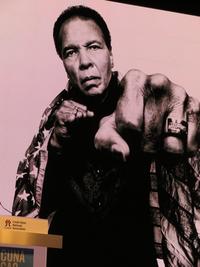
Muhammad Ali
Platon added, “The line between right and wrong is not always right. All of us at some point in our lives will cross over that line. What makes an honorable and courageous person is you recognize you’ve crossed over that line and you do all you can to get back to the right side.”
Platon said Snowden picked up an American flag the photographer had brought with him, and eventually posed with it. “I asked him what everyone wants to know: Are you a patriot or are you a traitor? And he said, ‘Don’t get bogged down with labels. It’s not about us vs. them or red vs. blue. It’s about us coming together to solve common goals. What I did was not for my own benefit. I didn’t ask for money. I took what I took and gave it back to the people.”
Platon’s take on all that: “I’m not clever enough to know if what he did was right or wrong. That’s for you to decide. I feel very privileged to live in this beautiful country called America. I’ve seen people in prison because they dared to sing a song about freedom. We can continue to debate these issues, but we need to be more sensitive to people and respectful.”
- Madeline Albright. “She said, ‘There is plenty of room for mediocre men, but there is no room for mediocre women.”
- Naomi Wadler. “She’s 11. She’s part of a bright future. She fights for the rights of young African-American girls. I said, ‘Can you give me some advice on how we should all come together as grown-ups?’ She said, ‘Talk with people, don’t talk at them. Listen to them, don’t just hear them.’

Naomi Wadler
“I asked, ‘What advice do you have for men about women’s empowerment?’ And she said, ‘Stand with us, not in front of us.’”
Late-Night Questions
Looking to his audience, Platon said he was told it was a room full of leaders.
“I bet there is a question you will ask yourself late at night in those quite moments,” he said. “You might say to yourself, ‘Well, I have some responsibility. I’m doing OK. I have a responsibility to my family and work colleagues and community. But how can I be a great leader? How can I be better? I have seen power up close and in person. What I haven’t seen in most of these people is where real power lies and that’s in a little word called service.”
To explore service, Platon stopped shooting pictures of politicians and instead spent a year shooting photos of the military. In one case he visited with a woman named Jessica whose husband had been killed in service. Until he had arrived she had never opened up the box that included his belongings and that had been sent to her by the military.
“As we lifted the lid she broke down in tears. And I felt ashamed of myself. For the first time in my life I had put a photograph above the well-being of a person. I quickly apologized because I had crossed the line of morality Edward Snowden had talked about,” said Platon. “She said, ‘It’s OK. You don’t understand why I’m crying. I just realized they washed his clothes and I wanted to smell him again.’
“If you felt that, then you felt something beautiful,” continued Platon, referring to the response from his audience. “We all came into this room defined by our differences, and yet we all felt that together. What we felt was compassion. Compassion for someone we’ve never even met. That’s the power of storytelling.”
Platon told credit unions empathy starts with storytelling, which is another way to humanize data.
“If you don’t believe in left vs. right but instead believe in right vs. wrong and in a nondivisive form of communication, then empathy starts here,” he said. “So, tear down your filter bubble and your echo chamber and then we’ll fight for what is right. We the people can pick up the torch and carry it over the finish line, but only if we are of one accord.”
A ‘Wow’ Moment
For those who still don’t believe they can do something to change the world, Platon concluded with a story about shooting a photo of the physicist and cosmologist Stephen Hawking, who amyotrophic lateral sclerosis had rendered him unable to move any muscle other than that of his left eye by the time of the photo shoot.

Stephen Hawking
Hawking used his eye to move a cursor to select letters and spell out words.
“I asked for one word of wisdom so I could pass it on to all my friends in America,” recalled Platon. “His nurse told me not to ask. And then I heard beep, beep, beep. He was typing. It went all the way to the letter W. Eventually, he spelled out ‘wow.’ That’s the beauty and majesty and optimism of life. Isn’t it amazing that this man still looked at the world in wonder?”
Rekindled Spirit
Platon dedicated his final words to overcoming the “politicians who divide us for votes, to the tech titans who profit from our echo chambers, and to the journalists who cover facts with opinion,” by saying that fear may be contagious, “but so is optimism.”
“I think we’re going to rise up and rekindle the spirit of optimism,” Platon said. “I see that your sleeves are rolled up and I see greatness in your hearts and I think we’re ready now to reclaim our times. So, leaders in this room, we need you now. Now is the time to think about your legacy while you can still shape it. I will leave you with a question: Are we to be bystanders like moths dancing around someone else’s flame, or are we to be upstanders and relight the torch ourselves with our compassion?”