ST. PETERSBURG, Fla.—After payments volume fell two weeks ago, transaction numbers headed upward again last week, according to the latest PSCU data.
PSCU’s Advisors Plus and Data & Analytics teams released year-over-year weekly performance data trends, comparing the 36th week of the year, the week ending Sept. 6, 2020, with the week ending Sept. 8, 2019. Among the findings:
Payment Volume
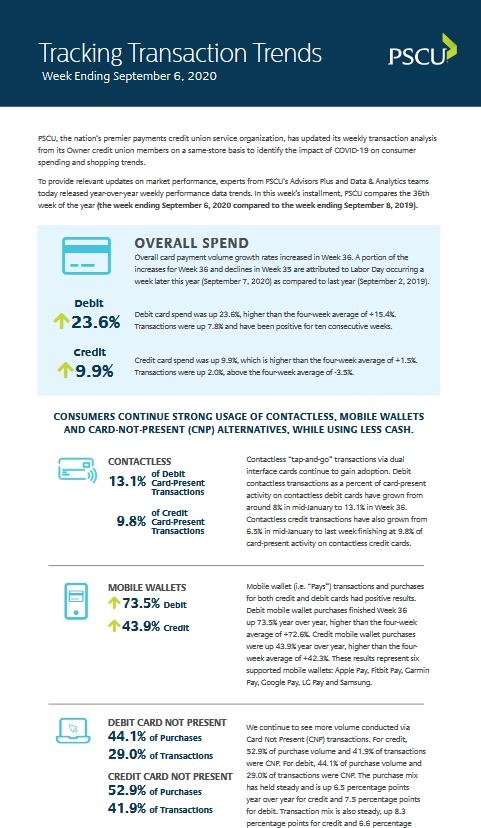
- Overall card payment volume growth rates increased in Week 36. A portion of the increases for Week 36 and declines in Week 35 are attributed to Labor Day occurring a week later this year as compared to last year, PSCU explained.
- Debit card spend was up 23.6%, higher than the four-week average of +15.4%. Transactions were up 7.8% and have been positive for ten consecutive weeks.
- Credit card spend was up 9.9%, which is higher than the four-week average of +1.5%. Transactions were up 2%, above the four-week average of -3.5%.
Contactless Payments
According to PSCU, consumers continue strong usage of contactless, mobile wallets and card-not-present (CNP) alternatives, while using less cash. Among the data points:
- Contactless “tap-and-go” transactions via dual interface cards continue to gain adoption. Debit contactless transactions as a percent of card-present activity on contactless debit cards have grown from around 8% in mid-January to 13.1% in Week 36. Contactless credit transactions have also grown from 6.5% in mid-January to last week finishing at 9.8% of card-present activity on contactless credit cards.
- Mobile wallet transactions and purchases for both credit and debit cards had positive results. Debit mobile wallet purchases finished Week 36 up 73.5% year over year, higher than the four-week average of +72.6%. Credit mobile wallet purchases were up 43.9% year over year, higher than the four-week average of +42.3%. The results represent six supported mobile wallets: Apple Pay, Fitbit Pay, Garmin Pay, Google Pay, LG Pay and Samsung, PSCU said.
Card Not Present Transactions
“We continue to see more volume conducted via card not present transactions. For credit, 52.9% of purchase volume and 41.9% of transactions were CNP,” the company said. “For debit, 44.1% of purchase volume and 29% of transactions were CNP. The purchase mix has held steady and is up 6.5 percentage points year over year for credit and 7.5 percentage points for debit. Transaction mix is also steady, up 8.3 percentage points for credit and 6.6 percentage points for debit year over year.”
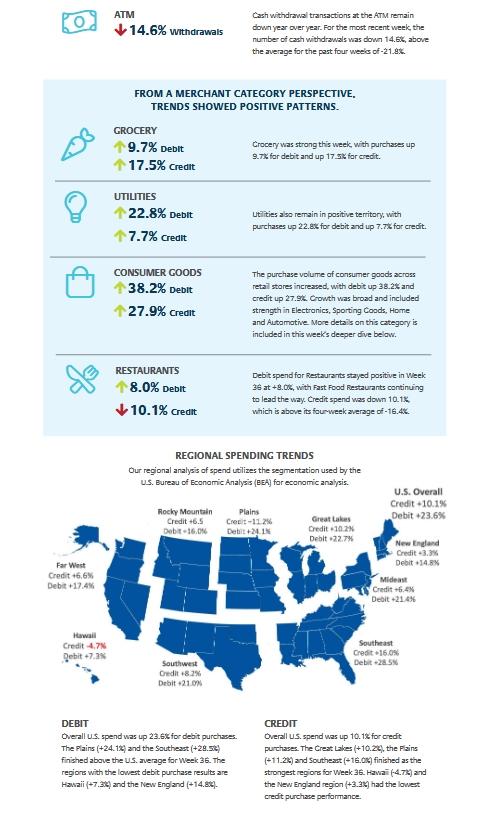
PSCU said cash withdrawal transactions at the ATM remain down year over year. For the most recent week, the number of cash withdrawals was down 14.6%, above the average for the past four weeks of -21.8%.
Merchant Spend
From a merchant category perspective, trends showed positive patterns, according to PSCU. Among the findings:
- Grocery was strong this week, with purchases up 9.7% for debit and up 17.5% for credit.
- Utilities also remain in positive territory, with purchases up 22.8% for debit and up 7.7% for credit.
- The purchase volume of consumer goods across retail stores increased, with debit up 38.2% and credit up 27.9%. Growth was broad and included strength in electronics, sporting goods, home and automotive.
- Debit spend for restaurants stayed positive in Week 36 at +8%, with fast food restaurants continuing to lead the way. Credit spend was down 10.1%, which is above its four-week average of -16.4%.
Regional Spend
Using a regional analysis of spend based on segmentation used by the U.S. Bureau of Economic Analysis (BEA) for economic analysis, PSCU reported:
- Overall U.S. spend was up 10.1% for credit purchases. The Great Lakes (+10.2%), the Plains (+11.2%) and Southeast (+16%) finished as the strongest regions for Week 36. Hawaii (-4.7%) and the New England region (+3.3%) had the lowest credit purchase performance.
- Overall U.S. spend was up 23.6% for debit purchases. The Plains (+24.1%) and the Southeast (+28.5%) finished above the U.S. average for Week 36. The regions with the lowest debit purchase results are Hawaii (+7.3%) and the New England (+14.8%).
- PSCU’s Weekly U.S. State/Territory Analysis is available at www.PSCU.com/COVID19, ranking U.S. states and territories by year-over-year performance for debit purchases, credit purchases and ATM transactions.
A Deeper Dive
In its latest analysis, PSCU said it did a deeper dive into the Goods sector and its components, including clothing and retail stores. PSCU’s Goods sector is a consolidation of merchant categories including retailers that sell “goods” to consumers and businesses, including both physical stores and online retailers, spanning a broad array of merchandise. Among the findings:
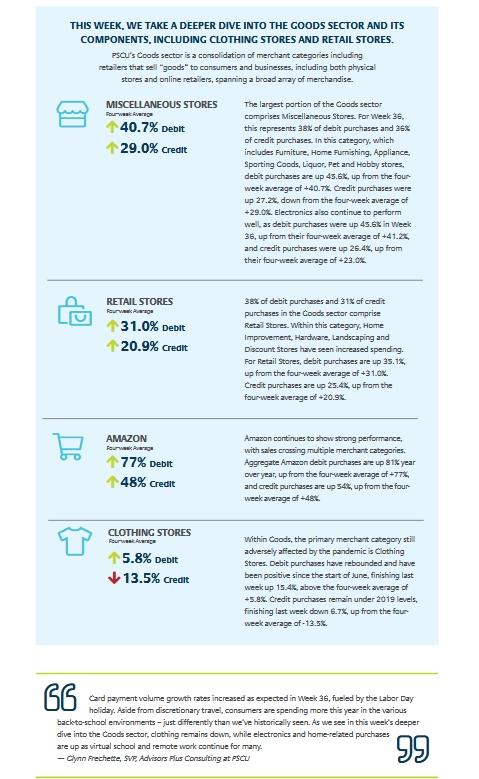
- The largest portion of the Goods sector comprises Miscellaneous Stores. For Week 36, this represents 38% of debit purchases and 36% of credit purchases. In this category, which includes furniture, home furnishings, appliance, sporting goods, liquor, pet and hobby stores, debit purchases are up 45.6%, up from the four-week average of +40.7%. Credit purchases were up 27.2%, down from the four-week average of +29%. Electronics also continue to perform well, as debit purchases were up 45.6% in Week 36, up from their four-week average of +41.2%, and credit purchases were up 26.4%, up from their four-week average of +23% PSCU said.
- 38% of debit purchases and 31% of credit purchases in the Goods sector comprise retail stores. Within this category, home improvement, hardware, landscaping and discount stores have seen increased spending, PSCU said. For retail stores, debit purchases are up 35.1%, up from the four-week average of +31%. Credit purchases are up 25.4%, up from the four-week average of +20.9%.
- Amazon continues to show strong performance, with sales crossing multiple merchant categories. Aggregate Amazon debit purchases are up 81% year over year, up from the four-week average of +77%, and credit purchases are up 54%, up from the four-week average of +48%.
- Within Goods, the primary merchant category still adversely affected by the pandemic is Clothing Stores. Debit purchases have rebounded and have been positive since the start of June, finishing last week up 15.4%, above the four-week average of +5.8%. Credit purchases remain under 2019 levels, finishing last week down 6.7%, up from the four-week average of -13.5%.
‘Increase Expected’
“Card payment volume growth rates increased as expected in Week 36, fueled by the Labor Day holiday,” said Glynn Frechette, SVP, Advisors Plus at PSCU. “Aside from discretionary travel, consumers are spending more this year in the various back-to-school environments – just differently than we’ve historically seen. As we see in this week’s deeper dive into the Goods sector, clothing remains down, while electronics and home-related purchases are up as virtual school and remote work continue for many.”