By Ray Birch
ALEXANDRIA, Va.—During its open board meeting Thursday, NCUA shared good and bad news regarding the National Credit Union Share Insurance Fund and its ability to cover potential credit union losses.
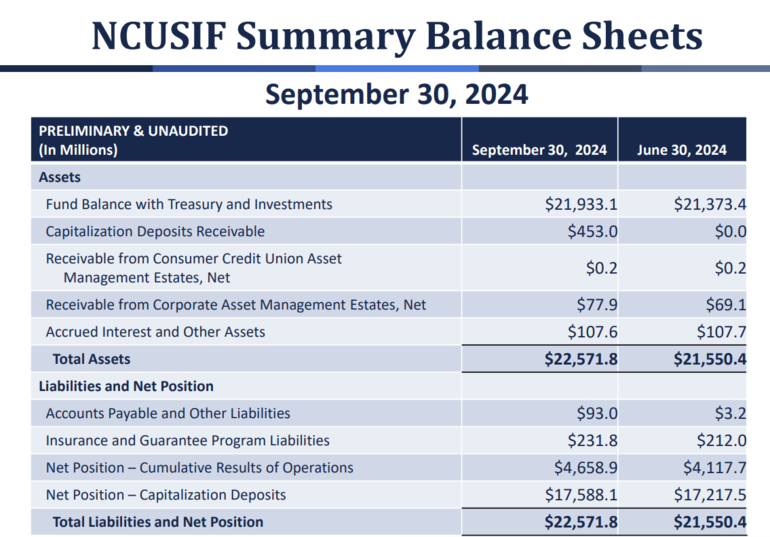
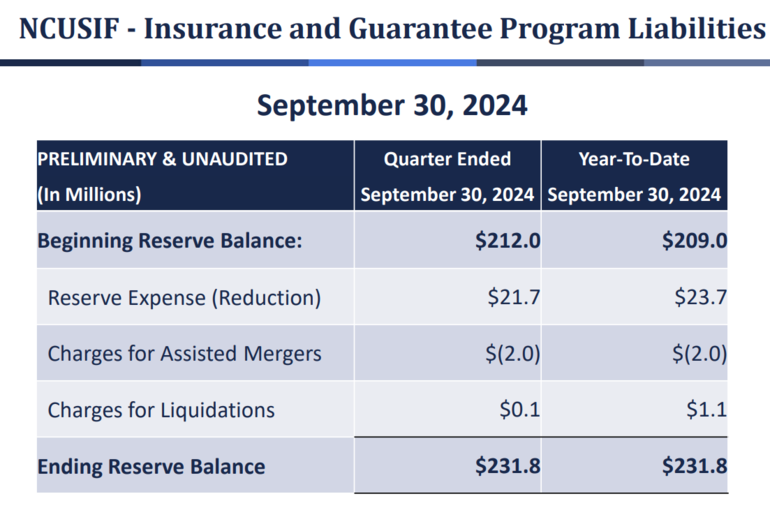
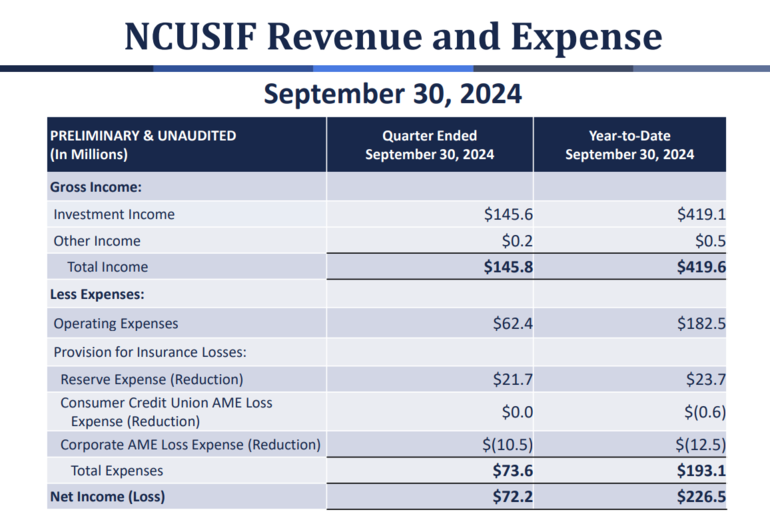
Noting the NCUSIF performed well in Q3 ($72.2 million net income, $145.8 total income), the agency also pointed out that total assets residing in credit unions rated CAMELS 4 and 5 continue to be concerning. NCUA, during its quarterly Share Insurance Fund briefing, also noted that $1.4 billion would be the amount—if a single check or a series of checks had to be written at once to cover losses—would take the fund’s equity ratio down to 1.20%, prompting the agency to develop a plan to replenish the fund via credit union assessments. NCUA, too, noted that 10% of the system’s aggregate assets are held in composite CAMELS code 3, 4, and 5 credit unions.
“Overall, the Share Insurance Fund’s performance (see information at bottom) in the third quarter of 2024 was strong,” said NCUA Chairman Todd Harper. “Yet, we continue to find ourselves in a good news, bad news scenario. The ongoing changes in the interest rate environment reduced the fund’s unrealized losses. In fact, since December 2022 until today, the fund has experienced a nearly $1-billion increase. This change resulted in the fund’s total assets reaching nearly $22.6 billion. Quarterly investment income has risen a healthy $12 million since the first quarter of 2024 thanks, in part, to the interest rate environment and the shift to higher yielding, short-term investments and overnights.”
Healthy, Countercyclical Fund
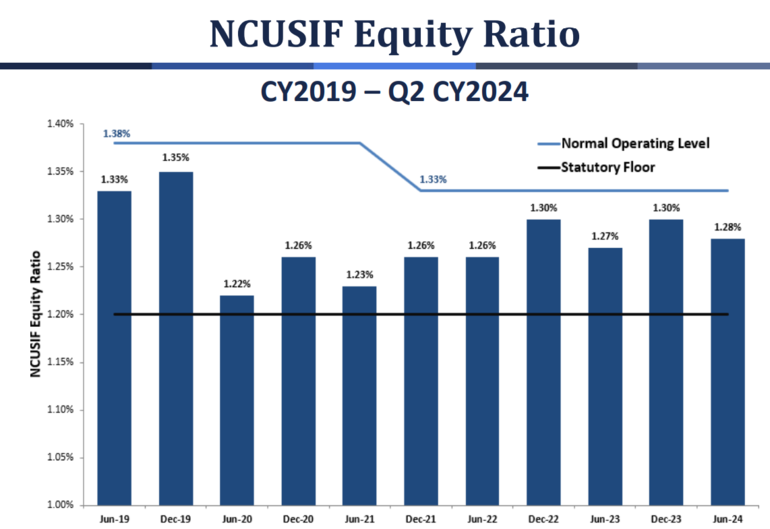
Harper pointed out the rise in interest income, along with continuing low levels of insurance losses, contribute to an equity ratio of 1.28 %.
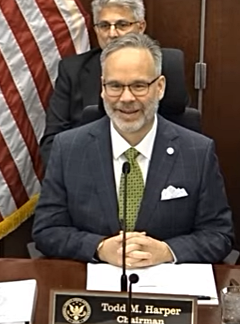
“Although this figure is less than the board-approved normal operating level (NOL) of 1.33%, it ensures a healthy, countercyclical fund that maintains sufficient reserves in good times to prevent us from charging premiums in economic downturns when credit unions can least afford it,” Harper said, adding the agency will be issuing the NOL methodology for public comment next year.
Despite the positive data, Harper said areas of concern exist that reinforce the need for NCUA to focus on supervisory priorities of credit risk, liquidity risk and interest rate risk.
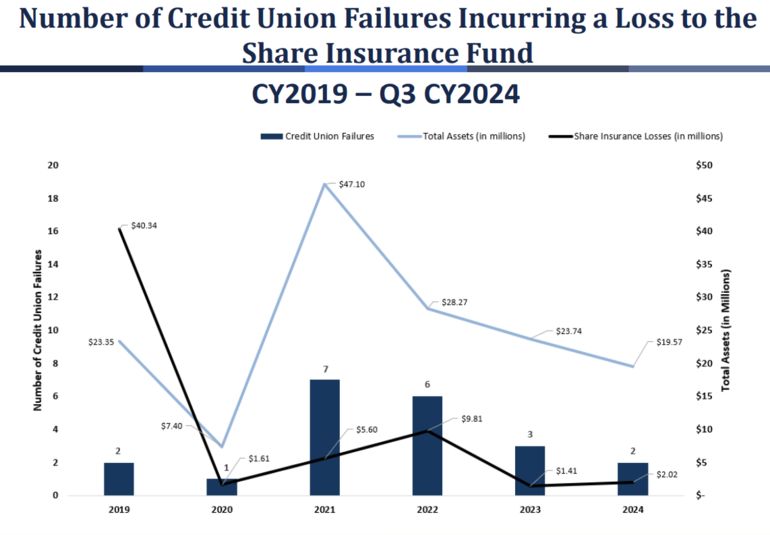
“As noted earlier, we continue to see signs of financial strain on credit union balance sheets and consumer financial stress,” said Harper. “And, we’re seeing this play out in the number of credit unions and the percentage of assets held by composite CAMELS code 3, 4, and 5 credit unions. Of greatest concern for me has been the large number of troubled CAMELS code 4 and 5 credit unions, especially the nine troubled complex credit unions with more than $500 million in assets. And, although down slightly this quarter, the number of CAMELS code 3 institutions remains elevated.”
Harper noted that the total assets held in composite CAMELS code 3, 4, and 5 credit unions accounts for nearly 10% of the system’s aggregate assets.
“These conditions are another reason why our supervision of these and all federally insured credit unions must remain risk focused,” he said. “They also highlight the need for the NCUA’s examiners to be ready to act expeditiously when identifying problems.”
While commercial loans continue to be concerning for the overall U.S. economy, NCUA staff Thursday said the amount of CU dollars held in commercial loans is “not overly concerning.”
“So, we are somewhat insulated against that potential risk, which is good news,” stated Harper. “But we also know that once the risk starts to happen it could start to play out in different ways and onto our balance sheets.”
Stubborn Inflation
Vice Chairman Kyle Hauptman reminded that inflation is not going away.
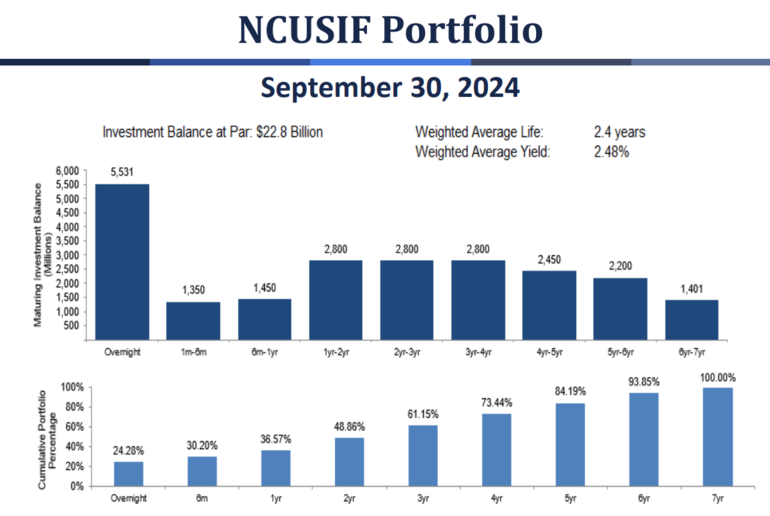
“While inflation has fallen, inflation still feels like the houseguest that stays way too long. It’s now been 44 consecutive months with inflation above the Fed’s 2% target rate,” he said. “In any event, NCUA is keeping its overnight holdings at $5.5 billion and investing new money back into our bond ladder.”
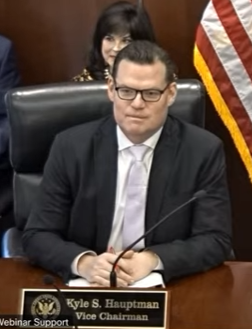
Hauptman reminded that the NCUA board in December 2021 set the NOL at 1.33%, reduced from 1.38%.
“Thus far, that change hasn’t affected distributions since the SIF hasn’t had enough money where we’d have sent money back to credit unions in either scenario,” he explained.
Hauptman asked NCUA staff for the dollar amount the Share Insurance Fund would have to pay out for a failed credit union, or series of failures at once, that would result in bringing the NCUSIF ratio below the 1.20% equity ratio.
NCUA CFO Eugene Schied told the board a loss of $1.4 billion would drive the equity ratio to about 1.20%, pointing out to Hauptman that when the vice chairman first joined the board a $200-million loss would have taken and the fund below 1.20%.
Hauptman asked Schied to share what’s been the largest check NCUA has written out of the Share Insurance Fund this year. Scheid replied, “$2 million,” to address an insurance related loss related to a failed institution.
Other Business
The board unanimously approved the 2025–2026 Central Liquidity Facility’s (CLF) budget of $2,307,863 for 2025 and $2,448,263 for 2026.
“The CLF is a beneficial tool, and it should be part of any credit union’s liquidity risk management plans for a variety of contingencies, not merely during times of crises,” Harper said. “Although it’s not required by our rules, having small and mid-sized credit unions with less than $250 million in assets join the CLF provides them access to this vital federal liquidity backstop during times of stress. Once markets freeze up, it’s difficult for institutions to quickly access emergency liquidity from market sources. Joining the CLF in advance of a liquidity event can better assist credit unions of all sizes to navigate unanticipated market situations.”
The CLF currently has 431 regular members and 11 corporate credit union correspondents. The CLF’s capacity stands at $21.7 billion compared to $20.1 billion approximately one year ago.
“While the CLF is growing in capacity, the congressional restoration of the expired CLF statutory enhancements — like the agent-membership provisions for corporate credit unions to serve a subset of their members — would serve the whole system well,” said Harper. “That’s why the NCUA board continues to call upon Congress to reinstate these provisions. In fact, we’re unanimous in our views here.”
Hauptman stressed the CLF’s budget is “relatively lean by some metrics compared to growing CLF membership, the operations, the capital managed and the service provided. The operating expenses-to-asset ratio is projected to be 0.22% for 2024. I should note that this CLF budget is admirably lean compared to the proposed NCUA budget we’re discussing tomorrow. If the NCUA proposed staff budget increase looked anything like this CLF budget increase, then tomorrow’s budget hearing would be a lot easier. I want to commend the CLF staff for being respectful of the people whose money we’re spending. Any organization has ways they can spend more money, some of which might even be good ideas. But NCUA has to live in the same world that credit unions do. That is to say, a world with limits.
This is the kind of planning credit unions must do. It is great to see budgets that are respectful of the folks paying the bill.”