

LVIV, Ukraine — World Council of Credit Unions' board met here with leaders of its member organization, Ukrainian National Association of Savings and Credit Unions (UNASCU), seeking to better understand challenges facing that country’s credit unions.
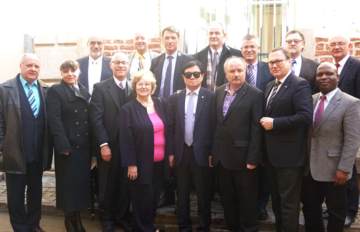
CAPTION: World Council's board of directors met with the Ukrainian National Association of Savings and Credit Unions in Lviv last weekend to better understand the Ukrainian system.
"Since 1992, World Council has worked to grow and strengthen Ukraine's credit union system," said WOCCU President/CEO Brian Branch in a statement. "Despite various challenges, we have come a long way and will continue to provide support."
UNASCU President Petro Kozynets and CEO/General Manager Ludmila Kravchenko explained how current issues, including political conflict, shifting regulatory and accounting requirements, shortage of liquidity, declining growth and low consumer awareness, have all affected credit unions' ability to serve their members.
“Naturally credit unions have much more trust than the banks, so there is an opportunity for their expansion," Kozynets said in a statement. "Yet, [the] overall situation very much depends on when the war (with Russia) is over."
The immediate goal of the movement is to find new sources of funds. Credit unions and UNASCU are looking for external borrowings to meet the demand for credit. Another priority is the legislative and regulatory framework for credit unions.
A series of financial and political crises, including that ongoing conflict with Russia, have significantly affected working families and the credit union footprint, according to credit unions. Over the past six years, a combination of political situation, a threefold devaluation of the Ukrainian currency and uncertainty has led to the loss of 1.7 million credit union members and over 70% of assets, WOCCU said. Nevertheless, credit unions remain optimistic about their role to help people in a context where banks are cutting down their activities.
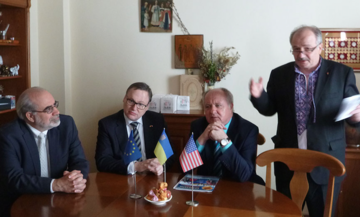
Ukrainian credit union representatives asked World Council to tell the world their country's credit unions need help and are willing to cooperate during this time of war. From left: Brian Branch, World Council president and CEO; Grzegorz Bierecki, World Council chairman; Petro Kozynets, UNASCU president; Volodymyr Sydorovsky, Anisia Credit Union chairman.
To learn more about issues affecting the local sector, the World Council delegation also visited Anisia Credit Union, founded by representatives of the Ukrainian Orthodox Church in Lviv.
Ukrainian credit unions are most prevalent in provincial cities and rural areas. They remain relatively small, with total assets of US$197 million, and respond to the common person's demands for consumer finance, appliances and education, WOCCU said. Ukrainian credit unions finance self-employment and small businesses and are often the only institutions financing small farmers in rural villages.
The Ukrainian government is working with credit unions to develop sounder regulatory systems and to continue financing agriculture. World Council continues discussions with the Polish credit union movement and USAID for larger, credit union-focused programs.