

ALEXANDRIA, Va.—For more than 15 years Martha Ninichuk, deputy director of NCUA’s Office of Small Credit Union Initiatives, has been active in helping to build a credit union in Macedonia, the eastern European country that is flanked by Albania and Bulgaria and which didn’t become an independent country until 1991.
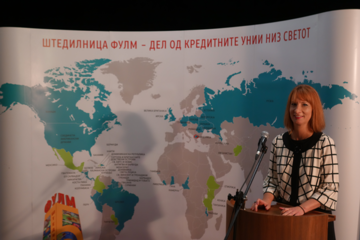
Martha Ninichuk of NCUA.
Paying for her own travel and expenses, Ms. Ninichuk recently returned from a 15th anniversary celebration of the creation of the credit union, the FULM Savings House.
Below, Ms. Ninichuk talks about the challenges of getting the credit union started, overcoming government opposition, and how to serve a country where for many people their average annual income is less than $400.
CUToday.info: How did you come to be involved with the Macedonia CU project?
Ninichuk: I was hired as Chief of Party to run the Macedonia credit union project.
CUToday.info: You covered your own travel costs; so you must feel some strong sense of connection there?
Ninichuk: Yes, I do. While working in Macedonia developing the credit union, FULM Savings House (FSH), I developed longstanding friendships with the CEO, Eleonora Zgonjanin Petrovich, board members and others. The kindness, generosity and commitment I experienced while working there has been an inspiration. Macedonia is like a second home and they are like family to me.
CUToday.info: Describe the project and its challenges?
Ninichuk: The project was funded by United States Agency for International Development (USAID) and awarded to WOCCU. WOCCU project targets consisted of opening a credit union with three branch locations, membership of 5,400, savings mobilization of $1,648,723, and net loans outstanding of $2,742,387. The project also instituted PEARLS, which is financial performance monitoring system that includes prudent financial standards much like we have in the U.S. At the end of the project FULM Savings House exceeded all project targets. Today, FULM Savings House has 8,000 members, assets of $5-million, and a net worth ratio of 16%. The credit union has made more than 20,000 loans worth $30 million and has opened five branches.
There were so many challenges, you can’t even imagine. There was not a computer software package available for FULM Savings House. Banks had their own software, which was too expensive and did not fit FSH needs. We ended up having to build our own software platform, which was a nightmare.
Most Macedonians saved in foreign currency, because they did not trust their own currency (worries of devaluation), but Macedonia regulations only allowed Savings Houses to save in its local currency, the Denar. We had to develop a savings product that tied the local currency to the (then) German Deutsche Mark to offset currency fluctuations. This was a little fledging credit union with very complicated products.
The Macedonian government, trying to alleviate risk in the financial sector, has worked to close Savings Houses in Macedonia due to their associated risk. Because of FULM Savings House safety and soundness standards, it did not have the risk associated with their institution. Examinations from the Macedonian Central Bank, its federal regulator, would last weeks on end with the examiners trying to find significant errors in order to justify the closing of FULM Savings House. They were not successful.
Tireless efforts have been made in lobbying the Macedonian government and Central Bank to keep FSH open. As the government has realized FSH’s contribution to Macedonia’s economy through providing financial products and services to its low-wealth consumers, it’s just recently committed, verbally, that it will make an exception for FULM Savings House, keeping the institution open.
CUToday.info: Is there enabling legislation in Macedonia that provides for credit unions? In some European countries such enabling legislation isn’t always so “enabling.” Can you describe the state of regulation/laws?
Ninichuk: There isn’t a credit union law in Macedonia. FULM Savings House is under the Macedonian Banking Law for Savings Houses, but is structured and operates as a credit union. One member, one vote, minimal deposit to open a savings account which then provides access to all other savings and loan products. Operating under the current legislation restricts the growth of FULM Savings House.
CUToday.info: What kinds of misconceptions or misunderstandings about credit unions did you encounter or needed to be overcome?
Ninichuk: There was no concept of credit unions in Macedonia at the time. Macedonians generally had a mistrust of financial institutions due to a collapse in the financial system where many lost lifetime savings never to be recovered; there was no deposit insurance. Therefore, we had to work hard to gain member trust. What was really interesting was to go through the activity of teaching members the concept of “one member, one vote,” that the members truly had a say in how the credit union was run. We had town hall meetings throughout Macedonia listening to member needs (types of savings accounts, types of loan products) and then took the ideas back to discuss implementation. By showing the members that we listened and then implemented new products and services helped to build that trust. Members would also test us by depositing funds and then coming back in an hour to withdraw, having that cash on hand for disbursement went a long way in building trust.
CUToday.info: Lending is the lifeblood of any credit union; what is loan demand like, is there credit report data available, or is this the old CU model of knowing a person’s character, or a mixture of all that?
Ninichuk: It was truly a grassroots effort. There were no loan policies, no loan forms, no credit bureaus. We had to build these things internally and then apply. As a part of a WOCCU credit union project there is technical assistance that is provided to teach and implement a set of financial standards that must be applied and followed by the credit union. WOCCU’s PEARLS, which can be compared to the U.S. CAMEL standards, were the standards used. For members applying for credit, they would complete a credit application, the credit union would determine the members debt ratio, and make reference phone calls. It would not be unusual for a loan to have one or two co-signers as collateral.
CUToday.info: What are the economic conditions like in the country?
Ninichuk: There is a great disparity between Macedonians that have money and those that do not. The “those that do not” segment of the population continues to grow. The average monthly individual income is $345.
CUToday.info: What role did/does World Council play? Is there a state league partnered with Macedonia?
Ninichuk: WOCCU projects provide technical assistance to countries building or rehabilitating credit union systems. The way it usually works is a WOCCU Chief of Party is sent to a country, and that person hires local nationals to be a part of the WOCCU project staff. WOCCU trains the project staff in the credit union concept, credit union operations, PEARLS, etc. Project staff identify those persons that will be the credit union board members, volunteers and staff, then work with them to implement the credit union.
The Michigan Credit Union League is partnered with FULM Savings House. MCUL has provided marketing materials, laptops, training, lobbying, etc. to assist in FULM Savings House development.
CUToday.info: Why should U.S. CUs get involved in these types of projects?
Ninichuck: It’s part of the worldwide credit union mission to provide products and services to the unbanked, low wealth individual. U.S. credit unions are in a unique situation with having the ability to give back to credit unions needing assistance worldwide.
CUToday.info: What will be your involvement moving forward?
Ninichuk: I will always be available to FULM Savings House to help them in an unofficial capacity. Whatever they need, and wherever I can, I will be there to help.