

BRUSSELS — The European Parliament Credit Union Interest Group, a caucus for Members of The European Parliament (MEPs) who support credit unions, met with European credit union leaders here to discuss how regulatory burden affects credit unions' efforts to promote financial inclusion.
European Parliament Vice President Ryszard Czarnekci, (Poland) and MEP Marian Harkin (Republic of Ireland) are the co-chairs of the European Parliament Credit Union Interest Group, and MEP Richard Howitt (United Kingdom) is the group's vice-chair. In total, 15 MEPs from Austria, Finland, the Republic of Ireland, Luxembourg, Poland and the United Kingdom who sit on the Parliament's Economic and Monetary Affairs (ECON) Committee are members of the interest group. Virtually all European Union (EU) legislation that affects credit union regulation falls within the ECON Committee's jurisdiction, according to the World Council of Credit Unions.
The meeting, held at European Parliament's Espace Leopold in Brussels, included credit union representatives from the European Network of Credit Unions, Association of British Credit Unions, Estonian Union of Credit Cooperatives, Federation of Romanian Credit Unions, Irish League of Credit Unions, FULM Savings House of Macedonia, National Association of Sooperative Savings and Credit Unions (Poland), and the World Council of Credit Unions.
Also in attendance were representatives of the governments Poland, the Netherlands, Lithuania, and the Republic of Macedonia, WOCCU reported.
At the meeting, MEPs and credit union leaders discussed how credit unions play an important role in promoting the financial inclusion of Europeans of modest means but are faced with expanding compliance burdens that take resources away from serving their members. European credit unions are much smaller than European banks and generally engage in less risky financial activities, but are subject to many EU directives and regulations designed primarily to address problems in the banking sector. WOCCU said the credit union representatives shared specific examples with MEPs regarding their financial inclusion efforts and regulatory burden challenges in Estonia, Great Britain, Ireland, the Republic of Macedonia, Poland and Romania.
MEPs and credit unions also discussed how credit unions can be negatively impacted by banking regulations in their capacity as bank customers even when they are exempt from a specific banking rule. Recent examples include the Basel III liquidity rules' requirement that banks increase their reserves held against deposits made by credit unions, which have reduced the yields that credit unions earn on investments in bank term deposits in the Republic of Ireland, as well similar examples from Poland, Romania, and Macedonia.
In addition, participants discussed government initiatives that help support credit unions' financial inclusion efforts, such as the British government's Credit Union Expansion Project.
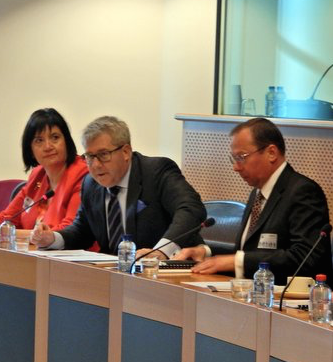
According to WOCCU, MEPs at the meeting said that they shared credit unions' concerns about the unintended consequences of regulation and excessive compliance burdens. European Parliament Vice President Czarnecki urged credit unions to continue this dialogue in order to prevent overregulation of credit unions at the European level and to help make it easier for credit unions to provide their members with loans, savings and other financial services at reasonable rates.
At right, from left, Eleonora Zgonjanin, FULM Savings House (Macedonia); Ryxzard Czarnecki, European Parliament Vice President (Poland); and Pawel Grzesik, NACSCU (Poland).