

ONTARIO, Calif.–Diana Dykstra, president and CEO of the California and Nevada Credit Union Leagues, was among a U.S. CU delegation that recently visited Cuba regarding launching credit unions in that country (as CUToday.info reported here).
Below, Dykstra offers her perspective on the trip in this Q&A that was first posted in the leagues’ Credit Union Weekly.
What can you tell us about your experience in a country with no credit unions?
Dykstra: Cuba is absolutely state-run. Financial services are run by the state and most workers are paid by the state. Most wages come in the form of pre-paid debit cards. It’s very controlled. They have two currencies: pre-paid debit and a hard currency, which many people feel is a big problem. They need to find a way to bring those currencies together for transactional efficiencies.
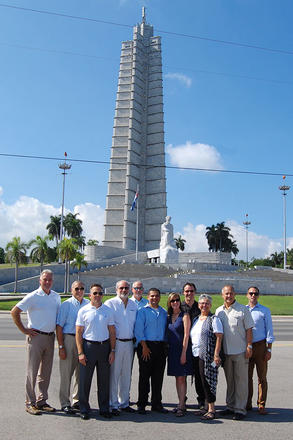
U.S. CU delegation visiting Havanna.
The country is filled with employees and retirees of the state. People receive education and medical care from the state, and every family gets a food subsidy. Any money left over can go toward non-essential goods and services. It’s an interesting economy.
There are thousands of old American cars everywhere—most of them are taxis and owned by the state. The people are warm and friendly. Their subsidized oil support from Venezuela makes a positive impact on their economy. However, other areas of their economy haven't been actively maintained. Many buildings and infrastructure projects have been neglected or remain in disrepair.
There’s a lot of change going on. Individuals are isolated and afraid of change, but at the same time they feel they can accomplish change. On the streets we found that small loans aren’t available to the common citizen. We concluded that credit unions can be a perfect vehicle to give Cubans control over their financial destiny.
What was the Cuban government’s reaction to your purposes for travelling there?
Dykstra: The national banks believe they can serve all the needs of the people. But the Cuban government is very interested in the credit union movement. They are very worried about how to take care of social-impact issues.
The social benefit of credit unions in that kind of atmosphere is a natural fit. Right now the largest non-state sector is cooperative agriculture. It will probably take a few years for the first credit union to open.
The smart way to organize credit unions would be to establish a central back-office support system and some central guiding principles. All credit unions in developing countries over the past 20 years have established themselves with some sort of central system and marketing efforts, with individual credit union names attached to that.
Cuba’s central bank and national banks are struggling with losing control. The central bank has organized nine other banks that offer various services—consumer focused, investment focused, and other areas. They’re all under the central bank umbrella. The international banks are there to facilitate trade exchanges between the Cuban government and other countries.
What is most relevant to U.S. credit union leaders who read or hear about foreign efforts such as this one?
Diana Dykstra
Dykstra: In the United States, we’re very far removed from countries where their financial systems aren’t necessarily satisfying the common consumer in the marketplace, or the average person doesn’t have financial services. Hopefully credit unions here in the states keep that in mind. We’re fortunate to have thousands of credit union educators.
We have to remember that our way isn’t the only way, and not necessarily the right way for everyone else. Going on a trip like this brings to light what Cubans are dealing with daily. But we shouldn’t walk in and say, “We can save you,” because they don’t necessarily need saving. We’re trying to help their people, and it doesn’t have to look exactly like how we do it here in the U.S.
It was fascinating visiting the American Embassy. The embassy’s leaders had an interesting discussion with us regarding what we heard and discussed with the Cubans because they haven’t had those discussions yet. American leaders realized we were doing something pretty important very early on, and Cuban leaders saw a group that didn’t have an ulterior motive. It was about offering tools and assistance to keep their money and capital in their community.