

TAMPA, Fla.–Discussions around DEI often fall into the trap of becoming all about platitudes, high-minded ideals and statements that seem aimed at getting applause. But they can also be touching, insightful, emotional and even funny, as one panel discussion here made clear.
At PSCU’s Member Forum, the mayor of Tampa, Jane Castor, who was the first female chief of police and first openly LBGTQ member elected to the post, was joined by Darcie Glazer Kassewitz, co-owner of the Tampa Bay Buccaneers and president of the Tampa Bay Foundation, and Thaddeus Bullard, better known as the World Wrestling Entertainment’s Titus O’Neal and also an entertainer and philanthropist, in a discussion of diversity, equity and inclusion that ranged from pro football to what can create heated—but necessary—debates to how one simple statement to a child can make a significant difference in the arc of that kid’s life.
The panel was moderated by PSCU EVP and Chief Talent Officer Lynn Heckler.
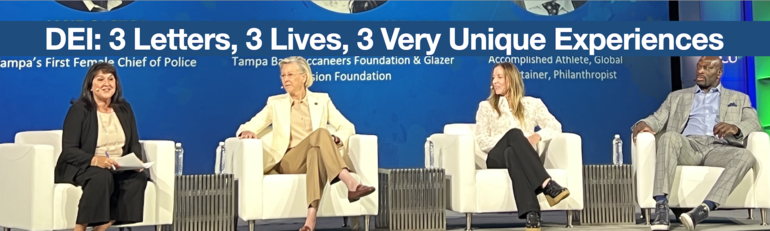
Here is a look at the Q&A:
Heckler: Credit unions are deeply aligned with the people helping people ethos. As DEI advocates in Tampa Bay, what has influenced your thinking in DEI and motivated you as a candidate for change?
Castor: Diversity, equity and inclusion is something that clearly has driven my life. In becoming a police officer and serving our community and then rising up through the ranks, you get an understanding of the significance that not only does the police force have to mirror the community we serve, but that the staff does as well.
We are all a sum total of our life experiences and we have to have those experiences around the table when we're making decisions that affect the community. I'm a bit biased because I was born and raised in Tampa. I've been here 63 years, but I really believe a lot of other communities can say they're diverse. What makes Tampa so unique is the way that everybody lives together. We all come together to celebrate our many championships.
In Tampa Bay there are issues to be addressed, and so diversity, equity and inclusion is really a part of our DNA. It is woven into the fabric of the entire Tampa Bay area.
Glazer Kassewitz: My family has owned the team for almost 25 years now, and DEI has been incredibly important to my family. It’s such an incredible, diverse community that really values it, that talks about it, that lives it.
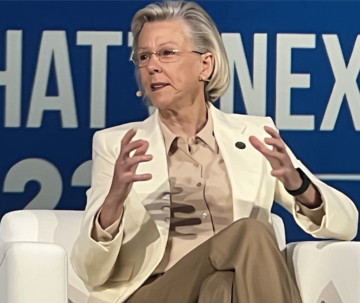
Mayor Jane Castor
It's incredible to have this platform in the NFL to really showcase what this city is about and also being able to bring awareness to DEI through the sport of football globally. For us, that's incredibly important.
Bullard: Diversity is being invited to the dance. Inclusion is actually being taken to the dance. You could be the worst dancer in the world, but you at least got the opportunity to get chosen to dance.
For me, as an almost 46-year-old African-American male that came from literally nothing, so many people invested in me. I went from being a Boynton Beach, Fla., kid who was the product of a sexual assault--my mother had me at 12 years old—and I was told I’d be dead by the time I was 16 and constantly saw the people around me not graduating from high school, not going to college, going to jail and getting murdered—I was given a chance to shine at the Florida Boys Ranch.
They gave me an opportunity to be the first person in my family to graduate from high school, the first person in my family to go to college and graduate from Florida.
People from all walks of life helped me get into the position that I'm in. When I go to hospitals and I visit kids, they don't say, ‘Oh there's that black guy that wrestles with WWE.’ They say, ‘That's Titus O'Neil.’ They're not greeting me by my race or what kind of car I drive or my political affiliation. They greet me as a human being. I truly believe to be the greatest country in the world we have to start by being the greatest people in the world.
Heckler: What changes have you seen in perspectives on DEI in Tampa Bay in the time you’ve been here, and what was your experience in breaking through some of the barriers to DEI in both your roles?
Castor: In 63 years I’ve seen a lot of changes, but really what I have seen is that you can't sit back and wait for things to happen. You have to be very intentional about change in your community. I came up through law enforcement, which is clearly a male-dominated profession. The important thing about being a woman in that position and rising up was you can't take things personally. You grow from your experiences, good and bad, and you have to have a positive outlook in all that you do.
One of the things with the police department was making sure we reflected the community we serve and that we worked hand in hand with the community to understand what the unique issues were in each area.
(Tampa is) growing in a way that I've never seen in my entire life and ensuring everyone in our city gets to take part in that success is critically important. Again, you can't stand on the sidelines and wait for that to happen. You have to take intentional steps to ensure that the entire community and their voices are heard.
Heckler: What has it been like being a female NFL team owner in a sport dominated by males, as well as the only sister among five brothers:
Glazer: I have not seen any difference between what a man and a woman can do. I was treated the same by my father, who worked 24 hours a day and he always included us in everything he was doing. We were all made to work all the time with him, which was very impactful. He was very empowering to all of us.
I grew up with the mentality that there is no difference between what a man and a woman can accomplish, which was great for me. I think it's helpful to me that I can bring some experience into the league. I think in my environment being able to speak and bring my own perspective and different ideas to the league is very helpful to what they're doing with DEI.
Heckler: Your commitment to charitable giving has earned you a spot in the WWE Hall of Fame and you have won the WWE Warrior Award, helped countless kids get into college, and more. How does this connect to DEI in the community?
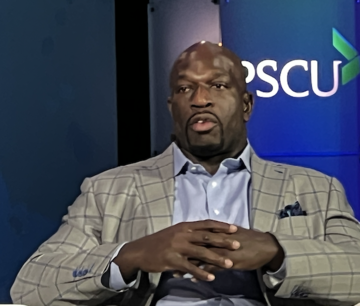
Thaddeus Bullard
Bullard: I take it back to exposure. I was exposed to something different and that leads to expansion. When you expose someone to something different, their lives can change. I never went to a nice restaurant. I never went outside of my neighborhood until my first fishing trip was the sheriff's office. My first time getting on the plane was actually my first college (recruiting) visit.
I just think that when we provide people of all races and backgrounds the opportunity to be exposed to something, it opens your learning curve to life. If you stay in certain silos you're only going to see things from one dimension.
My whole life’s passion has been to just connect people together from all parts of life, especially if it's around volunteering. I don't care if you are the CEO of PSCU, if you’re wearing one of our foundation t-shirts you're going to pick up trash just like everybody else.
Heckler: Can you come talk to my teenagers?
Bullard: You should have whooped them when they were five and six (he said to audience laughter). I’m going to be candid because the check already cleared. White people—you need to stop negotiating with your kids. You need to stop with the, ‘If you go to bed I’ll give you some juice.’
Heckler: You’ve been open about some of the challenges you had in your upbringing. But there were people who believed in you when others didn’t. How did you build upon that?
Bullard: When I was 12 years old and at the Boys Ranch, I used to fight a lot and I had just signed a contract that I wouldn’t get into any more fights or I would be sent home when 30 minutes later I got into another fight. Now, I get paid a lot of money to fight in underwear, boots and baby oil.
The Boys Ranch (leaders) had a meeting. There was this white guy from Chicago who asked, ‘Why do you think you get into trouble all the time?’ I said, ‘I don’t know, I’m just a bad kid.’ He said ‘A decision was made that you be sent back home to Boynton Beach, but I’m going to go against that decision.’ He said, ‘There is no such thing as a bad kid. I truly believe in my heart you’re going to turn things around. In the meantime I’m going to tell you something, and that is I love you and I believe in you.’
A lot of people told me they loved me and they also beat me and cursed me. No one ever said they believed in me. So, I began to live that message every single day that I love you and I believe in you.
People come in and out of kids’ lives, teachers coaches stepparents, etc. And that causes some shaky ground for someone to actually believe that love is a real thing. My commitment became to be exactly what he and God called me to do, and that's to help people believe.
Someone believed in me when they had essentially nothing to gain in return, and every one of us in this room has the capability of helping someone believe something. You all have positions that you're in because someone believed in you.
People say there are bad kids, but I always answer that there is no such thing as bad kid. They have been in bad situations, around bad influences, and in bad environments. They are making bad decisions and they're going to have bad outcomes. We just have to do a better job of putting people that are in those situations into better situations so that we can help them have better outcomes. You have to understand the power of believing.
Heckler: When the Tampa Bay Bucs won the Super Bowl in 2021, they had one of the most diverse coaching staffs in the NFL. How does the diversity of the staff lead to success on the field?
Glazer Kassewitz: We were able to show everyone that this is something you could more than dream about, that you can win a championship with a diverse coaching staff, that it is actually doable. We did it and so it was incredibly empowering and inspiring in in our organization and then, externally, for other people as well.
Half of America identifies as NFL fans, and half of those people are women, so 44% of our fans are female. We do a lot for women to educate them about all the opportunities that there are in the NFL. We reach 35,000 girls every year with flag football programs teaching them that football is for everybody. I've gone to many of these clinics…and by the end of that hour these girls have so much swagger, because they never have never experienced this before…It goes beyond the game and it empowers them as women.
Having female coaches in the organization is not just great for the women, but it's great for the players and the coaches and the staff and everybody to see that this is something that can be done.
Castor: I want to underscore that. I was a product of Title IX. I was used to be a pretty good athlete and I got a full athletic scholarship, which provided a college degree, which my family couldn't afford. I was the first to graduate from college. Someone took a chance on me, and that is the key that opened the door and that really put me here as the mayor of the best city in in the world. It was those life skills that I learned out on the field.
Heckler: Not to disparage your brothers, but until you came into the Bucs organization, it didn’t include women.
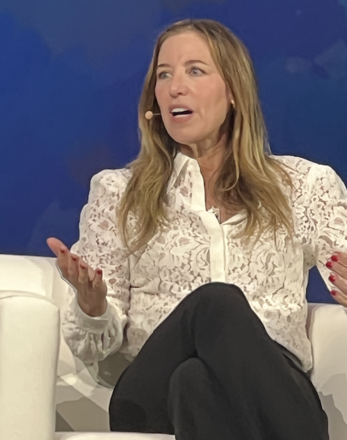
Darcie Glazer Kassewitz
Glazer Kassewitz: It wasn't that they were excluding women, they just didn't think about the inclusion of women. For me, being from Florida and being a huge Buccaneers fan, when you saw all the women standing on the sidelines as coaches and as referees, it made me feel so proud.
Cantor: I had a woman stop me at a breakfast one day when I was the chief of police and she said, ‘My nine-year-old daughter saw you this morning on TV at a press conference and she asked if that really was the chief of police,’ and the woman said yes, and the daughter said, ‘Wow, I can be anything.’
Heckler: You wrote a the book ‘There’s No Such Thing as a Bad Kid.’ What motivated you to write it?
Bullard: I get a chance to be something that I didn’t have, a father, which is the greatest title any man could ever have.
You hear kids say things like, ‘Someday I’m going to be an astronaut,’ and people say, ‘Well, that’s very hard,’ and we kind of kill kids’ dreams before they even get going. Then I see parents spending all this money and training kids on TB12 (Tom Brady) and the kids don't want to be out there (on the field). The kids are sitting on the bench and the parents are yelling to put their kid in the game, but if they do they’re going to have to dial 911.
Writing this book was therapy for me. It took me to places that I hadn't thought about going for a while. As I was writing it I was thinking I was the kid sitting in the back of class shooting staples and spitballs. The narrative behind the book is we have teachers all around the country who don't get paid anywhere near what they should. Teachers are investing, investing, investing, investing, time and are responsible for helping shape the leaders our society. If you take kids and you put them in a good situation around good people, they will have a greater chance to succeed. Sometimes, as humans, we just don’t get it right. Nobody is perfect and we're expecting these kids to make decisions that are perfect. We say, ‘I told you to do such and such.’ Well, telling them and teaching them are two different things. What you're telling them doesn't add up to how you're living.
Writing that book was my way to tell that story and give a different perspective. We stereotype kids based on behavior. A lot of times we ask people, ‘What's wrong with you? What's wrong with that kid?’ Nobody ever asks the question, ‘What happened to you?’ Once you find out what happened—maybe the kid’s mom died, he doesn't have a father or the kid was abused--unless you can start understanding certain behaviors, you are short-sighted. We label a kid in a heartbeat because of behavior we don’t know anything about. I was raised by a single mother, but as hard working as she was she could never be a man.
Kids will tell you about yourself. Listen to these kids.
Heckler: How does DEI influence your decision-making?
Cantor: I didn’t look to see how many women we can we put in these (city) positions or how we can check a box. I look for the people who are the most qualified. They bring their opinions. Our staff meetings can get pretty heated. I ask for honest opinions on issues. I don’t want anyone standing around who is a yes person. As a community we owe it to our city to ensure we are making the best decisions for the community. It comes down to the team you put in place.
Another change is mindset, which you often see in government, around organizational change. People say I love change. They are either a liar or they are saying ‘Change their world, don’t change mine.’ We are all creatures of habit. We changed how we police in Tampa in 2003. The only people more resistant to change than police officers are firefighters. We always say there are two things police officers don’t like: The way things are and change.
But we brought a possibility mindset to the city. It’s about how can we get this done and not ‘Here’s why you can’t do it.’ When you ensure you gathered all the information, and that can take a diverse staff, you can make decisions in the best interest of the community.