

LAHAINA, Maui, Hawaii–Credit union board members who haven’t bought crypto, taken offerings like Marcus for a spin, and that “punch their CEOs in the face” for tech investments that don’t meet expectations need to make some big changes, CU volunteers gathered here were told.
And that’s not all. How the current generation of board members has always thought about and interacted with financial services isn’t how new generatio

Brian Lauer speaking to VLI meeting.
ns are doing the same, and that needs to change as well, attendees at the Volunteer Leadership Institute meeting were advised.
Speaking to the VLI event, Brian Lauer, a partner in the firm Messick, Lauer & Smith, and Kirk Drake, president and CEO of CU 2.0, offered those warnings, advice, observations and more.
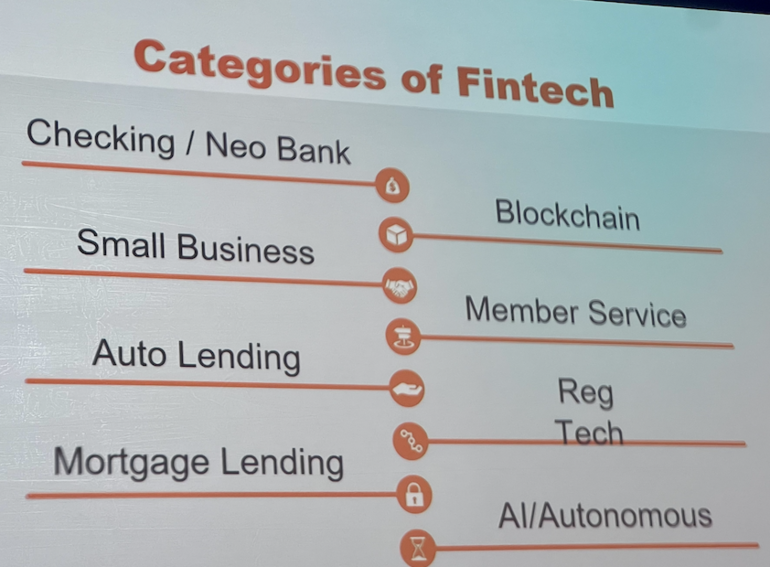
“There are two ways to look at fintechs, as opportunities and as threats. They are really two sides of the same coin, said Drake, before sharing some of the iterations of technologies credit union boards have had to sort through in the past and suggesting there are now “patterns and trends” that deserve board members’ attention when it comes to fintech and financial services.
“Most credit unions these days say ‘We need this fully encapsulated brand experience for our members. We're online banking. We’re mobile banking. Everything is all in one place’,” Drake related. “But how many of you would say your cores are super aggressive, super fast-paced technology companies?”
No hands were raised in response to Drake’s question.
“The second you are integrating to the core with your mobile or online banking platform you are intentionally choosing to slow down the pace of innovation and change,” Drake said. “Inevitably, you're now taking that fintech or that idea and making it go slower and with each of these adoption waves, if you miss out it means you're not going to see the next one. The best thing about having run tech companies is when you have an innovation and an idea and you're successful you get a really nice growth curve. When you miss an innovation, you sit there and stagnate for a while, but another one's going to come right behind it, so there's this constant pace that that starts to evolve.”
Seeing Faster
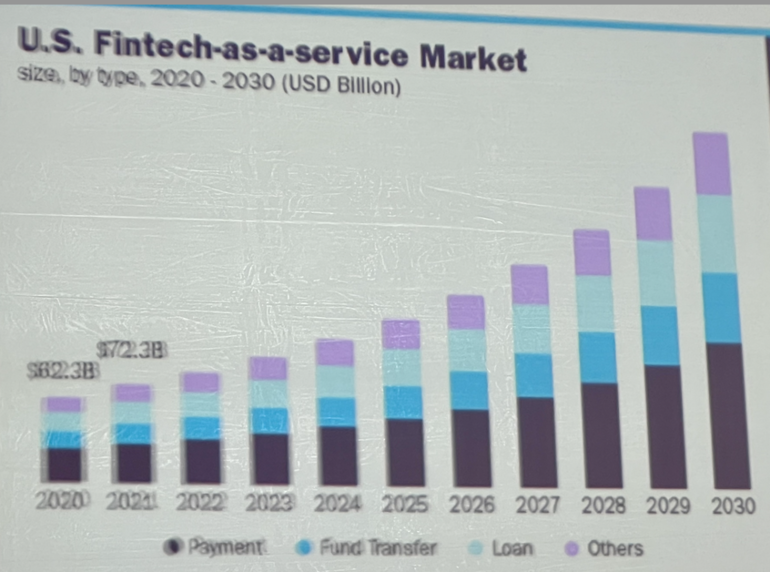
Credit unions and their boards need to be able to see things a “lot faster,” especially with all the outside capital that continues to be invested in fintech, said Drake. He added that financial services has been by far the leading venture capital investment over the last few years, with some $62 billion invested in 2020 and growing since.
Lauer introduced many in the audience to the Curql Fund, the credit union-backed fintech investment fund that is backing a number of fintechs. The partnerships are critical, according to Lauer, echoing Drake’s comments regarding opportunities and threats, as fintechs continue to do everything from nibble away at CU offerings to taking full bites.
“Curql puts credit unions in position where they can start to attack problems in the financial services industry for consumers and members without worrying so much about is this right for the company, for the overall membership,” said Lauer. “In order for credit unions to be successful they're going to need to take that next step.”
Drake pointed out that next step for credit unions and fintechs often looks different for the respective organizations, with Lauer reminding credit unions have the additional step of always thinking about related regulations.
The ‘Niche Piece’
Drake explained, for example, that a fintech may look to launch a product with the thinking “I just need to find a million people with this problem across the country.
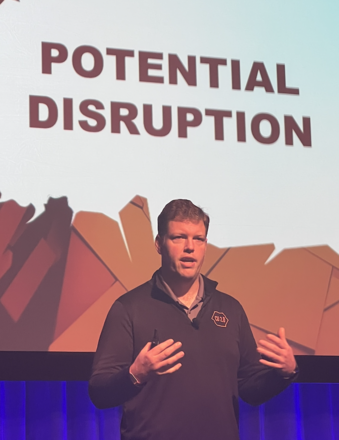
Kirk Drake speaking to VLI meeting.
“It's a kind of a generic one-size-fits-all, but the fintechs can then blend that access to capital with some knowledge or expertise about the problem, and usually change the pricing dynamic because the more you know about the situation the more you can derisk,” Drake said. “They don't need a huge volume, they just need that niche piece. So, really, what I'd like you to imagine we're sitting here and we're dropping 1,000 BBs that are bouncing up and down. What we're all trying to do as credit union people is pick the winners. We're looking at thousands of BBs and going with the one that seems like a great idea.”
The Secret? No Idea
So, what’s the secret for investing in a fintech that is going to succeed? Drake readily admits he doesn’t know.
“I've been doing this for 25 years and I can tell you I'm wrong as often as I'm right,” he said, explaining the process can be like attempting to pick the right BB out of all those that are bouncing about.
“I once heard the CEO of Capital One talk about this and he said the way we need to think about this is not looking at all the BBs, but instead at where is the drain going to be? Where are these things all going to eventually end up? If we can spot the drain we could be ready. We can't predict what next Black Swan event is going to trigger it, but we can be ready to take advantage of that market opportunity,” said Drake. “Capital One did a phenomenal job converting out of credit cards into commercial banking by recognizing that the traditional path of credit cards is going to change significantly.”
Drake said he wanted to challenge credit union thinking around innovation when it comes to financial services products. He recommended borrowing a strategy from Tesla’s early days when it would put out a number of new ideas and ask for member feedback, including being put on a wait list for a new offering.
But most of all, he urged understanding how quickly fintechs move vs. credit unions. A fintech may allow a consumer to move $100,000, for example, in a matter of moments. A credit union, meanwhile, will consider it an improvement if it can get its online account opening process down to 18 minutes from 20.
“We're going to be happy about that but you've already lost,” Drake said. “It's too late. A 20% improvement isn't the right metric. You have to revolutionize those things because I would argue up until COVID it was all about digital transformation. We made more progress in two years of COVID in digital transformation and today I would tell you it's not even about transformation, it's about 100% digital. The consumer doesn't want any friction in that equation.”
‘Completely Disruptive’
Drake noted a core system likely can’t even do two releases in a year, while fintechs are doing four or five releases in a week.
“The pace of change and innovation is completely disruptive in that regard. At the same time, let's be real, we have to do enterprise risk management, we have to do better due diligence,” Drake said. “We need you to bet $100,000 of your credit union’s capital on this idea and. by the way, I'll be blunt--if you made five of these bets four are going to fail and what are we going to do as board members? We're going to punch the CEO in the face for the next 10 years about the four failures over and over and over again to the point that the CEO gets the message that there’s no point in taking these risks.”
The lesson there, according to Drake: “Celebrate the test, not the outcome.”
To that end, Drake said the ideal for any CU is to test and invest with the smallest possible projects with the cheapest possible failure rate while in the first phase of testing.
An Additional Challenge for CUs
Lauer, who is an attorney, reminded that it’s important for credit unions to keep regulators in mind as they get involved in fintech, new lines of business and new channels.
The credit union needs to be able to go down the “checklist” with their examiners to show compliance and limits on risk, Lauer explained, while also “planting the thought in the examiner's mind” that the credit union understands its responsibilities but is also looking to make a bet on opportunities.
“Examiners are being taught now that they should be working with the credit union to understand how the credit union mitigated that risk,” Lauer said.
Added Drake, “I like to say like if this is a test for 1,000 members, the risk is different than it is for 10,000 members and different from 100,000 members. Your regulatory risk, your compliance risk, your financial risk--all of those things are different. but the better diligence process today is one size fits all.
‘Important’ Job for Boards
“I think it's also important as a board to begin to look beyond the short-term financial pieces. We’ve got to create room and some sustained investment in this because we're not going to be very good at this. It takes, three, five, seven years before you get good at spotting these trends and seeing what things are relevant and beginning to understand the timing elements,” he continued. “It’s really important your board begins to look like the membership you want and the constituency you want, not just like the membership you have today. You need a diversity of younger members, all those different kinds of perspectives. If you guys haven’t bought crypto, if you haven't tried Marcus, if you haven't tried some of these fintechs because your life is pretty stable and pretty good, you don't really know what the competition is doing and how to evaluate and compare your credit union versus what's going to be happening three to five years from now.”
Drake said he couldn’t emphasize enough the importance for credit union boards to be “curious” and to experience all the offerings in the market that are competing for a credit union’s members.
“We always like to say ‘fail fast, fail cheap’,” observed Drake. “I think a great conversation for your management teams and your boards is what did you fail out of this week, because when you start asking that question you implicitly give permission to try things and to see things differently and to not have this idea of perfection.”
A Unique Position
Lauer told the credit union volunteers they and credit unions are in a unique position because the job is to manage risk.
In response to that point, Drake noted many fintechs don’t want anything to do with the balance sheet business, which makes CUs ideal partners.
“Venture capital says, ‘We do not want to hold the financial risk that comes with the balance sheet of these loans’,” he said. “But we are good at client acquisition.”