

SAVANNAH, Ga.–Hybrid work environments have created as many challenges for credit union leaders as there are places to work from. One expert has some advice on how to make the new work landscape more effective for everyone, including acting as a recruiting and retention strategy, while avoiding the kinds of scenarios that cost money, time and lost employees.
Speaking to the CUES TalentNEXT Conference here, Dr. Bradford S. Bell, the William J. Conaly professor of Strategic Human Resources and director of the Center for Advanced Human Resource Studies at Cornell University, outlined workforce trends that are here to stay and offered insights gleaned from research and real-world examples on how credit unions can compete in a hybrid work environment world.
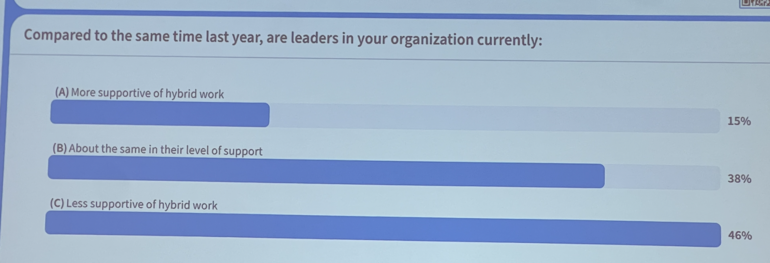
Here is how attendees at CUES TalentNEXT Conference responded to question posed to them, above.
The Trend Line
First, the trendline. Bell noted that prior to the pandemic 4.7% of all full-time work days were being done remotely, or about one in 20 people. Immediately with the pandemic, that jumped to nearly 60%, levelled off, and has since settled around 30% of all days being worked remotely.
“Researchers suggest this kind of jump reflects about 40 years of prepandemic growth,” said Bell. “That’s a really amazing shift in how we think about work today.”
The shift is evident in credit unions, he pointed out, citing data that showed in February of 2020 71% of credit unions had no remote workers at all. One year later, 79% of CUs allowed some remote work among some employees.
What to Think About
“Finance is the number-two industry in adopting hybrid work with about two days per week on average,” said Bell. “As you think about attracting and retaining talent, often (candidates) are in the same industry as you. You need to be aware of the industry trends and what people in your industry are expecting, and in this industry they are expecting some hybrid work. The hybrid model has become the model.”
The hybrid work model in terms of deployment peaked in the summer of 2022, according to Bell, as the Great Resignation was at its zenith and has now leveled out in the 45% range.
“More bosses who had praised remote work have soured on productivity from home,” said Bell. “There has been a shifting pendulum in who has control. It had been an employees’ market; they had the bargaining power. Now, the pendulum has swung back to giving employers a little more control.”
The Issues Remain
Whether well-founded or not, the worries that emerged when employers moved to hybrid work models remain, said Bell, including whether employees are sneaking off for a round of golf during the day or taking leisurely lunches. Challenges also remain around Zoom meetings, which work well for colleagues who already know one another but which aren’t so good for getting new managers and employees up to speed.
Another issue Bell said some employers have encountered is workers who are offered promotions can turn them down because the promotion means coming into the office and losing flexibility with scheduling.
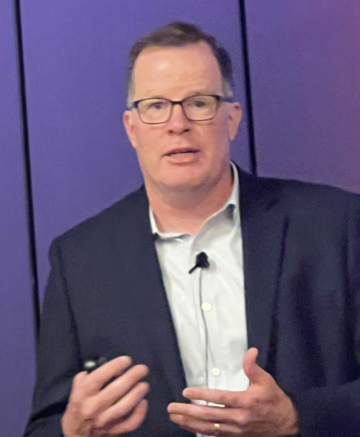
Dr. Brad Bell speaking to CUES event.
While questions will remain around whether the hybrid work model is sustainable, Bell said, “As we head into a year of efficiency, trust and human bond will be needed more than ever.”
Workforce Trends
Looking to the broader workforce and implications for new work models, Bell noted the talent shortage so many organizations have faced isn’t solely due to the pandemic. While the labor force participation rate plunged in the pandemic and remains below the pre-pandemic rate, it’s a natural trend line, said Bell, noting an agin workforce and Baby Boomer retirements are ongoing trend lines, as is the decline in fertility rates and declining number of births.
In addition, the average number of hours worked per employee has also declined and is now about 36 minutes less per day per person, which adds up to 2.3 million employees per year.
4 Key Challenges
In recent CUES surveys of its members, the four key challenges respondents identified include:
- Attracting and retaining talent
- Developing future leaders
- Building sufficient bench strength
- Building robust mentoring programs
Asked for their own thoughts now, audience members at the CUES TalentNEXT event said the issues they are confronting include:
- Young people lacking in many basic human interaction skills
- Problems with technology competencies
- One person who has had remote workers for a decade said not everyone has skills to work remotely and it is critical to identify that in the interviewing process
- “We have been challenged to find out what motivates and engages different employees.” Bell noted it’s not a “one size fits all and likely needs to be customized.”
The Opportunities & Challenges
The last few years have been a mixed bag of hybrid work policies, according to Bell, saying many employees can be highly productive in working hybrid either on a part-time or full-time basis.
The opportunities that have been discovered include cultural transformation, he added, explaining that involves an increase in trust between managers/employees and results in flattened hierarchies and changing perspectives on work and performance.
“Hybrid has shifted our views around performance,” said Bell. “No more is it about how much time is spent in the office or in being visible, and instead focusing on different measurement metrics.”
Hybrid Work: Challenges
Among the challenges in hybrid work environments, according to Bell:
- Creating serendipitous meetings and interactions is much more difficult in remote environments and Zoom meetings. There are no “happy accidents.”
- Virtual onboarding programs are difficult and there is a passive intake of culture.
- Game time and social chat initiatives online are not harmful, but are also not very effective.
A Key Risk
One key risk in the creation in hybrid environments, Bell cautioned, is the creation of different classes of employees, which is also an equity and inclusion issue. The nature of many jobs doesn’t allow for the kinds of flexibility other jobs have, he reminded, which requires new ways to think about work and what the work looks like.
Many employees who lack flexibility have looked to migrate to jobs that do offer the ability to be more flexible, said Bell. “Organizations have had to rethink the employee value proposition (EVP).”
He pointed to a study conducted by his Center at Cornell that found many companies saying they have used their brands to reinforce their EVP or they don’t have a formal EVP in place at all.
But employees have a different view, he explained. They want flexibility, autonomy, agility in their work and companies they can relate to in terms of their own values (“which is probably a good position for all of you to be in,” Bell told attendees).
“We really need to understand our employees, what they are looking for, what their preference are, and that it’s not a one-size-fits-all model,” said Bell.
The ‘5C Challenges’ of Hybrid Work
Bell outlined the “5C challenges” for employers:
- Communication: Do individuals have equal access to tools and technology? Are there ambiguous terms and expectations?
- Coordination. The is about the additional time and costs involved in coordinating work among different work models. People can feel “out of the loop” in many environments, he said.
- Connection. This is about how to build social connections and professional networks and not allowing workers to become siloed from the organization or even from the team.
- Creativity. As work becomes more scheduled and formalized, it becomes more difficult to become creative.
- Culture. This is about the difficulty of socializing and integrating newcomers while colleagues feel less connected to the mission and values.
Strategies for Overcoming Barriers
To overcame barriers in building a successful work environment that involves a hybrid component, Bell advised:
- Engage a Cross-Functional Team. “Partner with IT to ensure the tools and technology are in place to support hybrid ways of working. The real estate and facilities team can help you think through the redesign of the physical office space. Partner with your HR colleagues.”
- Offer Training and Development. This is about preparing managers and employees to have the tactical skills as well as softer skills, such as hosting and leading meeting and engaging with employees, according to Bell.
Preparing Leaders to Manage Hybrid Teams
Organizational leaders can focus on a lot of areas, Bell said, but preparing leaders to manage hybrid teams is one he believes is “critical.”
“For most of history leaders have been co-located with their followers. That shifted overnight. Now leaders are leading from a distance,” he said. “It’s created new challenges and opportunities for leaders in working with their team.”
What Effective Team Leaders Do
To that end, Bell said it’s necessary to understand what effective team leaders do. While there are numerous models around leading teams, what is common to all of them is four broad enabling conditions of high-performing teams, Bell explained.
Those include:
- Compelling Direction. High-preforming teams have explicit goals that are clear, challenging and consequential.
- Strong Structure. High-performing teams have the right mix and number of members, perform meaningful tasks and establish clear norms.
- Supportive Context. High-performing teams have a reward system that reinforces good performance, an information system that provides access to necessary data, and an educational system that offers training and development and more.
- Shared Mindsight. In high-performing teams, members have a strong common identity and a shared understanding of the task and one another.
The latter is a recent addition, said Bell, as teams have become more digital and diverse and distributed.
“The challenge is these things can be a little harder to do and establish when your teams are in different work models,” he acknowledged.
Two Broad Issues
According to Bell, team leaders need to do two broad things, as outlined in slide below.
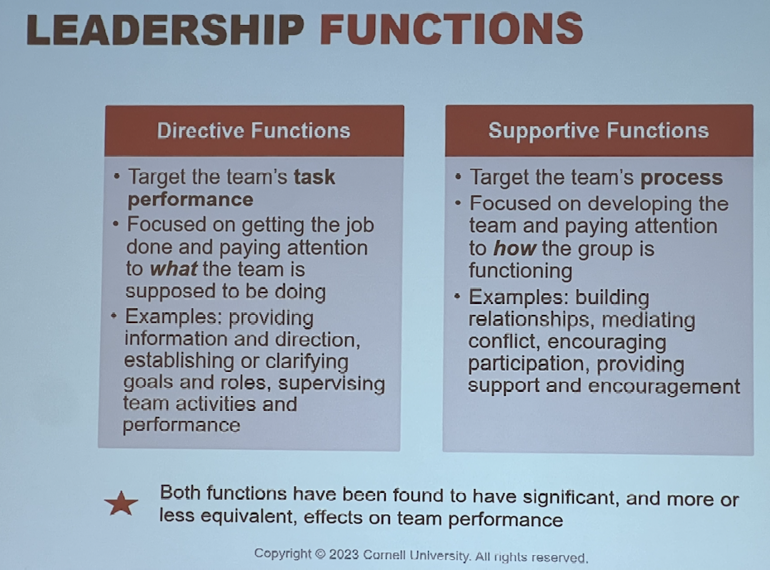
“We often see team leaders function on one or the other,” said Bell. “Years of research have shown the best team leaders focus on both of these.”
Critical Leadership Function in Hybrid Environments
Critical points leaders must keep in mind when it comes to hybrid environments, according to Bell, are:
- Define the mission and establishing expectations and goals. “Some define this as setting the course,” said Bell. “It’s important to be explicit so everyone is on the same page.”
- Support the social climate. “In person, a lot of that occurs organically. People hang out before and after meetings. That doesn’t occur when people meet virtually. Virtual meetings are very task-focused. So, how do you build in the opportunities for social interaction? This is also about supporting team members and helping them to navigate the challenges they face in different work models.”
- Encourage Self-Management. “It’s about as a leader being able to step back and steer the team, but letting the team manage itself.”
- Facilitate the Use of Technology. “It’s about building the right infrastructure and ensuring everyone, regardless of where they are sitting, has the right tools and technology.”
Developing Hybrid Work Norms
In the early days of the pandemic and even since then Bell said many managers kicked the can down the road by letting the managers below them set the parameters around the hybrid environment.
“There is some value in that autonomy for managers. The downside of that model is managers make decisions based on their own personal preferences,” he said. “That can be problematic, especially when employees don’t work on a single team or work across different teams on a regular basis.”
The Norms
To address this issue, he said credit unions need to establish “norms”:
What are norms? According to Bell:
- Norms are a set of rules of guidelines that clarify outline acceptable and unacceptable behaviors, serve as a “code of conduct.”
- Norms express values and help to ensure that everyone knows what is expected of them.
- Norms should be revisited and adjusted over time, particularly after significant changes.
Just About Anything, But…
According to Bell, hybrid work norms can cover just about anything, but the most critical are:
- Flexibility. Guidelines can specific how often employees work remotely and meetings-free days.
- Meetings. This identifies how often meetings are held, and the expectations when everyone is together on a Zoom (“meaning we expect active participation”) and more.
- Communication. How to communicate beyond just meetings, how often, expected response times, etc.
- Collaboration. General rules for collaborating, such as respecting differences of opinion, open to ideas, helping others, etc.
- Work-Life Boundary Management. Clarify expectations around work hours/availability.