

By Ray Birch
NEW YORK—Will delinquencies continue to tick up at a steady pace and simply return to “normal” levels seen prior to the pandemic? Or are credit unions about to see a spike in late payments and even charge-offs?
That answer for now is there is no certainty, as a very “unpredictable” economy that one expert says has the potential to drive delinquencies above the levels seen before COVID arrived.

Rick Hughes, SVP at NFP, an insurance broker that offers coverage for home equity lines of credit, is advising credit unions—if they haven’t already--to begin a more cautious approach to loan underwriting.
“Our 30-day delinquencies right now, with the clients we work with, have gone up just slightly,” said Hughes. “But what this really looks like, so far, is that delinquencies are going back to more normal levels, versus where they’ve been—very low—for the last two years.”
Hughes said 60- and 90-day delinquencies among the company’s client CUs are flat.

Rick Hughes
“They look the same as they as they looked for the last two years,” said Hughes.
Given that backdrop, that 30-day delinquencies are climbing in what could be the first sign of potential trouble within a very “unpredictable” economy, Hughes said credit unions must be more cautious with their underwriting in case there is a big shock to the economy—more than the slight recession most economists have been forecasting.
As CUToday.info reported, numerous reports have begun to show consumers are starting to fall behind on their credit card and loan payments as the economy softens, according to some of the country’s biggest U.S. banks, although delinquency levels remain modest.
What Beige Book Shows
In addition, a recent Federal Reserve Beige Books shows tighter lending standards by banks across the nation.
That Beige Book data reflects information collected prior to April 10, with the Fed reporting that a number of its bank districts expressed concern by its business contacts over the failure of Silicon Valley Bank of Santa Clara, Calif., and Signature Bank of New York.
“There’s still that uncertainty, because you just don't know what else is going to happen in the economy,” said Hughes. “Will delinquencies just go back to normal, as the current trend seems to suggest? Or will things go beyond what we have considered normal in the past?”
Hughes said his company and credit unions probably won’t get any more signs about where delinquencies are headed this year until the second or third quarter of 2023.
Hughes noted his company has more than $5 billion worth of equity loans insured across the United States, with 75% of that being credit union business.
“Our 30-day delinquencies are running somewhere around .31%,” he explained.
But that is still lower than his company’s clients’ delinquencies prior to the pandemic, when they were close to .54%.
In Good Position
Hughes, who has been involved in home equity lending for 32 years, emphasized that if the economy does in fact decline sharply, lenders are currently in much better position to absorb any rising delinquencies and eventual defaults, because lending guidelines have been improved and tightened since the “Wild West” that preceded the Great Recession (see chart below).
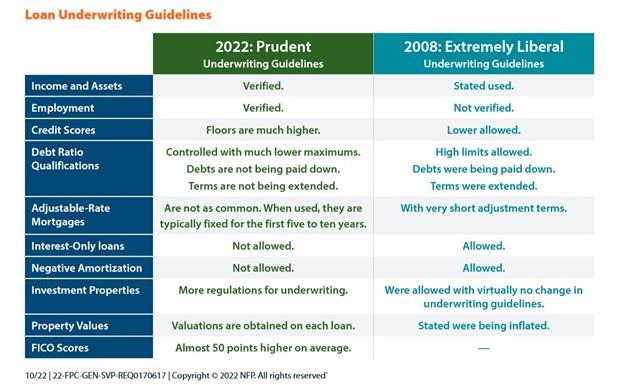
Noting credit unions were never among the lenders that were granting loans with skimpy underwriting and little scrutiny before 2008, Hughes pointed out CUs want to keep feeding the lending machine today that continues to grow, and that could lead them to possibly head in the wrong direction with underwriting.
Watching Unemployment
“I would, again, tell them to be more cautious,” Hughes said. “I think if we get into a deep enough recession that starts getting into the job market, to the extent that's going to create some real pain—unemployment that starts getting into 6% and 7% range—then that's when we're going to see a real issue from a delinquency perspective.”
Hughes said that credit unions can still expand their home equity lending with the safety net of insurance.
“Our products are going to create some opportunity for credit unions to keep themselves afloat even in the bad times,” Hughes said. “Our program is two-tiered and is a revenue-creating product, which is a little bit unusual for an insurance product.”