

COLORADO SPRINGS, Colo.—One executive with Tesla wants credit unions to realize how he and others view the company: “We are not a car company, we are an energy innovation company.”
The point of that is to urge credit unions to rethink what it is they are. While Tesla is known for its revolutionary and extremely popular electric cars, J.B. Straubel says the automobiles are really the end-result of that thinking.
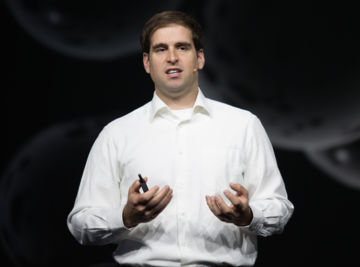
Tesla's J.B. Straubel speaking to CO-OP THINK Conference.
Straubel, who is co-founder and chief technology officer with Tesla, shared with CO-OP Financial Services’ THINK Conference here the history of the company and what’s coming next, as well as offering four intriguing predictions for the future of batteries and energy, including a tipping point he believes is taking place this year. Straubel was speaking as part under one of the four umbrella themes at THINK, in this case, “Helpfull,” which is how to operationalize new technologies and experiences.
Tesla was founded in 2003 by technology pioneer Elon Musk, among others, and rolled out production of its first car, the Roadster, in 2008. It went public in 2008, when it rolled out its popular Model S. Tesla’s latest groundbreaking endeavor was a literal groundbreaking, beginning to build a “gigafactory” in Nevada to produce batteries. This year it’s introducing Tesla Energy, a grid battery storage endeavor as part of a larger energy “shift” the company believes is taking place right now.
“I see us as more of an energy innovation company more than an automobile company,” he said.
One point Straubel stressed is that Tesla was never created to be a reaction to the price of a barrel of oil. In fact, he noted, the price of oil was around $30 a barrel when the company was launched. The vision is much further than that, he said.
“We were focused on the long term, where things were going,” he said. “We felt that being focused on electric vehicles was going to be very relevant.”
Tesla would not have been possible in a world automobile market with huge, established brands had a technology shift not occurred elsewhere in the battery market. The long-time technology behind batteries, lead acid, has been replaced by the emergence of lithium ion, driven primarily by the consumer electronics industry.
Fundamental Changes
“That has fundamentally changed the kind of product you could build with an electric car,” said Straubel. “Not many people noticed. Tesla was really the first to pull lithium ion batteries into the sector. That became the Tesla Roadster, which gave us our toehold. It also set the foundation for the company around innovating battery technology, and energy technology. We didn’t even start with building cars.”
The most fundamental challenge to Tesla, said Straubel, was getting consumers to reimagine what an electric car could really be, moving away from the perception such vehicles were essentially underpowered golf carts.
“We had to change people’s understanding of what this technology was, which is why we started with the Roadster,” Straubel said. “It was fun and sleek and sexy and it really changed perceptions…And we could compete with gas-powered cars in terms of performance.”
The Roadster was really more of a demo of the potential more than anything else, said Straubel. In what he called a “risky move,” it essentially started over with the Model S in which it moved the batteries to the bottom of the car and “re-architected” the entire vehicle. Reviews of the vehicle have earned raves since launch.
“When we really embraced the new technology, electric propulsion and batteries, and we found a lot of new opportunities that would not have been there if we had kept one foot in the old gasoline world,” said Straubel. “We started from scratch, and threw away every assumption.”
Straubel noted Tesla has made all its progress despite “tons of critics” saying it couldn’t work. “This is a great example of how you can embrace a new technology and bring it to market and challenge the status quo,” he observed.
'This Is Incredibly Helpful'
Tesla is more than just the hardware, however, he said. It has also redesigned the driver/passenger interface. Tesla vehicles feature the glass cockpit, without the traditional dials and knobs, instead employing a touch screen where everything is controlled by software.
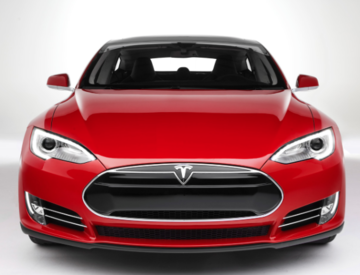
“What this did, which we didn’t fully appreciate at the time, is give us the ability to constantly update this. This is incredibly helpful,” said Straubel. “It lets us add features with completely over-the-air updates. This is a massive difference. So many info-tainment systems in cars become obsolete so quickly. We are trying to stay very relevant for a long time.”
That kind of change, not surprisingly, is not always embraced by legacy manufacturers. Straubel said when Tesla met with representatives of Diamler/Chrysler, for instance, there was enormous fear of not having mechanical back-up systems for the software. “They don’t totally trust it. They don’t understand it. They see it as something that needs to be controlled. Our team grew up around software. Most of the teams at the big auto manufacturers grew up around manufacturing and stamping. Unless you can get that mindset into your management team you will have this challenge.”
Among Tesla’s latest venture has been it’s Supercharger Network, aimed at confronting a chicken-and-egg conundrum: more cars will be bought when there are more charging stations, and more charging stations will be bought when there are more cars. Tesla continues to build out its Supercharger Network, which now has more than 300 stations at which owners of its Model S can recharge their vehicles, not just quickly, but for free. It is now opening a Super Charging station every 24 hours.
“A lot of the other car companies still don’t get this,” said Straubel. “They don’t see the energy problem as their problem. We look at it as a whole ecosystem; the electric vehicle doesn’t have a lot of good if you can’t use it. We pay for the stations and all the electricity and make that free to our customers. Now we’re expanding in Europe and China. This is really changing the dynamic of electric vehicle infrastructure.”
What's Next for Tesla?
What’s next? Before credit unions could ask, Straubel said the company is working as quickly as it can to build a mass market model, to be called the Model 3, that will sell for approximately $35,000 and have a range of 200 miles “The reason a lot of electric vehicles do not work is they don’t have enough range-to-value,” he said. “Cost tends to scale down with range. This really comes down to a big battery challenge. People keep asking, ‘when is the big breakthrough in batteries, when is the next big things. But it tends not to move that way. It tends to move a lot more smoothly over a long time, and then it looks like a tectonic shift happened. Batteries are doing this. In the last 10 years batteries have doubled in range. This trend is not slowing. Batteries are marching up this improvement curve. And that’s where we plan to be with Model 3.”
Straubel said he and Tesla believe 2015 will be a year of an “interesting shift,” when batteries manufactured for vehicles will start outpacing batteries built for consumer electronics. Already, he said, electric vehicles are just 0.5% of the vehicle market, but Tesla represents 10% of the world’s lithium ion batteries.
“When you look at how many batteries are going to be needed as we scale up and the industry scales up, it’s going to be a huge problem, but also a cool, cool opportunity. “We expect that the Model 3 will use more batteries than the whole world built in 2013.”
To meet that demand, Tesla is racing to build its gigafactory in Nevada and is examining every step of battery manufacturing from end-to-end, he said, beginning with mining of materials. “We have this incredible urgency,” he said. “We couldn’t even rely on the current suppliers. We had to find a way to pull the supply chain faster. The big opportunity here is cost reduction. We’re going to need a lot of these factories. That is going to happen in the future, there is not a doubt in my mind.”
Where the Oil Money is Going
Straubel also said:
- Battery cell and cell material suppliers are going to see huge growth opportunities, as are raw materials.
- Electric utilities are going to see revenue growth. “All of the revenue going to petroleum companies is going to go to electric utilities. There will be opportunities in public charging, renewable energy, and storage.
- There will also be opportunities in power electronics supplies, magnetics, DC-DC conversion, and thermal interface materials.
- Major oil and gas companies are going to see reductions in revenue.
Tesla is now using its technology to move into the home and business back-up power market. It is rolling out a 10kWh battery for $3,500 that easily integrates with solar, is computer controlled, and comes with a 10-year warranty.
“You can basically lose the utility,” he said. “We are deploying in some markets where there is a big time change in the cost of electricity, such as Hawaii and Germany. We’ll be able to replace power plants that ran for just a few hours in the afternoon in some markets. Now can have storage to avoid the topping off of electricity.”
Straubel made it clear he and Tesla are very optimistic about a future in which all fossil fuel-powered energy plants will be retired. “This is a solution that’s right in front of us, and the economics are right at the threshold that are staring to work,” he said. “I think this is a pretty amazing vision for where we are headed. All of the technology and cost trends are headed in this direction.”
Four Predictions
He offered four preditions:
1. Battery costs will continue to decline faster than most predictions.
2. Nearly all ground vehicles will evolve toward battery, electric vehilces
3. Bulk battery energy storage on the grid will grow rapidly and further accelerate battery cost reduction.
Straubel closed with a quote from Sheikh Yamani, the former Saudi oil minister, who observed, “The Stone Age came to an end not for the lack of stones, and the oil age will come to an end not for the lack of oil.”