

SPOKANE, Wash.–All the PowerPoints and data in the world will never convince anyone to act: not members, not coworkers. Instead, persuasion requires a story be told, and three experts here shared with CU leaders how and why they should be telling those stories, citing examples ranging from Swahili to neuroscience to pineapples.
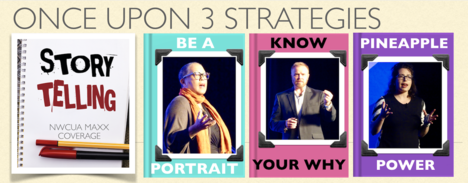
The advice and stories were shared during the Northwest Credit Union Association’s MAXX Conference here. Here’s a look at the three different storytellers and the strategies they recommended for harnessing the power of storytelling.
The Unexpected Journey
Eliaichi Kimaro, a filmmaker, artist and activist, was driven to tell a story as the result of her own “unexpected journey,” and the extraordinary circumstances and odds that led to her walking the earth.
“As a kid, I was fascinated with my origin story; how wildly the universe had to conspire for me to be here,” said Kimaro. “My dad was born and raised on a coffee farm on the slopes of Mt. Kilimanjaro in Tanzania. He studied by lamplight and got a scholarship to study in the United States. My mother grew up in Seoul, South Korea, the youngest of six, and she got a scholarship to study in the U.S. They met at college and got married after three months, and nine months later I was born. Fifty years later they are still married.”
Stories of Love & Sacrifice
Kimaro said she came to see stories as the foundation of relationships, communities and movements.
“I would think about these stories of love and sacrifice and migration and survival that go back generations, just so my parents could meet and have me,” she told the meeting. “As I got older, I realized everyone has stories that are epic in scope. We carry these stories with us whether we are conscious of it or not.”
In her own case, Kimaro, who had been working as a trauma counselor and advocate for victims of rape and abuse for more than a decade, said she was driven to tell her own father’s story in a film, even though she knew nothing about how to go about doing so.

Eliaichi Kimaro speaking to MAXX conference in Spokane.
“I had no experience and no background in film,” Kimaro said. “So, I signed up for an Intro to Filmmaking class. Seven months later, we bought all the equipment on eBay, bought one-way tickets to Tanzania, and took off.”
The original plan to tell her father’s story was soon side-railed. Her aunts, speaking in Swahili, began to tell their own stories of violence and abuse, Kimaro said. Not fluent in Swahili, Kimaro recalled, “All I could do was bear silent witness, sit and listen. But my aunts changed.”
Just the opportunity to talk about their lives changed her aunts, Kimaro said, adding she realized when people open themselves up to seeing things through someone else’s eyes, it opens the world up.
A Changed Story
For seven years Kimaro sat on the film of her aunts and their stories, unsure what to do with it and fit it into the story of her father.
“I finally realized if I was going to do right by my aunts, I needed to follow their lead and speak my own truth and let go of trying to tell dad’s story,” she said. “So, I took out my journal and started rewriting my own story to tell it from my own point of view. This was the hardest part of my entire journey–believing that what I thought as a mixed-race person, that my story would actually matter to anyone. But this story was coming and there was nothing I could do to stop it. My goal became to create a film that I could just share with my kid and reach her.”
Validating & Powerful
Kimaro, who leads 9elephants Productions, said she has now been traveling for eight years with the film she finally created, “A Lot Like You.”
“After every screening people come up and tell me how validating it was and how powerful it was to hear their struggles presented so truthfully for the first time,” Kimaro said.
Kimaro offered this advice for credit unions.
“Share your story. Our stories are how we connect with one another. We all have stories. Our stories are how we connect, bridge divides, find common ground, mobilize communities, and start changing hearts and minds,” she said. “When we see ourselves in someone else’s story, it’s validating. You’re reminded you’re here and you exist. Don’t think for a moment your story has to be some grand gesture in order to have an impact. Even if you connect with just one person, that’s one person who might breathe deeper and stand taller as a result. Stories beget stories. Every time we share a story we create a more expansive and inclusive portrait of humanity.”
People Seize What They See
Credit unions are frequently advised to tell their stories, but what kinds of stories do they really have to tell? Prior to addressing the Northwest CU Association’s MAXX Conference here, one person reached out to credit unions and collected some of the stories he said CUs need to be telling.
Dale Dixon, a long-time television news personality, author of the book “Sweating Bullets” (which is about overcoming the fear of public speaking), as well as chief innovation officer for the Better Business Bureau of the Northwest + Pacific, said everyone needs to understand, “People seize what they see, and there is no better way to help people seize something than with a story.”
The problem, he said, is stories are typically left behind in childhood and as people get to college they give up stories for data and PowerPoint slides and charts.
Actual CU Stories
The types of stories Dixon said he collected from credit union execs and that need to be told include:
- A story from Connie Miller of Icon Credit Union, whose passion for helping people was “palpable.” It included the story of helping a member who had a credit score so low—408—it had not been previously seen. Miller worked with the member—who had earlier defaulted on a loan—to get a resolution plan in place, and still does weekly check-ins with the member.
- A story from Jeff Adams, CEO at Horizon Credit Union, who reminded that lawmakers see the same faces over and over again, so when see new faces with new stories to tell, they know there is a groundswell of real people behind the credit unions.
- An observation by Amy Nelson of PointWest Credit Union, that “Data is important. Member stories are important. Marry the two and you have impact in action.”
That Sounds Good, But…

Dale Dixon speaking to MAXX Conference.
Dixon conceded an audience of finance professionals may say that all sounds good, but they still want to see the data. The data, he said, can be found in research done by the Journal of Cognitive Neuroscience and Harvard Business Review, both of which have found the power of stories is real. “Challenge, struggle and resolution are the three keys to a great story. A physiological change occurs when people hear the story.”
Also Powerful
In addition to recognizing the power of a story, Dixon urged CUs to also recognize the power of:
Habit
Habit is about mentally being intentional, also known as “reticular activation,” which is the process of the brain being activated to a certain activity, in this case about opening the filter when looking for story. “You all represent incredibly powerful stories, but it’s about creating the habit of (looking for them) day in and day out,” Dixon said.
Know Your Why
Every credit union leader needs to know why they and their employer are doing what they are doing. And CUs have an advantage over other businesses, according to Dixon.
“You are so tapped into your why of credit unions,” sharing that one person had told him, “What we stand for as credit unions is just as important as our rates. It’s about serving our members.”
“When you understand the power of story and match that with telling stories on a daily basis, matched with your why, it’s a powerful tool,” Dixon said. “People seize what they see, and they see something different in you and the work you do. The most important story you tell is the story you tell yourself. Make it a great one.”
The Power of Blind Harry
Who was the most persuasive story teller in history? It won’t be you if you’re relying solely on data and facts, according to one person.
Instead, Lisa Kagan posited the most persuasive storyteller in history was Blind Harry, and while CU leaders may not know Blind Harry, they will certainly know of the story he told.
Blind Harry is the primary source on the life of Sir William Wallace, best known to many today as the subject of the Mel Gibson movie Braveheart. Written around 1477 and based on another work, Blind Harry gathered stories and traditions of Wallace from all over Scotland and sang or recited his verse.
While the movie (and history) have exaggerated or misstated some of Wallace’s life, Kagan, director of communications at Unify Consulting in Seattle, said Blind Harry’s account presents William Wallace as a matter of communications and inspiration, especially when it comes to combining emotions. For example, as the movie presents it (Kagan said it may not be historically accurate but her MAXX audience needed to just go with it), Wallace “banged together” the emotions freedom and regret when the Scottish rebels he was leading were vastly outnumbered.

Lisa Kagan speaking to MAXX meeting.
Is It Worth Living?
Wallace’s inspirational remarks, in a nutshell: “Run and you live; fight and you die. But your life won’t be worth living if you run.” The rebel Scots won on that day.
“I thought, what if William Wallace took a different tack? What if he saw those farmers running away and he went to them and instead of using emotion he used logic? ‘There is a 48% chance you will lose two of your limbs. If we’re unsuccessful, projections tell us each clan’s production will decline. I think it’s obvious what we need to do next’ Really, do you think you’d get that bonkers response?
“And yet that’s exactly what we’re told to do at work,” continued Kagan. “Smother them in stats. Drown them in data. Humans can’t say no to the facts, right? We’re reasonable. People will be reasonable every time, right?” Kagan continued. “On one hand, why do we look at facts and proof and not do the thing that seems like the reasonable choice? And why do we do things that are against the odds? It boils down to this one thing: Neuroscience.”
What Neuroscience Shows
Kagan said neuroscience has proven human beings cannot make decisions devoid of emotion, and she semi-joked that most business presentations are full of “logic, logic, logic, jargon, and appendices. I hate to admit it, but humans need to feel like something is the right choice and then rationalize it to the right choice. When you look at people who are truly persuasive, were they robots who just told you the facts, or did they have personal emotion and then back it up with the data?”
Repeating the adage “You’ve got to get people to feel something to do something,” Kagan said many people will respond by saying they understand that, but believe they don’t have a story to tell.
“They may not have a William Wallace story, but nobody does. And neither does he. In real life, none of the stories are like that,” she said “The truth is the stories that are real are way more interesting.”
Kagan said she has three stories she wants credit unions to tell.
Story One: Lessons Learned
“I know you have a lessons learned story. No one wants to tell these stories at work. Why would I want to tell the story of the time I blew it?” she asked. “The lessons learned story isn’t about the mistake or what you did wrong; it’s about you fixing it and becoming You 2.0. The reason you tell a lessons learned story is it makes you credible.”
Story Two: Origins
“It’s about how you start at point A and get to point B. But the best ones are when point A and point B don’t really make any sense together,” Kagan said. “You can decide what the story needs to position yourself. You can say, ‘I come different place than you, and I’m one of you now.’ Or, ‘This is good, we have different perspectives now.’”
Story Three: Hard Won Triumph
“The key isn’t how big the triumph is, it’s what it took for you to win it,” Kagan explained. “It’s a personal or team branding story, or a story of branding your credit union.”
Don’t ‘Chicken Out’
Kagan said credit union execs should not be afraid to tell their stories even if tempted to “chicken out.” That’s typically the result of “comparison,” said Kagan, who called comparison the “thief of joy.” This is especially true when someone feels they are a “small potato.”
“This is exactly when you tell the story, when you’re new, when you’re little, when you’re weird,” Kagan said, adding, “When you are telling your stories, you have to tell the truth. The reason you put it in a story is you control the perception of what everything is worth.”
After all, said Kagan, William Wallace was never able to single-handedly change the odds.
“But he could change the perception of those odds,” Kagan said. “That’s what you have the power to do. So stop comparing your little apples to everyone’s big apples. Be a pineapple.”