

VIENNA, Austria–Technology may seem overwhelming, but there’s a way of approaching it in simpler terms by answering this question: What do cave men in 38,000 BC and today’s mobile phone carrying consumers have in common? Both used or use pictures to communicate.
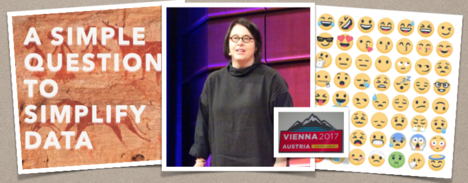
And that’s because what technology and data are really about is human beings trying to better understand themselves and each other.
In remarks to WOCCU’s World Credit Union Conference here, Susan Etlinger, an industry analyst with Altimeter, which focuses on data, artificial intelligence and ethics, and who has been featured as a TED speaker, outlined for credit unions what they need to understand about data, technology, and where they fit in all that.
First, Etlinger walked her audience through history’s milestones in technology and data:
Timeline of Technology & Data
38,000 B.C: Cave paintings.

1455: Birth of mass communication with the Gutenberg press.
1844: First long-distance message sent via telegraph. The message: “What hath God wrought?” “That is interesting to me,” said Etlinger, “because it gets to the anxiety that we have about technology even today. This anxiety about how it will change us is probably as old as we are. But this is the first time it becomes manifest in the way technology is introduced.”
1950: Question of Machines vs. Humans is posed as Alan Turing asks, “Can machines think?” “It’s the first question about AI, and is really about 70 years old.
1985: Beginning of The Well, the first online community and forerunner to the Internet.
1991: The birth of the Internet for commercial purposes.
2005-06: Video Streaming and Mass Social Media. YouTube uploads first video, and Facebook expands beyond its academic community. “What’s important here is it’s the first scalable mass communication.
2007: Birth of the iPhone. “This enables any of us to carry a computer in our pocket.”
2017: The Visual, Ephemeral, Connected era. “This is an extraordinary time. There is this idea now of connected devices and the Internet of Things,” said Etlinger.
“The thing about this time in our history is we are communicating in images again, except this time we’re doing billions and billions of them every day,” said Etlinger, noting that one study found the fastest growing language in the United Kingdom was emojis, which she called the “hieroglyphics of the modern age.”
How to Think About Big Data

Susan Etlinger speaking to WOCCU Conference in Vienna, Austria.
Big data is on the agenda at just about every credit union meeting, and on the minds of credit union leaders everywhere. What’s the big deal, asked Etlinger. How should people think about big data?
The idea of big data has actually been around for a long time, and it’s not about the size necessarily, said Etlinger.
Instead, to understand big data, Etlinger cited a Gartner analysis that said it is necessary to understand the three main characteristics of big data: Volume, Velocity and Variety. “Variety is the hardest to solve,” said Etlinger.
“What should we care?” asked Etlinger. “For the first time the power dynamic between individuals and organizations has changed. For the very first time, individuals can communicate with the world.”
For organizations such as credit unions, said Etlinger, that significant change affects innovation, brand health, customer experience, operational performance, revenue generation and marketing optimization.
“These are ways to understand in broad terms the value of big data,” Etlinger told the meeting.
Challenges of Data-Driven Businesses
Etlinger acknowledged there are some big challenges in big data. “One challenge is that data is a mess,” said Etlinger. There are problems created by understanding human intent and language and even the way data is entered, she added.
“The other thing to understand is it’s not infallible,” said Etlinger, citing an example that the systems that should have spotted the outbreak of Ebola in Africa and which were in place, didn’t understand French, the native language of those first affected by the virus.
The Five C's
For credit unions, like all data-driven businesses, there are five C’s to pay attention to, according to Etlinger:
Clean Data: “It’s important to have your systems in order.”
Clarity: “You need to understand the problem to be solved.”
Customer-Oriented. “Let’s think about problems from the member’s point of view. This is about focus on attitudes and behaviors.”
Community: “This is ability trade ideas, context, and different points of view to bear.”
Culture: “To me this is most important. You have to have a culture of empowerment and experimentation. The culture in my part of the world, Silicon Valley, for instance, is about never stopping.”
Data is scary for people, including herself, said Etlinger. “As you sit here with your phones there is tons of data being collected on you without you even thinking about it.”
Another Thorny Issue
With technology moving so quickly, another thorny issue has emerged that is especially relevant to credit unions, which consider themselves values-driven organizations.
“The problem of making people feel comfortable and building trust is not just one of applying the law,” said Etlinger. “You have to go beyond that.”
To that end, a number of academics and business people have been trying to build an ethical guide for the use of big data, according to Etlinger. That group is the Information Accountability Foundation, which has developed five “ethical considerations.
Beneficial: Does our use of data benefit consumers as much as it benefits us.
Progressive: Do we have a culture of continuous improvement and data minimization.
Sustainable: Are the insights we identity with data sustainable over time.
Respectful: “Have we been clear, transparent, and inclusive?”
Fair: Have we thought through the potential impacts of our data use on all interested parties?
Looking forward, Etlinger cited the Bill Gates observation that, “We always overestimate the change that will occur in the next two years and underestimate the change that will occur in the next 10.”
She urged credit unions to pay attention to even the small things, such as those first cave dweller drawings, noting that one Facebook executive recently told here that “Very often the most revolutionary technology advances don’t look like anything at all when they are introduced.”