

HONOLULU–Sitting there with a job-list for the credit union and just waiting for the perfect time to get it started? Now’s the perfect time—especially if you aspire to be a leader.
And Vincent Boles knows about being on time and being a leader.
Boles, a retired two-star Army general who at one point was responsible for 1.1 million soldiers, shared with NAFCU’s Annual Conference here what he has learned during his 33-year military career followed by another decade in business. He offered his take on what differentiates management from leadership, what people are looking for at work, and what can be gained from the wisdom of Stevie Wonder and Adam Sandberg.
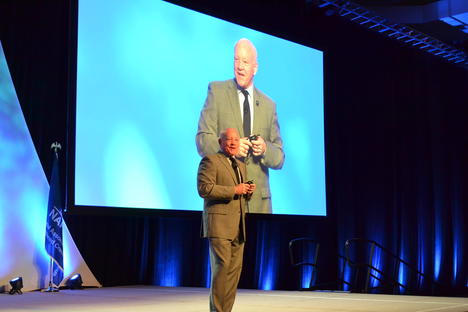
Boles, who joined his first credit union when he got a $200 loan in the mid-1970s to buy a 1976 Chevrolet Vega, told credit unions that while the management discussion is often all about the pace of change and technology, “leadership hasn’t changed.”
Leadership, Boles said, “is the difference between an organization being different and being great. Leadership is the secret sauce. Leadership is what makes the difference. Organizations that know the difference between leadership and management are the ones that make the difference. Leadership is connective. Management is reactive.”
The Good News & Bad News
When it comes to leadership, there is good news and bad news, said Boles.
“The good news is leadership is not complicated,” he said. “It is taking the time to extend yourself and connect. When you talk to people when they are upset about their leaders, they don’t have a laundry list of issues, they just want someone to care and to listen.”
And the bad news?
“The bad news is it’s hard,” said Boles. “You got to be consistent and persistent. If leadership was easy, we’d contract it out.”
Boles admitted that when he started out his Army career as a young army officer at Aberdeen Proving Grounds in Maryland, he was “clueless.” He knew nothing about managing people or even what it was those who are managed are looking for.
“Let me ask you: Who works for you?” asked Boles. “Why do they work for you? Why do they get up every morning to come to work to bask in the glow of your charisma every day? Are you their plan B? Do you know why? Knowing their story begins that connection.”
3 Reasons Leadership SEEMS Easy
It seems leadership should be easy, said Boles, for three reasons:
- There is plenty of information on the subject
- People want to be well led. (“People don’t quit IBM or your credit union; they quit you. They don’t won’t to work for you”
- Leaders (normally) want to lead well
“So, it should be easy, but it isn’t. And the reason it’s hard is when we think about leadership, we think about what works for us, when in reality, to be a truly effective leader, you need to think about what works for them,” said Boles. “People say kids are different today. Duh. So were you. The difference is we allow technology to keep us from forming a connection with them, and we have to work through them.”
The 4 Expectations of Subordinates
According to Boles, all employees have four expectations of their boss or manager. The four expectations:
1. Establish Structure
“I don’t mean the management structure diagram. Have many people who work for you know how you are structured, how you are wired. Do they know how you decide to decide? The first critical thing people want is for you to establish structure. Otherwise, they are going to spend all their time trying to figure out what you want.”
2. Manage Relationships
“They want your help in managing the critical relationships that make it work. I must confess that in your industry some of you are rolling your eyes and thinking, ‘We are all about connecting and taking care of people.’ And I say, ‘Really, let’s take a test.’ I want you to draw a line down the middle of a paper and at the top write down a list of critical relationships to make things happen. And then make a list and identify the people in your organization who are known as ‘Dr. No.’ Take the other side of paper and identify all the critical external relationships you need to make things work. You have to make those work. Then go through and rate the list with plus and minus signs. The ones that should concern you is if you have question marks on that list. Then put down your list. Anywhere you have a question mark or a minus sign is someone with you haven’t had a positive relationship in six months. And they are probably a pain, a difficult relationship. And your folks don’t care. The next time one of your folks does something well, ask you who helped them with that, and they will tell you.”
3. Balance Risk
“This is identifying, balancing and mitigating risk,” Boles said. “People want your help and judgement to identify, manage and mitigate risk. They expect that of you, and if you’re not doing it they will go to someone who does.”
4. Make Decisions
“Everyone knows leaders make decisions, right. I thought so, too. People also expect you to be responsible for the decisions that get made. Next time you have a staff meeting and go around the table and say, ‘Tell me about the decisions you made this week.’ You’re going to learn things. The other thing you shouldn’t do is ask people what they think about a decision you made. They will tell you what you want to hear and they think you ought to already know. Instead, ask ‘What are you working on and how is it going?’ Then shut up and listen. I would always ask, ‘What decision are you waiting on from me?’ The first time you ask, people won’t tell you. But after a while you start finding out things you need to fix.”
It might have sounded odd coming from a retired Army general, but Boles closed by citing two unexpected people for lessons in management: Stevie Wonder and Adam Sandberg.
In the case of Wonder, Boles cited a line from his song Superstition: “When you believe in things you don’t understand, you suffer.”
It's 11:35
In the case of Sandler, he cited the time the actor was asked how Saturday Night Live’s cast gets ready to go on every Saturday night.
“We don’t go on because we’re ready,” responded Sandler. “We go on because it’s 11:35.”
For credit unions, said Boles, it’s 11:35.
“You’re going to go home from this conference with a notebook full of this stuff. And you aren’t going to do a damn one of them,” said Boles. “And you aren’t going to do it because you are waiting for the right time. You put it off and put it off and a year later you are looking at the same list. If you see things that have to be done, get a reputation as the leader who goes out and gets things done. The goal isn’t perfection, the goal is progress.”