

LAKE FOREST, Ill.—The more services the financial institution cross sells account-holders, the more net revenue it makes, right?

Not necessarily, asserts one economist, who wants credit unions to recognize that a successful sales process is a “balancing act. Profitable services measured by classical economic principles is the key to achieving success in cross-selling,” said Michael Moebs, economist and CEO at Moebs $ervices.
A new study by Moebs $ervices shows there can be a limit to how many services can be cross sold profitably, and that three to four services per account holder, generally, is the point at which the costs and time associated with selling more services actually steals dollars from the bottom line.
“In fact, when the marginal revenue of the services sold is less than the marginal cost, basic economic principles reinforce that the FI is selling too many services and should scale back production—cross-selling—and hopefully return to its maximum level of economy of scale by selling only the services it does best,” said Moebs. “When you try to push past more than three to four services per customer or member, the process becomes difficult. People want more value with each service and resources become strained adding to increased costs and more pressure to sell more.”
Marginal Revenue Equals Marginal Cost
Moebs pointed to the “basic economic theorem” that profit is maximized up to the point marginal revenue equals marginal cost.
“However, financial institutions often believe adding more services will add more revenue,” he said. “If all financial services are profitable and marginal revenue exceeds marginal cost, you can continue to add services. However, some services are not profitable, so there is a limit to how many services can be cross sold. For example, more than 94% of checking accounts lose money.”
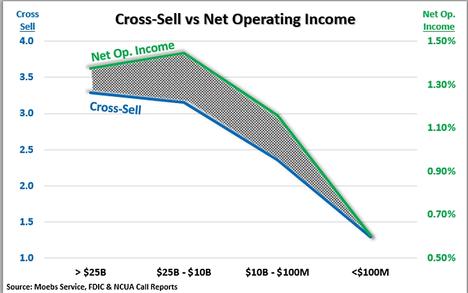
Moebs said that a “straightforward way” to measure the effectiveness and profitability of cross-selling is to compare net operating income (NOI) to the cross-sell rate.
“Since cross-selling involves all services a financial institution sells, our study incorporates interest revenue and cost, fees and expenses to reflect the all-services approach to selling using NOI,” said Moebs, explaining that the study compares NOI as a percent of assets to the FI’s cross-sell rate. “The cross-sell rate is determined by dividing all services—loans and deposits—by all users. In the case of CUs, the mandatory share account is excluded in the cross-sell rate.”
10 Functional Services
According to the study, there are basically 10 functional services offered by financial institutions ranging from checking to loans, and retirement services to wealth management.
“Some FIs specialize in one or more of the functional services, as it is common for many to not offer all ten functional service categories,” said Moebs, whose study shows that credit unions average about 1.3 products per account holder and the big banks over three.

Michael Moebs, Moebs $ervices
“Ultimately the NOI and the marginal revenue of cross-sell peaks when an FI hits $25 billion in assets, which is also about the same asset size when an FI will maximize its economy of scale,” said Moebs. “After $25 billion, a diseconomy of scale sets in, and it gets increasingly difficult for a financial institution to increase cross-sell profitability as NOI starts to decrease.”
Moebs said the analysis finds economies of scale for financial institutions begin to improve once they cross $500 million in assets, and peaks between $7-$10 billion. The same can be said for the rise in NOI, he said (see chart).
Economies Of Scale
Moebs said that credit unions must pay attention to their economies of scale and how they approach cross selling, saying that below $100 million in assets it is most cost effective for the credit union to have tellers simply take orders. From $100 million to $500 million in assets, the credit union can split staff roles, having both order takers and sales people. Above $500 million, Moebs said the credit union should have well trained sales personnel.
Moebs asserts that Wells Fargo paid little attention to its economies of scale.
“Wells Fargo management claims to have six services per customer. Applying only classic economic principles, it is clear Wells’ marginal cost was exceeding their marginal revenue as cross-selling was pushed beyond the cross-sell rates of their peers and the industry standards. The cost to achieve this was 5,300 people fired, loss of trust with two million customers, and enormous increase in reputation risk leading to government intervention,” said Moebs. “The sales process is a balancing act.”