

MADISON, Wis.–The need for true digital transformation at all credit unions is clear, but it won’t happen unless the right culture is in place, according to one expert, who offered strategies for getting culture aligned with where it needs to be.
As for credit unions that believe they already have the right culture in place? They are just beginning, said Joe Sullivan, CEO of Seattle-based Market Insights, who has consulted with numerous organizations on alignment, agility and adaptability and who is also a psychotherapist.
Sullivan offered his insights during the World Council of Credit Unions’ virtual World CU Conference.
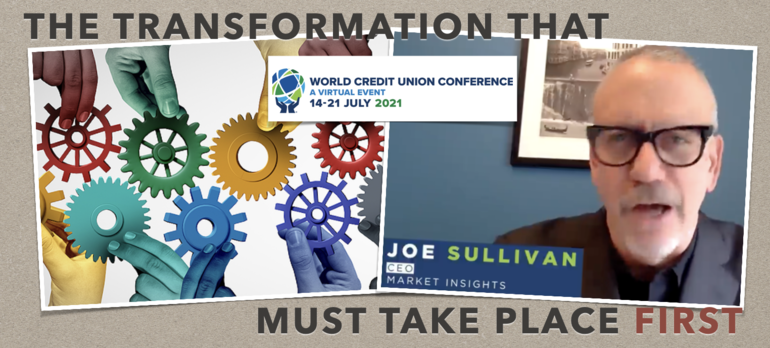
“We know you have done a lot in the last 18 months to transform digitally, but the party is just starting,” said Sullivan, observing that the COVID-19 pandemic only served to “throw gas” on digital transformation.
Sullivan, who said his goal was to help credit unions build a framework to create and nurture a culture that moving forward is agile, said credit union leaders need to remember three things: purpose, empathy and “excited urgency.”
Purpose: “Why are you doing it? You can’t ask your team to be excited; you have to explain why are you doing it? You need to be clear about the purpose of digital transformation.”
Empathy. “We’ve seen dramatic change in people’s lives. Put yourself in the minds, hearts and shoes of your members; they need that more now than anytime before.”
Excited Urgency. “We have no time for thinking, ‘Let’s postpone this until next year.’ Things are so fast that if we don’t make decisions and do it quickly, we will be left behind.”
Consumers Looking to Switch
Citing the numerous statistics showing consumers’ increased embrace of e-channels during the pandemic, Sullivan said one finding to give attention is the 30% of members who said they are willing to switch to big tech or a fintech because they’ve had a dissatisfactory experience. “Sometimes members don’t tell you, they just move on.”
To keep them from moving on begins with culture, Sullivan said, explaining culture is a system of shared beliefs and values and standards.
And how does he define the often-discussed digital transformation? “It’s the transformation of everything at your organization. Your culture, your services, your mindset, how your digital app works. Digital transformation is not a one-and-done thing. It’s an ongoing way of living at your organization, of being. Culture and investment in technology and the deployment of that are inextricably linked to each other.”
The Five Barriers to Cultural Change
According to Sullivan, there are five barriers to cultural change within most organizations.
Past Success
“If you are trying to do something in 2021 that was successful in 2019, you are going to miss the boat. The world has changed, consumer behavior has changed, investments have changed,” he said.
The Wait & See Approach
The idea is ‘Let’s wait and see what the credit union down the street does.’ We have to be more nimble and act quicker and have an appetite for ‘Let’s take some action’.”
Top Down Only
This is where the C Suite knows best, said Sullivan. “Organizations that are successful are not only top-down, but bottom-up. It’s a collaboration between all levels of authority in an organization.”
Complacency
Sullivan cited a study done by Deloitte and MIT that surveyed executive leaders in financial services and outside financial services over what they view as their biggest threats. “All were internal,” said Sullivan. “Lack of agility, inflexibility, internal culture issues. Those need to be the antithesis of who you are.”

Joe Sullivan speaking to World CU Conference.
Fear
“This is fear of change,” said Sullivan. “Maybe your contact center staff is afraid to talk to the member about using the mobile app, because if they do and the member uses it, they are out of a job. Fear hurts an organization.”
Four Basic Steps
Sullivan said there are four basic steps every organization must take to move forward and building a culture: Assess, Acknowledge, Adjust and Activate.
How to assess culture? According to Sullivan, it’s important to begin by observing and watching.
“Part of it is taking a good look at…your values and standards. You need to inquire, ask specific questions, such as ‘What would you tell a friend about what it’s like to work here? What would you change?’ Ask them who their heroes are, not just in your organization, but people in the world whom they admire. Ask them to define the current culture of your organization in just one word.”
Five Characteristics of Digital Cultures
Sullivan said there are five characteristics of data-driven cultures, including:
Data Driven
“I want to simplify this. We are all moving into data-driven cultures. This is where you get real-time analytics so you can observe how people are transacting and interacting with you,” he explained. “You can make some instant shifts. This is about data on your members: demographics, profitability, number of products per households. But you also need to get data on your competition. Who are you realistically competing with? Chances are it’s not the bank or credit union in your town. Chances are it’s somebody on a mobile app who is eating away at your balance sheet.”
What data does, said Sullivan, is provide context and personalization. Specifically, he said many consumers won’t buy a product until the seller can present it in the context of their lives.
“It’s personalized to them. You need to look at the member journey from the time people first sign up for an account with you and understand where they are in the member journey,” Sullivan explained. “Identify one member pain point somewhere in the journey. What do you need to do to fix that? All of this impacts the member experience.”
Collaboration
“This can be an overused buzzword, but digital cultures provide opportunities for people to work together in connected teams and they don’t need a C-suite title to do that. I have talked to many about what the work-from-home experience is like. What they have learned is having more systematic check-ins with their people, regular meetings, having systematic breaks for fun, all part of a concerted effort to stay connected, is what works.”
Member Centric
There is an ideological shift that needs to take place from being a credit union-centric organization to a member-centric organization, according to Sullivan.
“Amazon always leaves one empty chair at the table so they won’t forget who they are doing this for,” Sullivan said. “You can never forget the member. You need to put that on steroids. Being member-centric is a mindset. You need to solve problems here and now. And all of us need to be more empathetic.”
Agile
What this really means is thinking and acting quickly, said Sullivan.
“Get feedback on the market, monitor market conditions and members, and make a plan for getting something done. Seize the opportunity for letting the member know you have their back.”
Be Open
“This isn’t open banking,” Sullivan said. “But digital banking cultures are open cultures. It’s where people feel free to bring themselves to the office or virtual office and feel free to try something and not fear they are going to lose their jobs. You have to give people permission to fail. Create a culture where people want to try things. Make it clear it’s OK to make a mistake.”

Adjusting the Culture
Sullivan said there are cultural parallels to what is needed to get individual people to achieve psychological health. People, and cultures, only change when:
- The pain of doing the thing we’ve always done is greater than making the change.
- It costs more to maintain the old way of doing things.
- You give people permission in the culture to change things. “This is where real innovation happens. This is where people feel they can solve a problem.”
How to Activate a Culture
Activating a culture, said Sullivan, comes back to purpose.
“You have to be clear about why you are doing this. How is it going to affect their job? What is the timeline? Explain that you’re trying to free up time so members can spend more time with their families. Purpose helps everyone understand the why.”
Practices & Patterns of Commitment
Sullivan also offered the following advice:
- “When the why is understood by your team, generally they are going to be onboard a lot more.”
- “You need to be clear about the purposes of digital transformation. When people are being asked to change, they want to know why.”
- “Front-line team members need to see some progress. If they see no progress, say a few months down the road, they are going to tune you out and not be interested. Your word matters.”
- “Say what you are going to do. Do what you say. This is how people are going to judge you.”